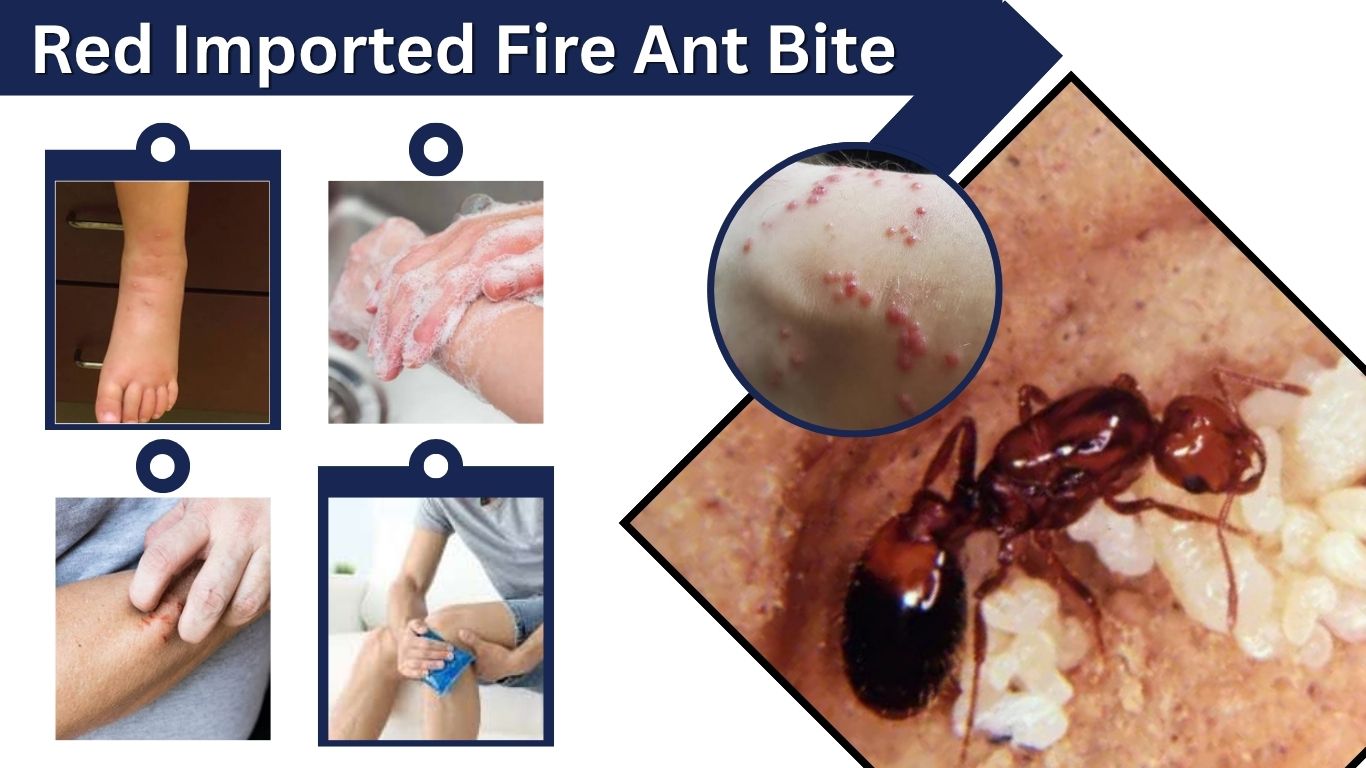
A red imported fire ant bite causes an immediate burning sensation followed by redness, itching, swelling, and often a small white pustule. Technically, most of the pain comes from the ant’s venomous sting, not its bite. The ant bites the skin to hold itself in place, then bends its abdomen forward and may sting repeatedly. Most reactions can be treated at home, but serious allergic reactions require immediate medical attention.
Red Imported Fire Ant Bite or Sting?
The red imported fire ant, Solenopsis invicta, has strong jaws and a venom-delivering stinger. A worker first grips the skin with its mandibles. It then pivots around that attachment point and repeatedly inserts its stinger.
Unlike a honey bee’s stinger, the fire ant’s stinger is not barbed. This allows one ant to sting several times without losing it. Multiple ants may attack simultaneously when someone steps on or disturbs their mound, producing clusters of closely spaced marks.
What Does a Red Imported Fire Ant Bite Look Like?
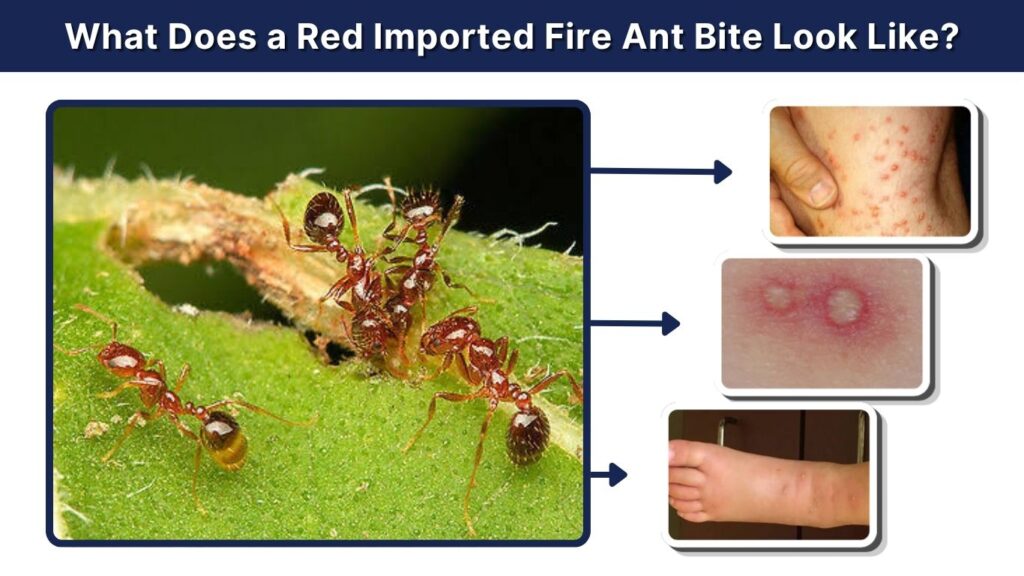
The appearance changes during the hours following the sting. A typical reaction begins as a painful red spot and develops into an itchy bump or welt.
Common Identification Features
- Several marks grouped close together
- Immediate burning or sharp pain
- Redness around each sting
- Small raised welts
- Itching and localized swelling
- A white or yellow-topped pustule after about one day
- Marks concentrated on the feet, ankles, or lower legs
The marks sometimes form circular or semicircular patterns because an ant remains attached with its jaws while moving its abdomen around to sting repeatedly. Fire ant stings are often found on the lower legs because attacks commonly happen after someone unknowingly stands near or steps on a mound.
Red Imported Fire Ant Bite Symptoms
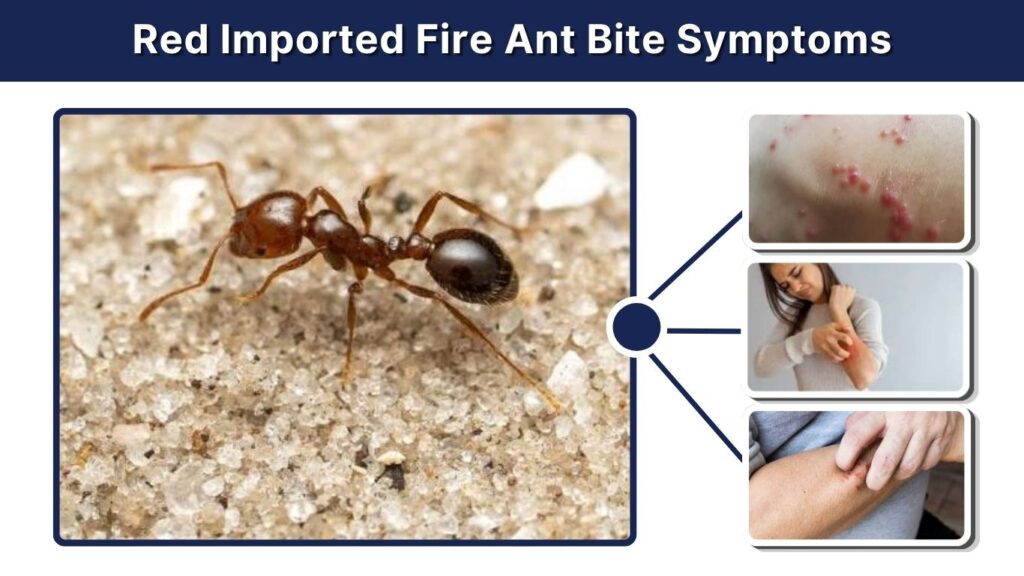
Symptoms vary according to the number of stings and the person’s sensitivity to the venom.
| Time after the sting | Common symptoms |
| Immediately | Burning, pinching, or sharp pain |
| Within an hour | Redness, swelling, and itchy welts |
| After several hours | Small blisters begin developing |
| Around 24 hours | White or yellow pustules may form |
| Following days |
The pus-like material inside the characteristic white bump is usually part of the venom reaction rather than evidence of a bacterial infection. However, infection can develop if the skin is scratched, broken, or contaminated.
Mild Local Reaction
A mild reaction affects only the skin around each sting. Common symptoms include burning, itching, redness, tenderness, and small amounts of swelling. The pustules generally remain visible for several days and commonly disappear within about a week.
Large Local Reaction
Some people develop swelling extending well beyond the individual sting. For example, stings around the ankle may cause much of the foot or lower leg to swell. A large local reaction can last several days and may require medical advice when it is painful, worsening, or interfering with movement.
Severe Allergic Reaction
Fire ant venom can occasionally cause anaphylaxis, a rapidly developing and potentially life-threatening allergic reaction. Warning signs include:
- Difficult or noisy breathing
- Swelling of the tongue or throat
- Tightness in the throat
- Persistent coughing or wheezing
- Difficulty speaking
- Dizziness, fainting, or collapse
- Widespread hives
- Abdominal pain or vomiting after an insect sting
Anaphylaxis is a medical emergency. A prescribed epinephrine injector should be used immediately according to the person’s emergency plan, followed by urgent emergency care.
Red Imported Fire Ant Bite Treatment
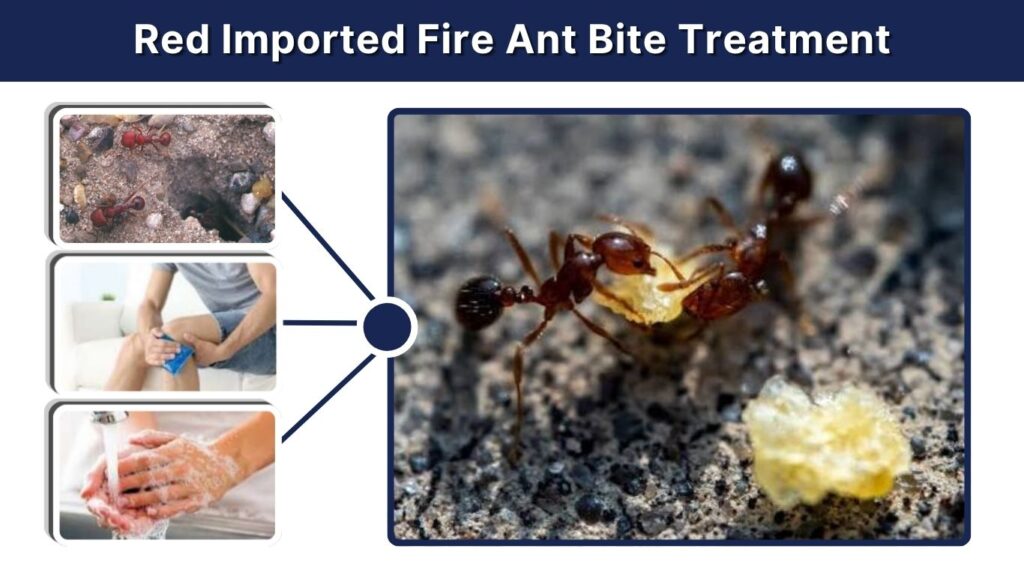
Most mild reactions can be managed with basic first aid. Begin treatment as soon as you are safely away from the mound.
Immediate First Aid
- Move away from the nest. Fire ants may continue climbing and stinging until they are removed.
- Remove attached ants quickly. Rub or brush them off before they sting again.
- Wash the skin. Gently clean the affected area using soap and water.
- Apply a cold compress. Wrap ice in a clean cloth and hold it against the area for about 10 minutes, followed by a break.
- Avoid scratching. Scratching increases irritation and the risk of secondary infection.
Reducing Itching and Swelling
An oral antihistamine may reduce itching and swelling, while an over-the-counter hydrocortisone cream may help calm the rash. Use medicines only according to the label and check with a pharmacist or healthcare professional when treating a child, pregnant person, or someone with existing medical conditions. Cold compresses can be repeated when needed.
Should You Pop the Pustules?
Do not intentionally squeeze or pop the white pustules. Opening them can introduce bacteria, delay healing, and increase the chance of scarring.
When a blister breaks accidentally, gently wash the area, keep it clean, and cover it with a clean, non-stick dressing when necessary.
When Should You See a Doctor?
Seek immediate emergency assistance when breathing difficulty, throat swelling, fainting, severe dizziness, widespread hives, or other symptoms of anaphylaxis occur.
Medical evaluation is also advisable when:
- The person received a very large number of stings
- Swelling continues spreading
- Pain becomes worse instead of improving
- Red streaks extend from the affected area
- Fever, chills, or body aches develop
- The wound begins draining pus
- Symptoms do not improve after several days
- The person has diabetes or a weakened immune system
Increasing redness, warmth, tenderness, pus, or fever can indicate a secondary infection rather than the normal sterile pustule caused by fire ant venom.
How Long Do Fire Ant Bites Last?
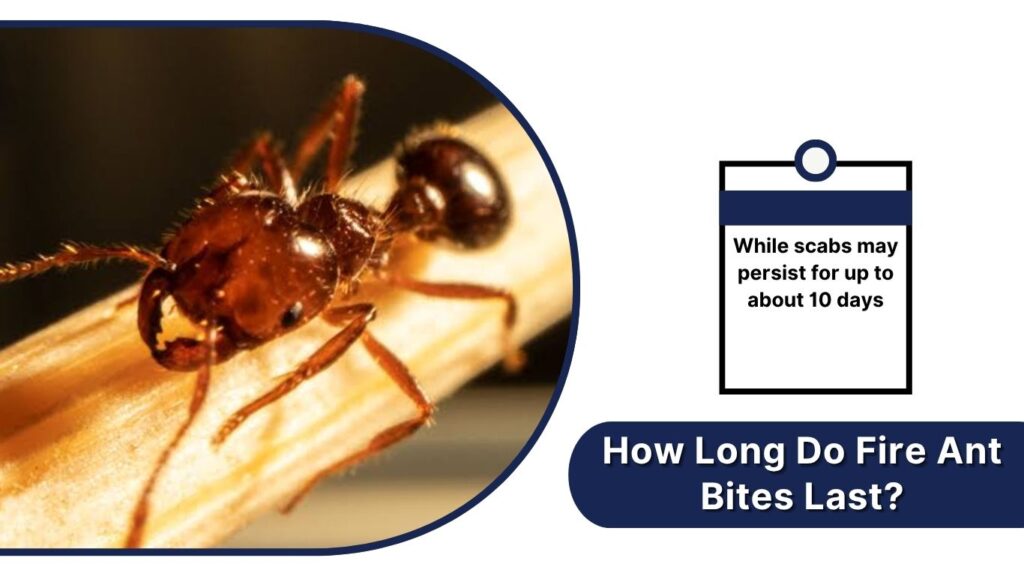
The immediate burning usually improves relatively quickly, but itching and tenderness may continue for several days. White pustules often remain for approximately three to eight days, while scabs may persist for up to about 10 days.
Picking or scratching the lesions can prolong healing and leave small scars or dark marks. People with large local or allergic reactions may experience symptoms for longer.
How to Prevent Red Imported Fire Ant Bites
Avoid standing on or disturbing unfamiliar soil mounds. Wear closed shoes outdoors and consider long trousers when gardening, mowing, or working in known fire ant areas. Inspect the ground before sitting, lifting logs, moving pots, or placing equipment in grass.
Teach children not to kick or touch ant mounds. Fire ants respond rapidly when a colony is disturbed, and numerous workers can reach exposed skin before the person notices them.
FAQs
Do red imported fire ants bite or sting?
They do both. The ant bites with its jaws to anchor itself to the skin, but the burning pain and pustule are caused primarily by venom delivered through its abdominal stinger.
Are white fire ant bite pustules infected?
Usually not. The white or yellow pustule that appears after about 24 hours is generally a normal sterile reaction to the venom. Infection becomes more likely when the lesion is scratched or broken.
What is the fastest way to treat fire ant stings?
Remove the ants, wash the skin with soap and water, and apply a wrapped cold pack. An appropriate antihistamine or hydrocortisone cream may reduce itching and swelling.
Can red imported fire ant bites be fatal?
Most stings cause only localized discomfort. However, venom can trigger life-threatening anaphylaxis in susceptible people, and massive numbers of stings may also be dangerous.
Why are fire ant bites usually clustered?
Several ants may attack together, and each worker can sting repeatedly. An ant may also pivot while attached to the skin, producing multiple marks in a curved or circular pattern.