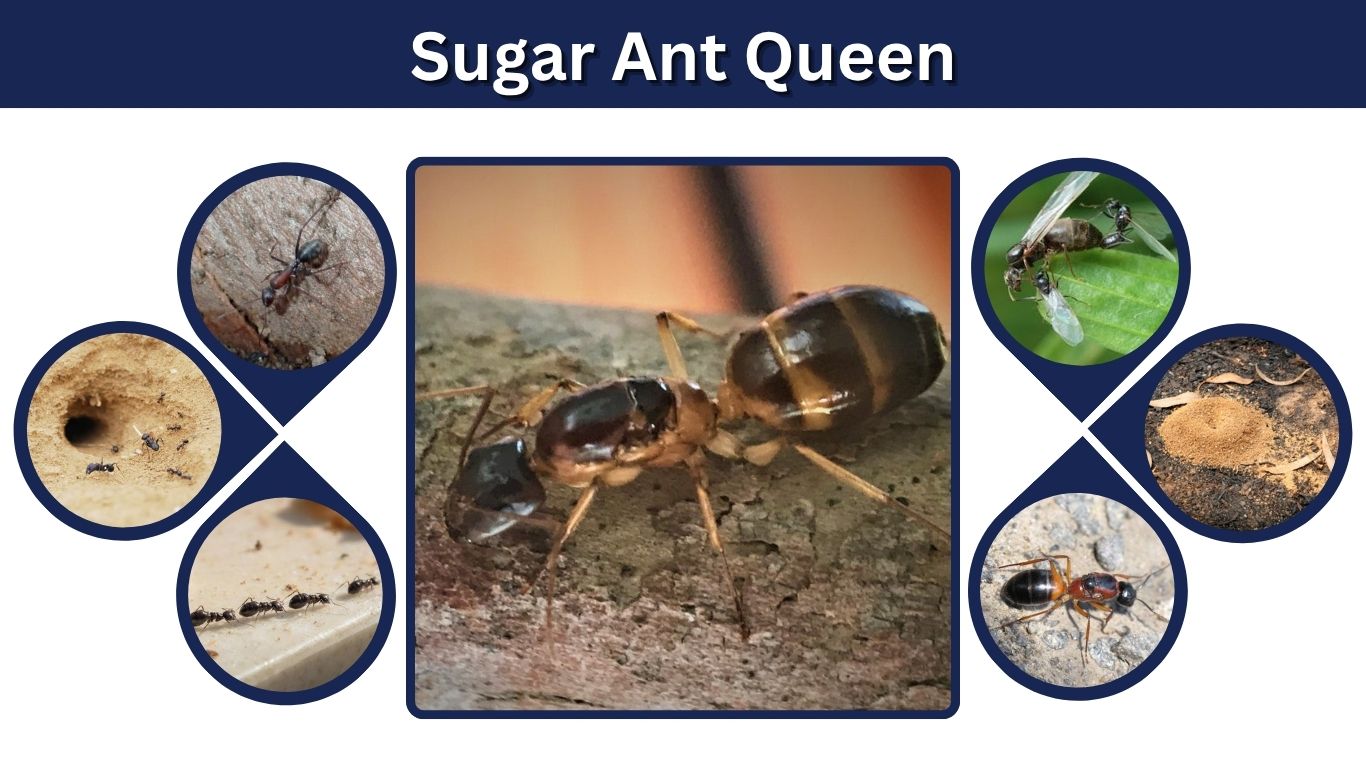
A sugar ant queen is the reproductive female responsible for starting and maintaining an ant colony. The term “sugar ant” can describe different sweet-loving ants depending on the region, including small household ants and larger Australian banded sugar ants. Queens are usually larger and more heavily built than workers, and young queens may have wings before establishing a nest. Understanding sugar ant queen size, appearance, egg production, mating behavior, and colony role can make it easier to identify a queen and understand how an infestation develops.
What Is a Sugar Ant Queen?
The queen is the primary reproductive female within a sugar ant colony. Her main role is producing eggs that develop into workers, males, and future queens. Although workers are the ants most frequently seen searching for food, the queen usually remains protected deep inside the nest once a colony becomes established.
Role of the Queen
A sugar ant queen performs several important functions:
- Starts a new colony after mating
- Produces most or all of the colony’s eggs
- Creates the first generation of workers
- Continues reproducing as the colony grows
- Produces future reproductive ants when the colony matures
- Remains protected within the nesting area
Workers are responsible for collecting food and caring for developing young, allowing the queen to concentrate primarily on reproduction.
Are All Sugar Ant Queens the Same?
No. “Sugar ant” is a common name rather than a single scientific classification.
In Australia, the name commonly refers to banded sugar ants in the genus Camponotus. In other regions, people may use the term for small household ants attracted to sugary foods.
Queen appearance and size therefore depend greatly on the actual species involved.
What Does a Sugar Ant Queen Look Like?
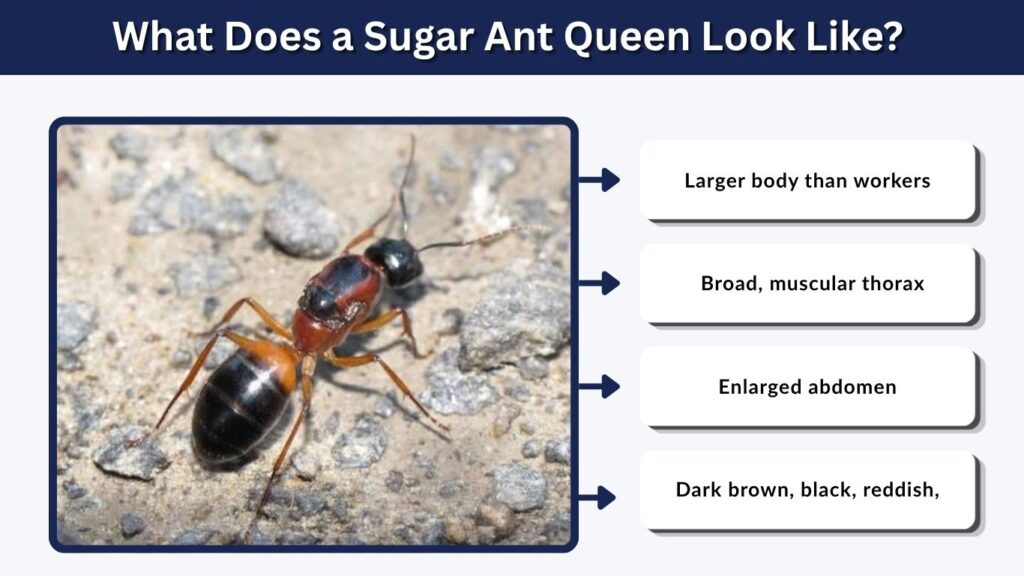
A sugar ant queen generally resembles a much larger and heavier version of the workers. She usually has a broad thorax because reproductive females develop strong flight muscles before mating.
After establishing a nest, a queen may shed her wings, leaving small scars where they were attached.
Sugar Ant Queen Identification
Look for features such as:
- Larger body than workers
- Broad, muscular thorax
- Enlarged abdomen
- Dark brown, black, reddish, or patterned coloration
- Wings on newly emerged reproductive queens
- Wing scars on queens that have already mated
- Slower, heavier movement compared with workers
- Frequent presence near a nest rather than food trails
A large ant is not automatically a queen, so body proportions and wing scars can be more useful than size alone.
Sugar Ant Queen With Wings
A winged sugar ant queen is sometimes called an alate.
Young queens develop wings so they can leave their original colony during a reproductive flight. They typically fly with winged males, mate, and later search for suitable places to establish new nests.
After mating, many queens remove their own wings before beginning colony formation.
Queen vs Worker Sugar Ant
Workers normally have smaller bodies and narrower thoraxes.
A queen generally has a noticeably enlarged middle section because this area originally supported her flight muscles. Her abdomen may also appear larger because it contains reproductive organs capable of producing large numbers of eggs.
Sugar Ant Queen Size
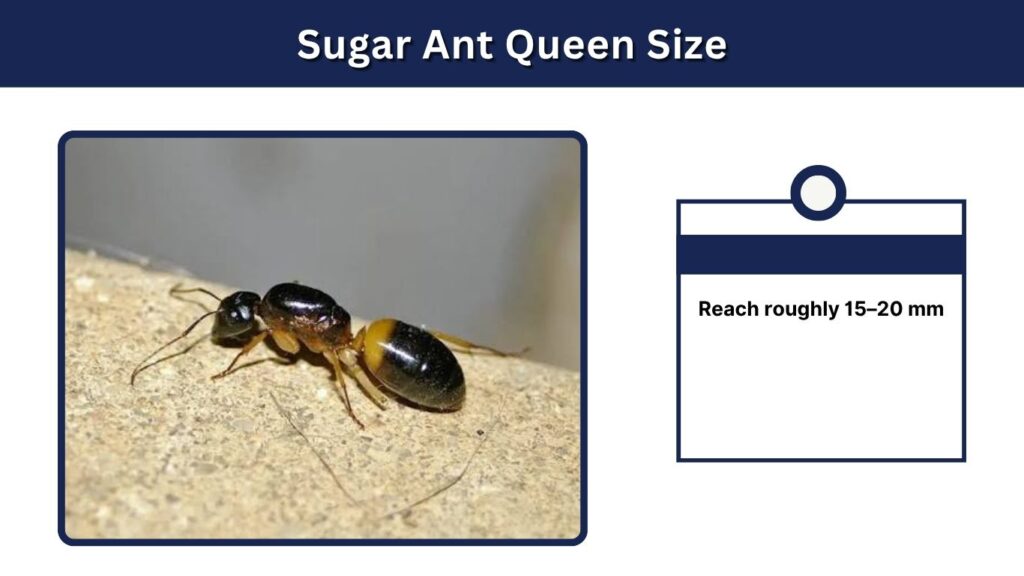
The size of a sugar ant queen depends on species. Queens of tiny household sugar ants may still be relatively small, while queens of larger carpenter-ant relatives such as banded sugar ants can be much more impressive.
This is why identifying the species matters before estimating queen size.
How Big Is a Sugar Ant Queen?
A queen is usually substantially larger than workers from the same colony.
In small household species, the difference may be only a few millimeters. In large Camponotus species, queens can approach or exceed the size of the largest workers and may have especially bulky thoraxes and abdomens.
Banded Sugar Ant Queen Size
Banded sugar ants are relatively large ants, so their queens are also large.
A mature banded sugar ant queen can reach roughly 15–20 mm in length, although size varies by individual and colony.
Her larger thorax, broad abdomen, and overall robust build usually make her easier to distinguish from ordinary workers.
Banded Sugar Ant Queen
The banded sugar ant, Camponotus consobrinus, is a well-known Australian species. Colonies usually contain dark workers with contrasting orange-brown bands around the abdomen, although appearance can vary.
The queen shares the general coloration of the species but has a much heavier body.
What Does a Banded Sugar Ant Queen Look Like?
Typical features include:
- Large body
- Dark head
- Broad thorax
- Rounded abdomen
- Brownish or orange abdominal banding
- Wings before mating
- Visible wing scars afterward
Queens normally remain hidden inside underground or protected nest chambers after colony establishment.
Black-Headed Sugar Ant Queen
The phrase black-headed sugar ant is sometimes used for sugar ants displaying a distinctly dark head.
Queens tend to share the coloration pattern of workers but are larger and broader. Identification based only on color is difficult because several related species may look similar.
Golden-Tail Sugar Ant Queen
Some sugar ants have golden or yellowish hairs and lighter-colored portions of the abdomen.
Queens of these species generally retain those distinctive characteristics while displaying the enlarged thorax and abdomen associated with reproductive females.
Sugar Ant Queen Life Cycle
A sugar ant colony usually begins with a reproductive flight. Mature colonies produce winged males and females that leave their nests when environmental conditions are favorable.
After mating, the fertilized queen searches for a suitable nesting location and begins producing her first eggs.
1. Mating Flight
Winged queens and males emerge from established colonies.
Conditions such as warmth, humidity, rainfall, and season may influence when reproductive flights occur.
2. Finding a Nest
After mating, the queen searches for a protected location.
Potential nesting areas may include:
- Soil
- Beneath rocks
- Under logs
- Tree cavities
- Wall spaces
- Cracks around buildings
- Rotten or damaged wood
Nest preference depends on species.
3. Producing the First Workers
The queen lays her initial eggs and cares for the developing brood.
Once the first workers mature, they begin collecting food and maintaining the nest. The queen then becomes increasingly focused on egg production.
4. Colony Expansion
As more workers emerge, the colony expands.
A mature colony may eventually produce new winged males and queens, allowing the reproductive cycle to start again.
How Many Eggs Does a Sugar Ant Queen Lay?
The number of eggs depends heavily on the ant species, queen age, colony condition, temperature, season, and food availability.
A newly established queen produces relatively few eggs while forming her first worker generation. An established queen supported by a large workforce may produce many more.
What Happens to the Eggs?
Sugar ant development follows four stages:
- Egg
- Larva
- Pupa
- Adult
Workers tend the eggs and larvae, feed developing young, clean the nest, and protect the colony.
The queen usually does not need to care directly for brood once enough workers are available.
How to Find a Sugar Ant Queen
Finding the queen inside an established colony can be difficult. She normally remains deep within the nest, far from exposed worker trails.
Following worker ants does not necessarily lead directly to the queen because nests may contain complicated tunnels and multiple chambers.
Signs a Queen May Be Nearby
Possible clues include:
- Large numbers of workers entering one opening
- Eggs, larvae, or pupae nearby
- Winged reproductive ants emerging
- A larger ant with an enlarged thorax
- Discarded wings after a mating flight
- Concentrated activity around a nesting site
Queens are much easier to observe shortly after reproductive flights than inside established colonies.
When Are Winged Queens Seen?
Winged queens usually appear when mature colonies release reproductive ants.
Timing differs among species and climates. Warm and humid conditions often favor these flights.
A queen found walking without wings soon after such an event may be searching for a place to start a colony.
What Happens If a Sugar Ant Queen Dies?
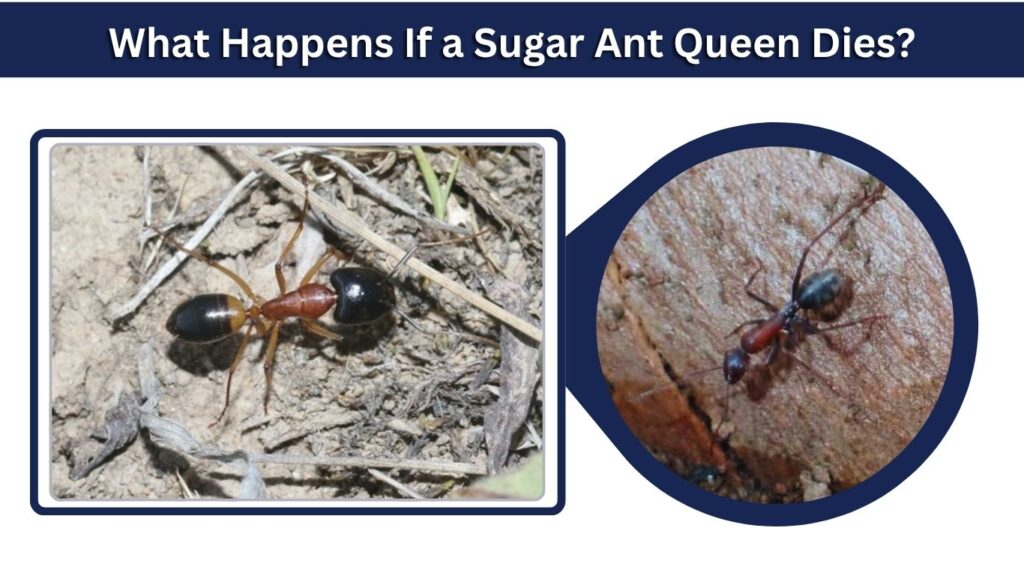
The queen is essential to long-term colony survival in species that depend on a single reproductive female. If she dies and there is no replacement reproductive, the colony gradually declines because no new workers are produced.
Existing workers may continue living and foraging for some time.
Eventually:
- Older workers die
- No replacement workers emerge
- Colony activity decreases
- The nest becomes abandoned
Some ant species can maintain multiple queens, however, so removing one queen does not necessarily eliminate every colony.
Does Killing the Sugar Ant Queen Stop an Infestation?
Simply killing visible worker ants rarely eliminates a colony because workers represent only part of the population.
Successful control usually requires affecting the queen and developing brood inside the nest.
Why Baits Can Be Effective
Ant baits are designed to be carried by workers back into the colony.
Workers share food with nestmates, potentially allowing the active ingredient to reach:
- Other workers
- Larvae
- Reproductive ants
- Queens
This delayed action can be more effective than spraying individual ants moving across a kitchen counter.
Avoid Spraying Only Visible Workers
Sprays may quickly kill ants you can see but fail to reach the nest.
For some species, disturbance may even cause sections of a colony to relocate. Identifying the ant species and nesting location can therefore improve control efforts.
Sugar Ant Queen vs Male
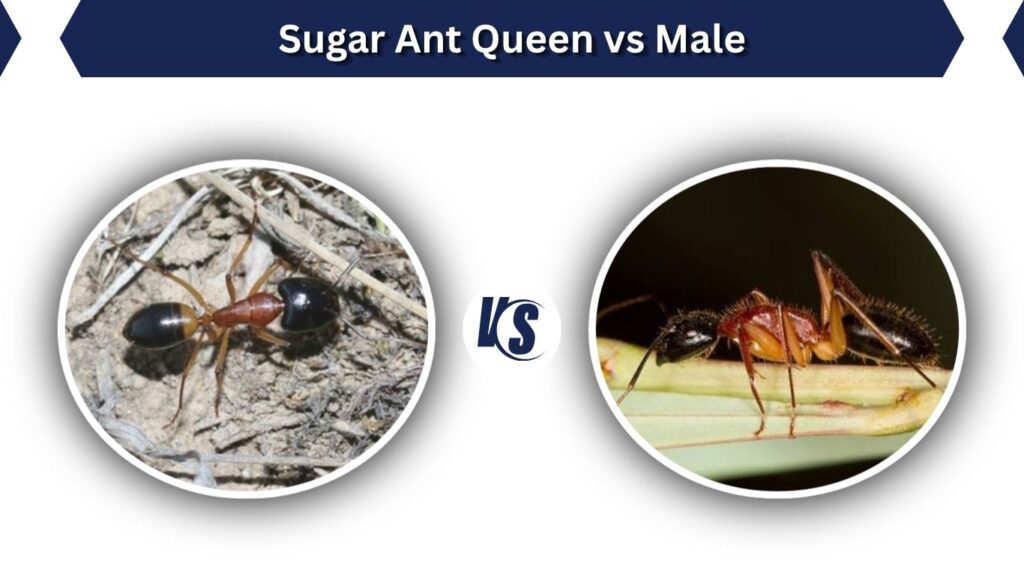
Male sugar ants and queens may both have wings during reproductive periods, making them easy to confuse.
Queens, however, are generally larger and heavier.
Main Differences
A queen typically has:
- Larger abdomen
- Broader thorax
- Heavier overall body
- Longer lifespan
- Ability to establish colonies
- Egg-producing reproductive organs
Males are usually slimmer and primarily exist to mate with reproductive females. They generally die relatively soon after mating.
FAQs
What does a sugar ant queen look like?
A sugar ant queen usually looks like an enlarged worker with a broader thorax and larger abdomen. Young queens may have wings, while mated queens often have visible wing scars.
How big is a sugar ant queen?
Size depends on species. Queens are typically larger than workers, and queens of larger species such as banded sugar ants may reach around 15–20 mm.
Does a sugar ant queen have wings?
Young reproductive queens have wings. After mating, they commonly shed their wings before establishing a new colony.
How many eggs can a sugar ant queen lay?
Egg production varies greatly by species, queen age, season, and colony size. Established queens generally produce far more eggs than queens beginning new colonies.
What happens if the sugar ant queen is killed?
In a single-queen colony, reproduction eventually stops and the colony gradually declines. However, some ant species can have multiple queens, so killing one queen may not eliminate the entire colony.