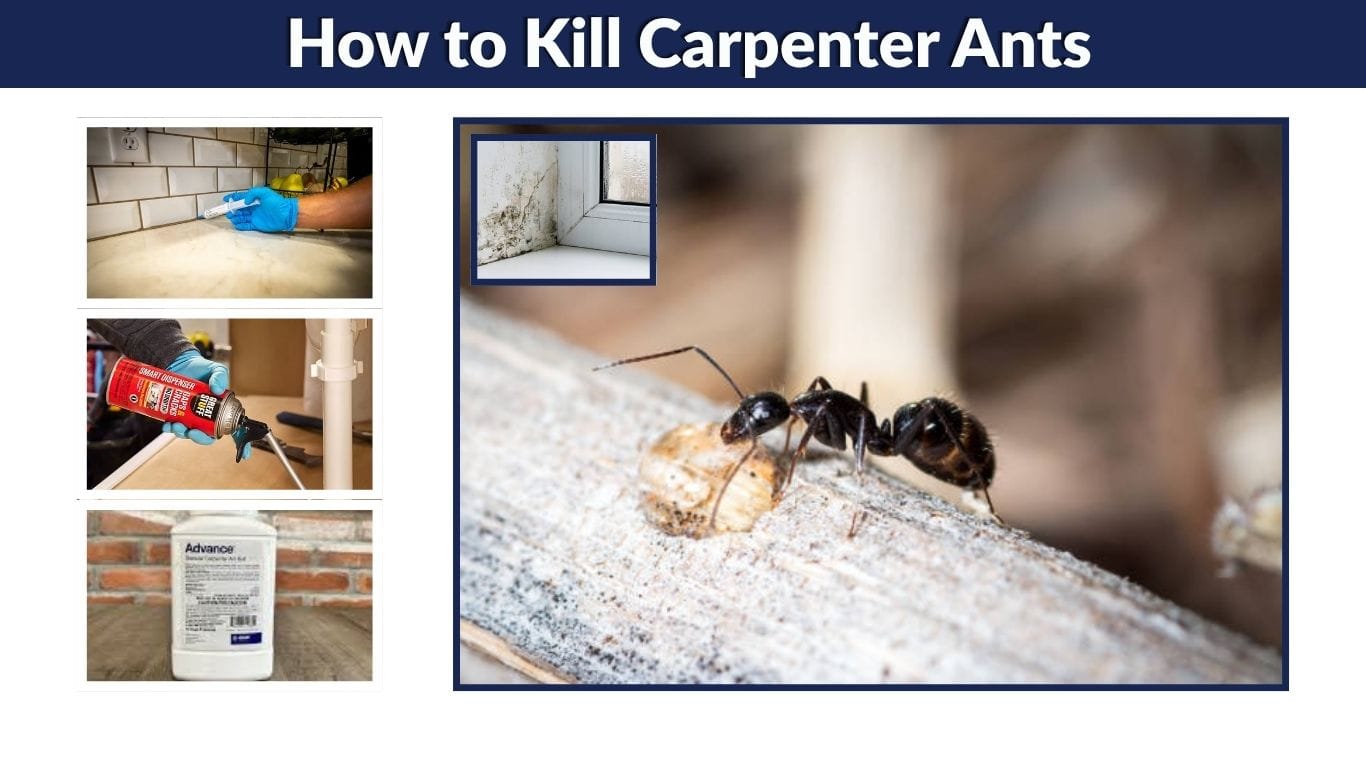
Carpenter ants can become a serious household problem when they establish nests inside walls, damaged wood, trees, or other hidden spaces. Killing a few visible ants usually does not eliminate the infestation because most of the colony remains inside the nest. Effective carpenter ant control involves locating their nesting area, using slow-acting bait or another labeled treatment, correcting moisture problems, and blocking entry points. The right approach depends on whether the ants are inside your house, walls, yard, or trees.
How to Kill Carpenter Ants Effectively
The most important goal is eliminating the colony rather than individual workers. Carpenter ants regularly travel considerable distances from their nests while searching for food, so the ants you see in a kitchen or bathroom may have come from another part of the building or even an outdoor nest.
Find the Nest First
Before treating an infestation, determine where the ants are coming from.
Watch workers during evening or nighttime hours, when many carpenter ants are most active. Follow their trails and look for places where they disappear into cracks, walls, roofs, trees, or foundation gaps.
Signs of a nearby nest include:
- Sawdust-like material called frass
- Large black or reddish ants indoors
- Ant trails appearing repeatedly
- Winged carpenter ants inside the house
- Small openings in damaged wood
- Faint rustling noises inside walls
- Moist or decaying structural wood
Finding the actual nest greatly improves your chance of eliminating the entire colony.
Use Slow-Acting Carpenter Ant Bait
Bait is often more useful than immediately spraying visible ants.
Foraging workers consume bait and may carry food back toward other members of the colony. This allows treatment to reach ants you cannot see.
Place a product specifically labeled for carpenter ants along active trails and near entry areas. Always follow the label directions and keep pesticides inaccessible to children and pets.
Avoid spraying repellent insecticides directly around bait because this can discourage ants from feeding on it.
Correct Moisture Problems
Carpenter ants frequently establish nests in wood softened by moisture or decay.
Repair leaks and moisture problems around:
- Windows
- Roofs
- Bathrooms
- Kitchens
- Gutters
- Crawl spaces
- Plumbing lines
- Exterior siding
Removing favorable nesting conditions is essential for preventing another infestation after the current colony is controlled.
How to Kill Carpenter Ants in the House
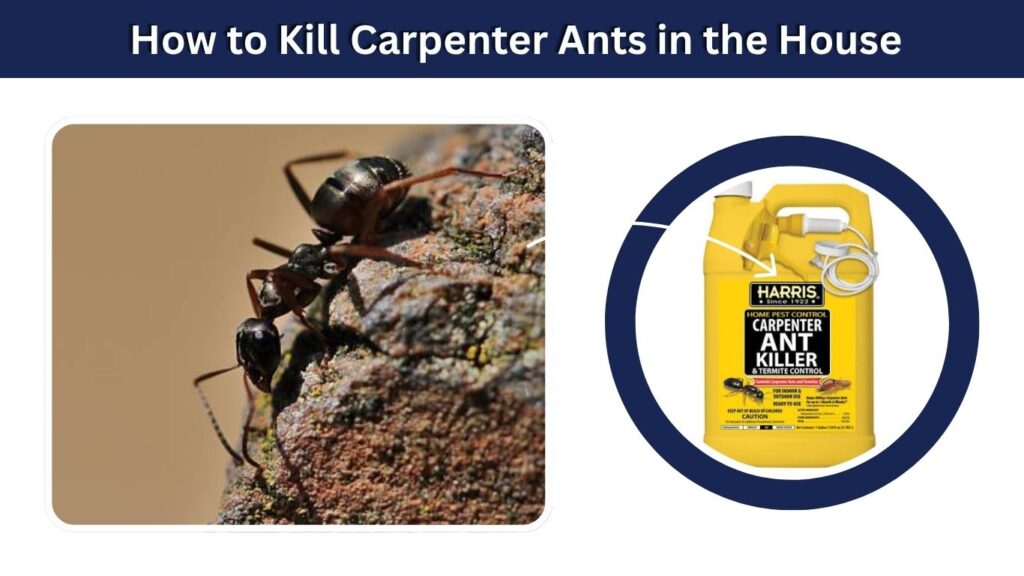
Carpenter ants found indoors may be outdoor workers searching for food or members of a colony established somewhere inside the building.
Repeated sightings, especially during winter, are more concerning because outside colonies are generally less active during cold weather.
Carpenter Ants in Kitchens and Bathrooms
Kitchens and bathrooms offer water and food, so workers commonly forage there even when their nest is elsewhere.
Clean food spills, store sweet foods securely, fix leaking faucets, and inspect plumbing areas.
Rather than spraying every ant you see, place labeled bait near active trails and observe where ants travel. Their movement can help reveal the nesting location.
How to Kill Black Carpenter Ants
Large black carpenter ants can be managed using the same principles as other carpenter ant species.
Focus on:
- Following their trails.
- Finding possible nesting areas.
- Using appropriately labeled slow-acting bait.
- Correcting damp wood.
- Sealing exterior openings after activity decreases.
Simply crushing visible workers will have little effect on a large colony.
How to Kill Carpenter Ants in Walls
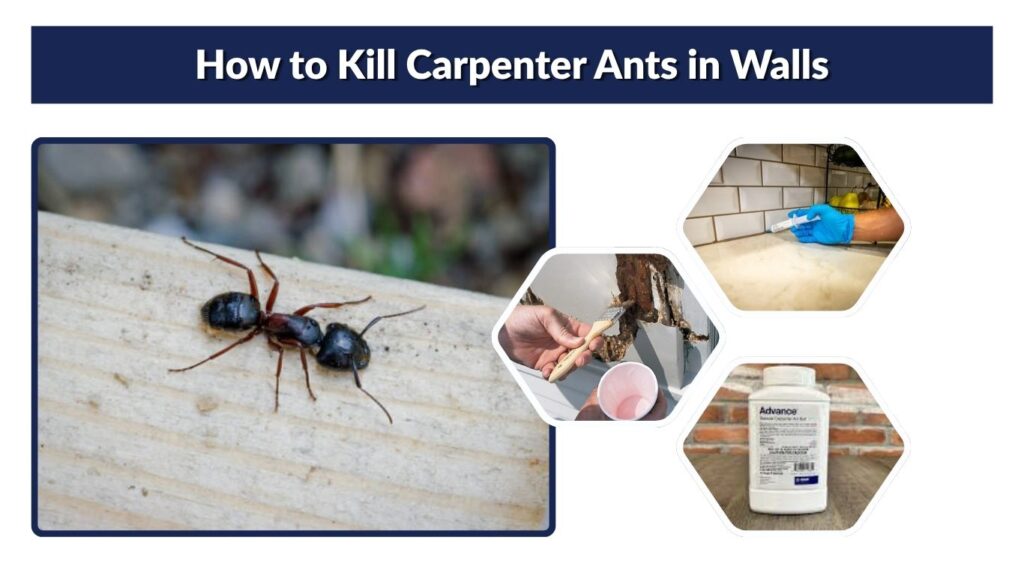
Wall infestations are challenging because nests can be hidden around insulation, framing, windows, doors, plumbing, or roof leaks.
Carpenter ants do not normally eat wood. Instead, they excavate galleries inside it to create nesting space.
Signs Carpenter Ants Are Inside a Wall
Look for:
- Frass falling from small openings
- Ants emerging from electrical or plumbing gaps
- Winged ants appearing indoors
- Regular nighttime activity
- Rustling noises in quiet rooms
- Moist or deteriorating wood
These clues can help narrow down the nest location.
Treating Hidden Wall Colonies
Baits placed along established foraging routes can sometimes reach a hidden colony.
Direct treatment inside wall voids may also be used by pest-control professionals after the nest has been identified. Because drilling walls or improperly applying pesticide into enclosed spaces can create unnecessary risks, inaccessible wall infestations are often best handled professionally.
How to Kill Carpenter Ants With Borax or Boric Acid
Borax and boric acid are frequently discussed as carpenter ant treatments. These substances can affect ants when properly incorporated into suitable baits, but concentration matters.
A bait that kills workers too rapidly may prevent them from carrying it back toward the colony.
Should You Make Homemade Borax Bait?
Homemade recipes are difficult to formulate consistently. Too much active ingredient can repel or quickly kill foragers, while too little may not control the colony.
A commercially prepared ant bait containing borate ingredients and specifically labeled for the target pest is generally easier to use correctly.
Never leave borax or boric-acid mixtures where children, pets, or wildlife could reach them.
How to Kill Carpenter Ants Naturally
Nonchemical approaches are most effective when combined with removal of the conditions that attracted the ants.
They can reduce activity and prevent reinfestation, although a well-established colony hidden inside structural wood may require additional treatment.
Natural and Lower-Chemical Methods
Useful measures include:
- Vacuum visible ants.
- Fix leaks and damp areas.
- Replace rotting wood.
- Remove food crumbs and sugary spills.
- Store firewood away from the house.
- Trim branches touching the building.
- Seal cracks after the infestation is controlled.
- Remove abandoned decaying wood near the foundation.
These methods address both food sources and nesting habitat.
Does Diatomaceous Earth Kill Carpenter Ants?
Diatomaceous earth can damage the protective outer layer of insects when they contact an appropriate dry formulation.
However, it generally kills only exposed ants and may not reach the queen or hidden colony. It should therefore not be considered a complete solution for a structural infestation.
If using a pest-control product containing diatomaceous earth, follow its label and avoid breathing airborne dust.
How to Kill Carpenter Ants Outside
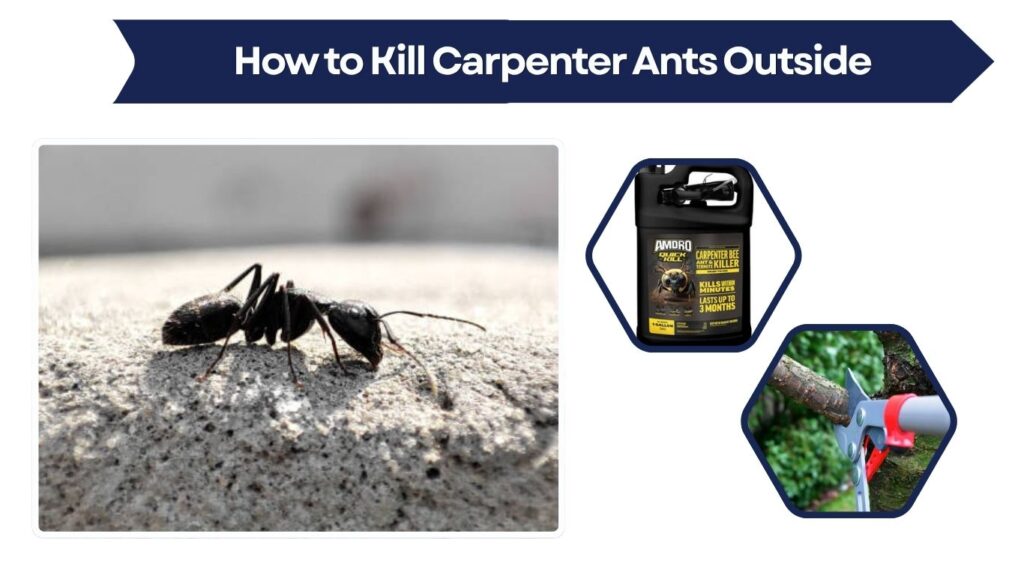
Outdoor carpenter ants commonly nest in dead trees, stumps, logs, landscape timbers, and decaying wooden structures.
Outdoor colonies can send workers into nearby houses while searching for food and water.
Carpenter Ants in the Yard
Check the yard for:
- Old tree stumps
- Rotting logs
- Damp fences
- Dead tree sections
- Landscape timbers
- Firewood piles
- Trees touching the house
Follow active trails to determine whether ants are traveling between an outdoor colony and your home.
Remove unnecessary decaying wood where practical and keep firewood off the ground and away from exterior walls.
Carpenter Ants Around the House
Trim branches and shrubs so they do not touch the roof or siding.
Ants can use branches, utility lines, fences, and vegetation as pathways into buildings. Seal gaps around pipes, wires, windows, and foundation penetrations after the active infestation is addressed.
How to Kill Carpenter Ants in a Tree
Finding carpenter ants in a tree does not necessarily mean the ants are killing it.
They generally excavate wood that is already dead, decaying, or moisture-damaged. An active nest may therefore indicate an existing cavity or internal rot.
Carpenter Ants in a Live Tree
Do not automatically remove or heavily treat a living tree simply because carpenter ants are present.
Inspect it for:
- Hollow sections
- Dead branches
- Rotting cavities
- Old injuries
- Moisture damage
- Structural weakness
If a large tree near a house appears compromised, consider having a qualified arborist evaluate its condition.
Carpenter Ants in a Tree Stump
Old stumps provide excellent nesting habitat because the wood is usually damp and decaying.
Removing an unnecessary stump can eliminate a potential nesting site. If the colony is actively sending ants toward your home, a labeled outdoor carpenter-ant treatment or professional control may also be appropriate.
How to Kill Flying Carpenter Ants
Flying carpenter ants are reproductive males and females called swarmers.
Seeing them outdoors during the reproductive season is normal. Finding numerous winged carpenter ants emerging inside a house is much more significant.
What Flying Carpenter Ants Indoors Mean
Indoor swarmers can indicate a mature colony somewhere within the structure.
Do not focus only on killing the flying ants. Vacuuming them removes the visible insects, but the parent colony may remain hidden.
Inspect walls, windows, roofing, and moisture-damaged wood, or contact a pest-control professional for a more thorough inspection.
How Long Does It Take to Kill Carpenter Ants?
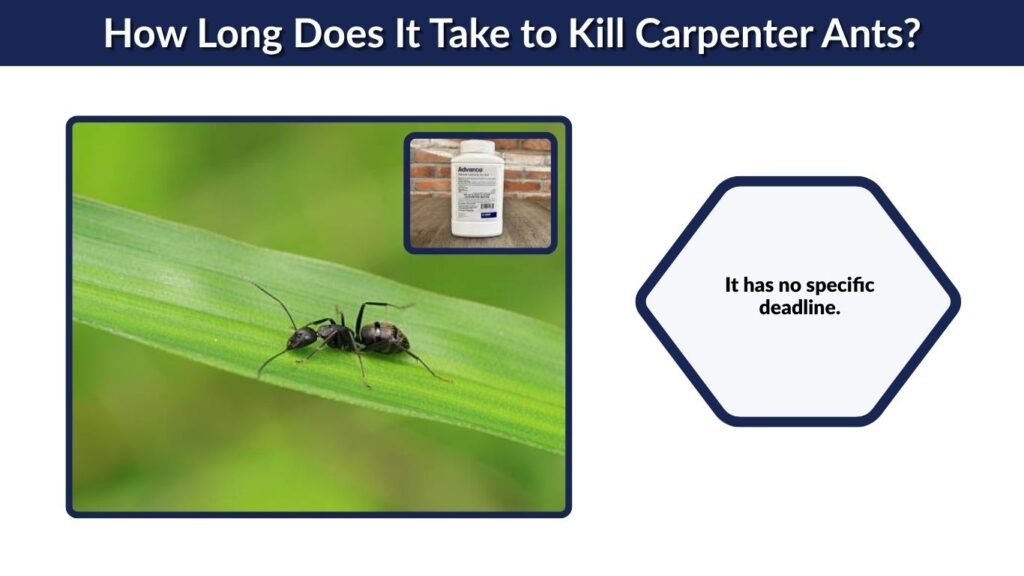
There is no exact timeline because treatment depends on colony size, location, bait acceptance, and whether several related nests are present.
Slow-acting baits intentionally take time because workers need an opportunity to interact with other colony members.
Why Carpenter Ants May Keep Appearing
Continued activity may occur because:
- The main nest was never treated.
- Several satellite nests exist.
- Ants are ignoring the bait.
- An outdoor colony remains active.
- Moisture problems continue.
- Entry points remain open.
If activity remains strong after reasonable control efforts, professional inspection may be necessary.
How to Prevent Carpenter Ants From Returning
Eliminating the existing colony is only half of successful carpenter ant management. Conditions that favor damp wood and easy access should also be corrected.
Prevention Checklist
- Repair plumbing and roof leaks.
- Replace badly damaged wood.
- Keep gutters clear.
- Trim trees away from the roof.
- Store firewood away from buildings.
- Seal exterior cracks and openings.
- Improve crawl-space ventilation.
- Remove unnecessary stumps and rotten wood.
- Clean food spills promptly.
- Inspect previously affected locations.
A dry, well-maintained structure is significantly less attractive to carpenter ants.
When to Call a Pest Control Professional
Professional treatment is worth considering when the colony is hidden inside walls, several areas of the building are affected, winged ants repeatedly emerge indoors, or structural damage is suspected.
A professional can identify nesting locations and use targeted treatment rather than repeatedly spraying individual workers.
FAQs
What kills carpenter ants the fastest?
Contact insecticides may kill individual ants quickly, but rapid killing does not necessarily eliminate the colony. Slow-acting labeled baits can be more useful when workers carry the treatment back toward hidden nest members.
How do you kill an entire carpenter ant colony?
Locate the nest, use an appropriate colony-targeting treatment, correct moisture problems, remove damaged wood when necessary, and prevent ants from re-entering the structure.
Can borax kill carpenter ants?
Borate ingredients can kill ants when properly formulated, but homemade concentrations may be unreliable. Using a labeled carpenter-ant bait according to its instructions is generally preferable.
How do you kill carpenter ants inside walls?
Baiting active trails may reach hidden ants. If the colony is deep inside a wall and requires direct void treatment, professional pest control is usually the safer approach.
Does killing visible carpenter ants solve the infestation?
Usually not. Visible workers represent only a fraction of the colony. The queen, brood, and many workers can remain protected inside the nest.