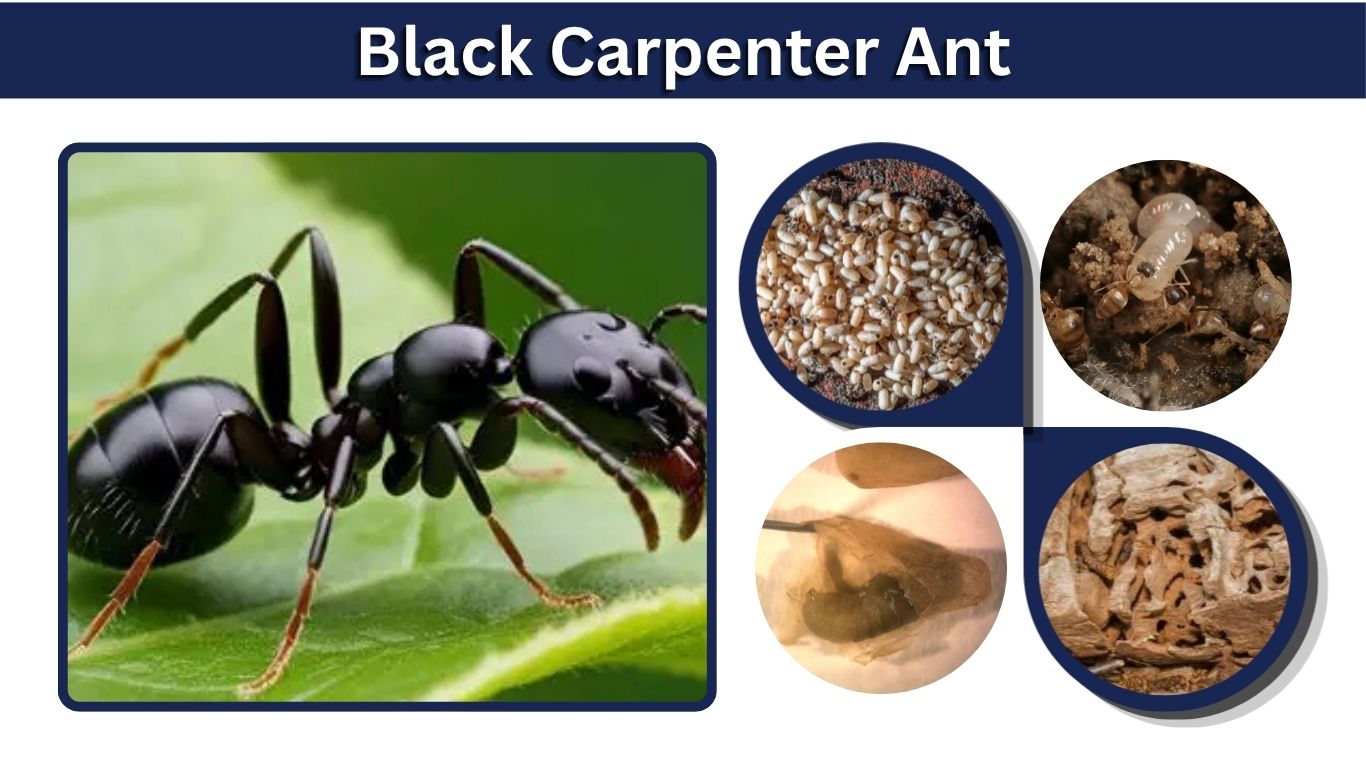
The black carpenter ant is one of the largest ants commonly found around homes, forests, and wooden structures. These ants are usually black or dark brown and are known for excavating galleries inside damp or damaged wood. Unlike termites, carpenter ants do not eat wood; they remove it to create nesting space. Large workers, winged ants, or piles of sawdust-like material indoors can signal an infestation. This guide covers identification, size, queens, bites, nests, diet, life cycle, damage, and effective control.
What Is a Black Carpenter Ant?
Black carpenter ants belong to the genus Camponotus. In eastern North America, the Eastern Black Carpenter Ant, Camponotus pennsylvanicus, is one of the most familiar species. Colonies usually establish their primary nests in moist or decaying wood and may later create satellite nests in nearby structures.
Black Carpenter Ant Identification
Look for these characteristics:
- Black or very dark brown body
- Large size compared with common household ants
- Smooth, rounded thorax when viewed from the side
- Narrow waist with a single node
- Elbowed antennae
- Strong jaws
- Workers of several different sizes
- Large queens
- Winged reproductive ants during swarming season
Workers may vary considerably in size within the same colony.
Black Carpenter Ant Size
Carpenter ants are usually much larger than little black ants or common garden ants. Workers may measure roughly ¼ to ½ inch long, while queens can reach approximately ½ to ¾ inch depending on species.
Major workers have especially large heads and powerful jaws.
Size alone should not be used for identification because other large black ant species exist, but the combination of size, body shape, nesting behavior, and wood debris is highly useful.
Carpenter Ant vs Black Ant
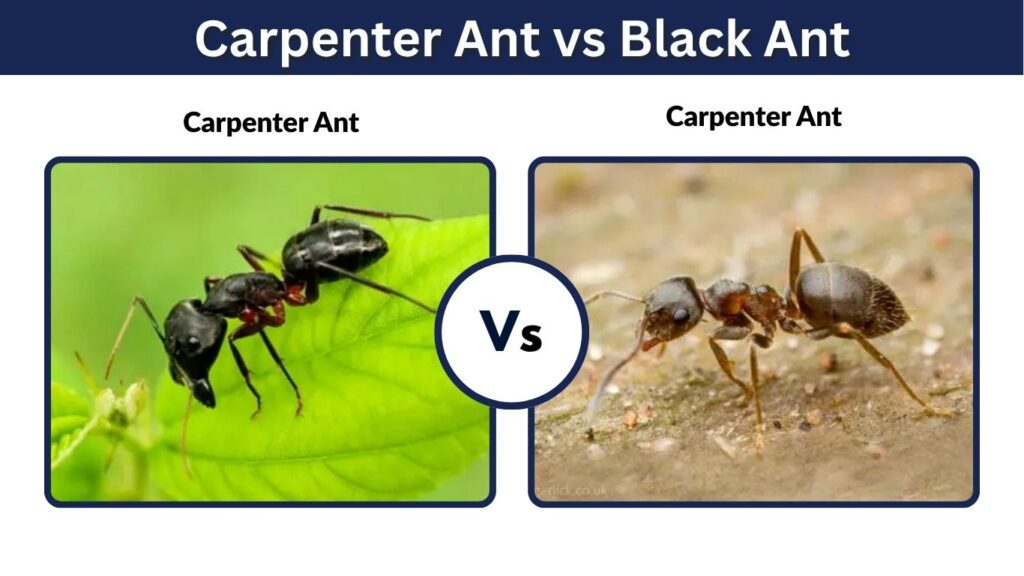
Not every black ant is a carpenter ant. “Black ant” describes coloration rather than one specific species. Many small household and garden ants are black but differ significantly in size, nesting location, and behavior.
Carpenter Ant vs Common Black Ant
Important differences include:
- Carpenter ant: Usually much larger
- Black garden ant: Generally smaller
- Carpenter ant: Often nests inside wood
- Garden ant: Commonly nests in soil
- Carpenter ant: Workers vary noticeably in size
- Small black ant: Workers are usually more uniform
- Carpenter ant: Can produce visible wood shavings
- Common black ant: Does not excavate extensive wooden galleries
If you repeatedly see very large black ants emerging from walls, window frames, or wooden trim, carpenter ants become more likely.
Black Garden Ant vs Carpenter Ant
Black garden ants normally establish colonies outdoors beneath soil, stones, sidewalks, or garden structures.
Carpenter ants can also nest outdoors, but they commonly choose rotting logs, tree stumps, damaged trees, or moisture-damaged building wood.
Large workers seen indoors at night may be foraging from either an indoor nest or an outdoor colony nearby.
Black Carpenter Ant Queen and Winged Ants
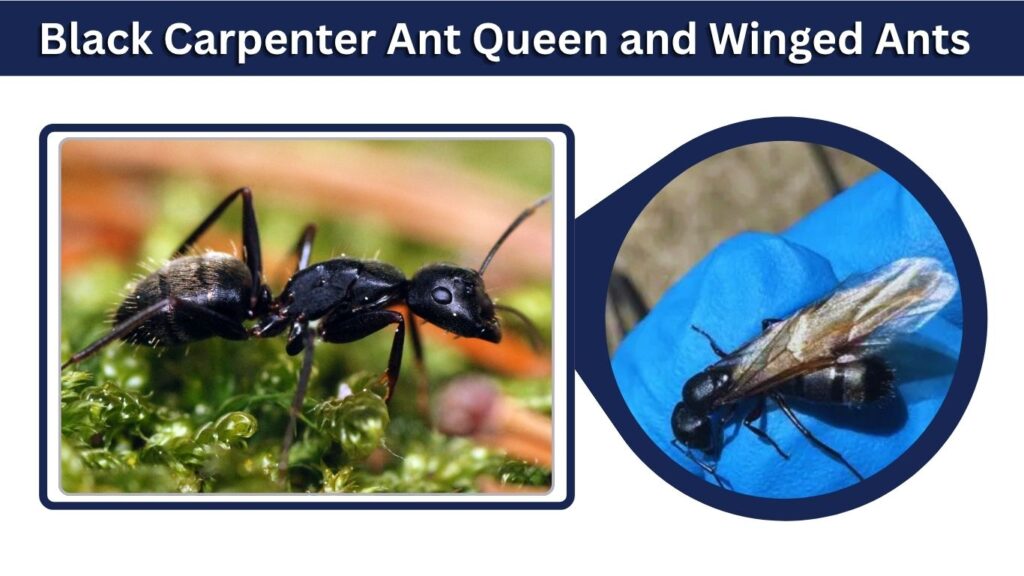
Carpenter ant colonies contain a reproductive queen whose primary role is producing eggs. Mature colonies eventually generate winged males and females that leave to mate and establish new colonies.
Black Carpenter Ant Queen
A queen can usually be identified by:
- Larger body than workers
- Thick thorax
- Large abdomen
- Wing scars after mating
- Dark coloration
- Longer lifespan than workers
A newly mated queen searches for a protected nesting location and begins raising the colony’s first workers.
As the colony grows, workers assume responsibilities for feeding, nest expansion, defense, and caring for larvae.
Black Carpenter Ant With Wings
Winged carpenter ants are reproductive individuals called alates.
Finding a few winged ants outside during seasonal swarming is not necessarily a problem. Finding many winged carpenter ants inside the house, especially around windows, can indicate a mature colony nesting within or close to the structure.
Winged carpenter ants have:
- Elbowed antennae
- Narrow waists
- Front wings longer than rear wings
These characteristics help separate them from termites.
Black Carpenter Ant vs Termite
Carpenter ants and termites can both be associated with damaged wood, but they affect it differently.
Carpenter ants excavate wood to create nests, while termites actually consume cellulose.
How to Tell Them Apart
Carpenter ants:
- Have narrow waists
- Have elbowed antennae
- Have unequal wing lengths
- Produce smooth internal galleries
- May leave sawdust-like debris
Termites:
- Have broad waists
- Have straight antennae
- Have wings of roughly equal length
- Consume wood
- May leave mud tubes or other characteristic damage
Correct identification is important because treatment strategies differ significantly.
Do Black Carpenter Ants Bite or Sting?
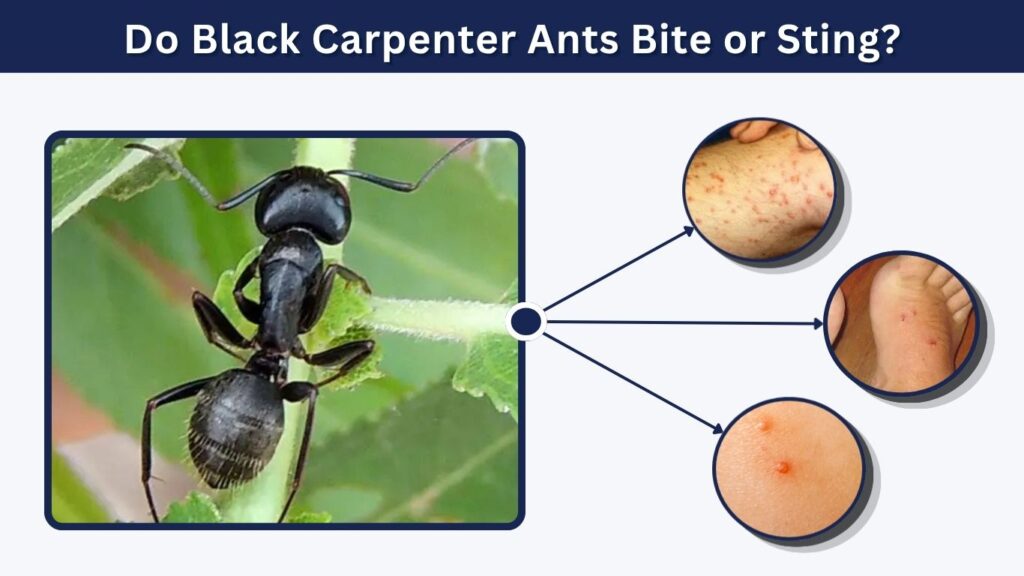
Carpenter ants can bite when threatened. Large workers have strong mandibles capable of pinching skin.
They do not have a functional stinger like many wasps or fire ants, although some carpenter ants can apply formic acid to a bite.
Black Carpenter Ant Bite Symptoms
A bite may cause:
- Immediate pinching pain
- Mild redness
- Temporary swelling
- Burning or irritation
- Minor itching
Most bites are relatively minor and improve without special treatment.
Wash the area with soap and water and avoid scratching irritated skin.
Seek medical attention if severe swelling, difficulty breathing, dizziness, or another serious allergic reaction develops.
Where Do Black Carpenter Ants Nest?
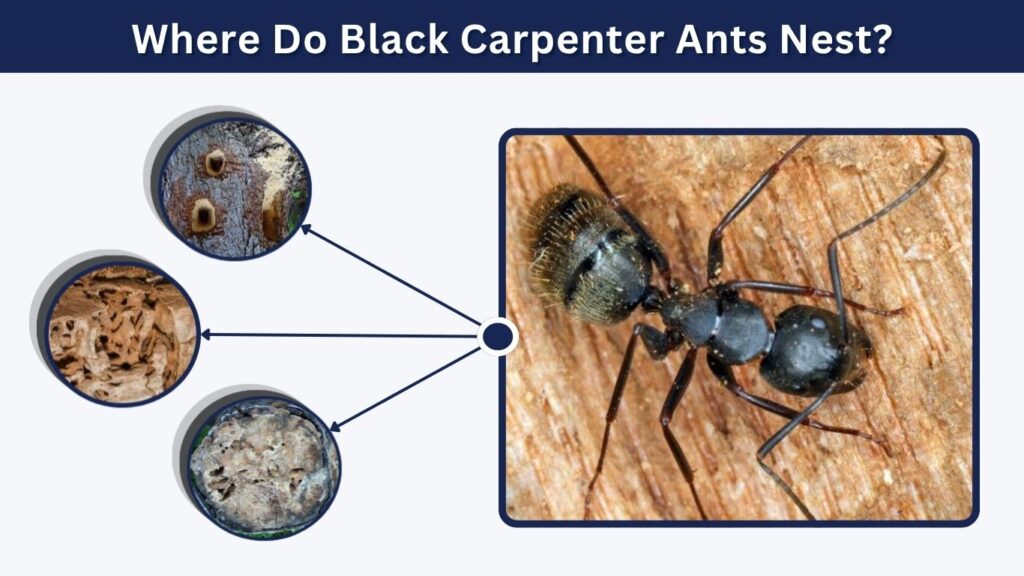
Carpenter ants prefer wood that has already been softened by moisture, decay, or fungal activity.
Indoor infestations therefore often point to an underlying moisture problem.
Common Nest Locations
Inspect:
- Window frames
- Door frames
- Roof eaves
- Wall voids
- Crawl spaces
- Attics
- Decks
- Porches
- Areas around leaking pipes
- Wood near sinks or bathrooms
- Damp insulation areas
- Tree stumps
- Dead trees
- Firewood piles
A colony may have one main nest and several satellite nests.
Signs of a Carpenter Ant Nest
Possible warning signs include:
- Large black ants appearing regularly indoors
- Sawdust-like material called frass
- Small pieces of insect remains mixed with debris
- Rustling sounds inside walls
- Winged ants indoors
- Ant trails active at night
- Ants entering cracks in wooden structures
Frass often appears beneath holes or cracks where ants are removing material from galleries.
What Do Black Carpenter Ants Eat?
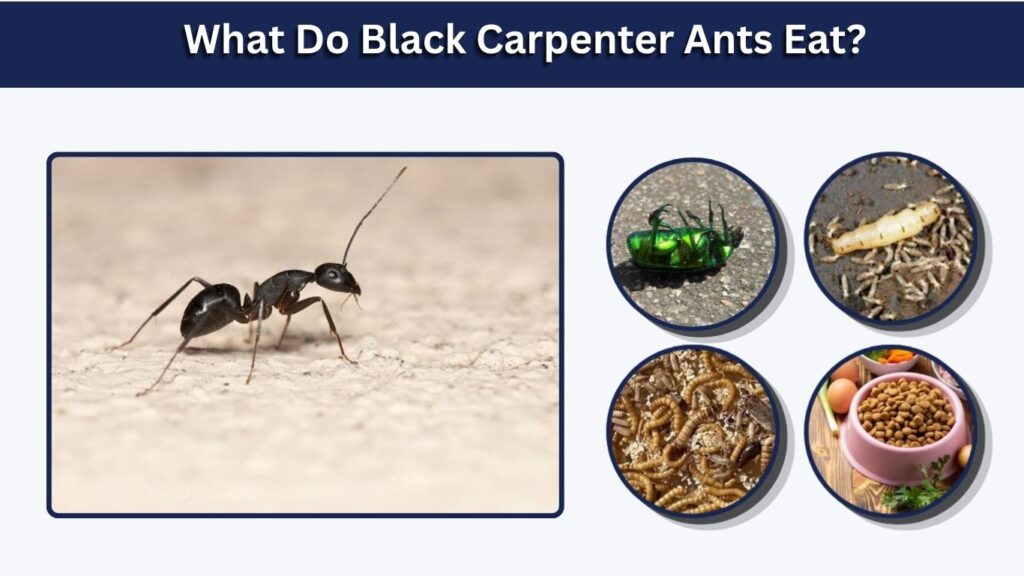
Despite nesting in wood, carpenter ants do not eat wood.
They forage for foods containing sugar and protein and can travel considerable distances from their nest.
Black Carpenter Ant Diet
Common foods include:
- Honeydew from aphids
- Nectar
- Fruit
- Sugary liquids
- Dead insects
- Living insects
- Meat scraps
- Grease
- Pet food
- Syrups and sweet foods
Inside houses, they may forage around kitchens, garbage, pet dishes, and food spills.
Workers are frequently more active at night.
Black Carpenter Ant Life Cycle
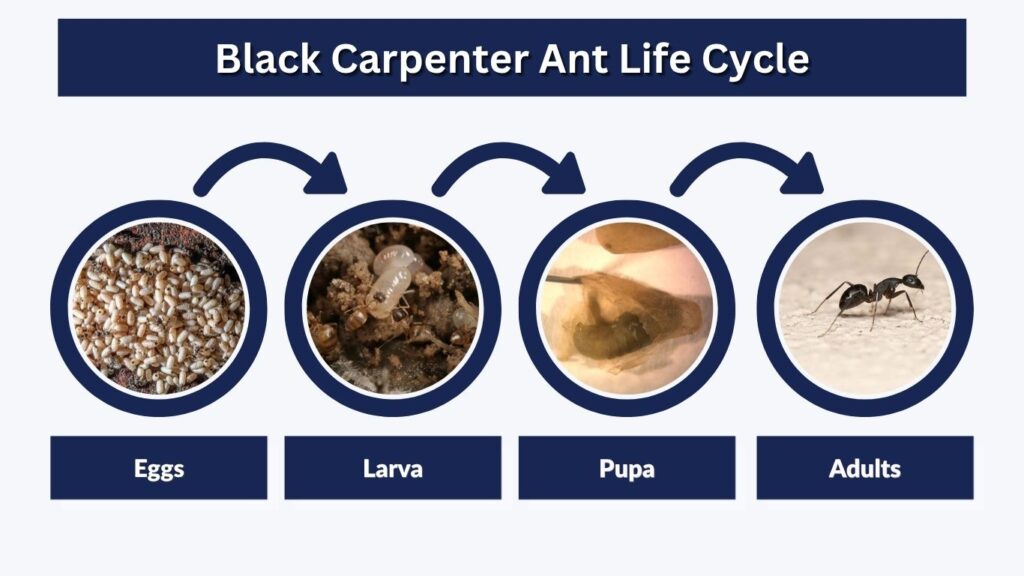
A colony begins after a winged female mates and becomes a queen. She establishes a nest and raises the first generation of workers.
Growth can be slow during the early stages.
Carpenter Ant Life Cycle Stages
The stages include:
- Egg
- Larva
- Pupa
- Adult worker, male, or queen
Established colonies can contain thousands of ants.
Mature colonies produce winged reproductives that leave during seasonal mating flights, potentially starting additional colonies in suitable areas.
Queens may survive for many years under favorable conditions, allowing established nests to persist if left untreated.
Black Carpenter Ant Damage
Carpenter ants do not damage wood as quickly as some termite infestations, but large colonies can weaken wooden materials over time.
Repeated excavation creates expanding galleries.
What Carpenter Ant Damage Looks Like
Watch for:
- Smooth tunnels inside wood
- Hollow-sounding timber
- Frass below nest openings
- Damaged insulation
- Weakened trim or framing
- Multiple nesting holes
- Ant activity around moisture-damaged wood
Damage is often concentrated in wood that already has moisture problems.
Repairing leaks is therefore an important part of permanent control.
How to Get Rid of Black Carpenter Ants
Killing individual ants will not eliminate an established colony. Effective control requires locating the nest, removing moisture problems, and targeting the colony itself.
Black Carpenter Ant Control
Useful steps include:
- Follow ant trails to locate nesting areas.
- Repair plumbing and roof leaks.
- Replace severely damaged wood.
- Trim branches touching the building.
- Move firewood away from exterior walls.
- Seal cracks after the infestation is controlled.
- Keep food in sealed containers.
- Clean sugary spills.
- Use properly labeled carpenter ant bait when appropriate.
- Avoid spraying every visible worker before locating the colony.
Slow-acting bait can be useful because workers may carry it back toward nestmates.
However, carpenter ants sometimes change food preferences, so bait performance can vary.
For colonies located deep inside structural wood, professional pest control may be more effective.
FAQs
1. Are black carpenter ants dangerous?
They are not usually dangerous to people, but they can bite when threatened. Their greater concern is potential structural damage caused by nesting inside wood.
2. What does a black carpenter ant look like?
It is usually a large black or dark ant with elbowed antennae, a narrow waist, and a smoothly rounded thorax. Workers occur in noticeably different sizes.
3. Do black carpenter ants eat wood?
No. They excavate wood to build nesting galleries but eat insects, sugary substances, honeydew, nectar, and household foods.
4. Why are black carpenter ants inside my house?
They may be searching for food or nesting in damp wood. Repeated indoor sightings can indicate moisture damage or a nearby colony.
5. What is the difference between a black ant and a carpenter ant?
Carpenter ants are generally larger and commonly nest inside wood. Many ordinary black ants are smaller and primarily establish nests in soil or other cavities.