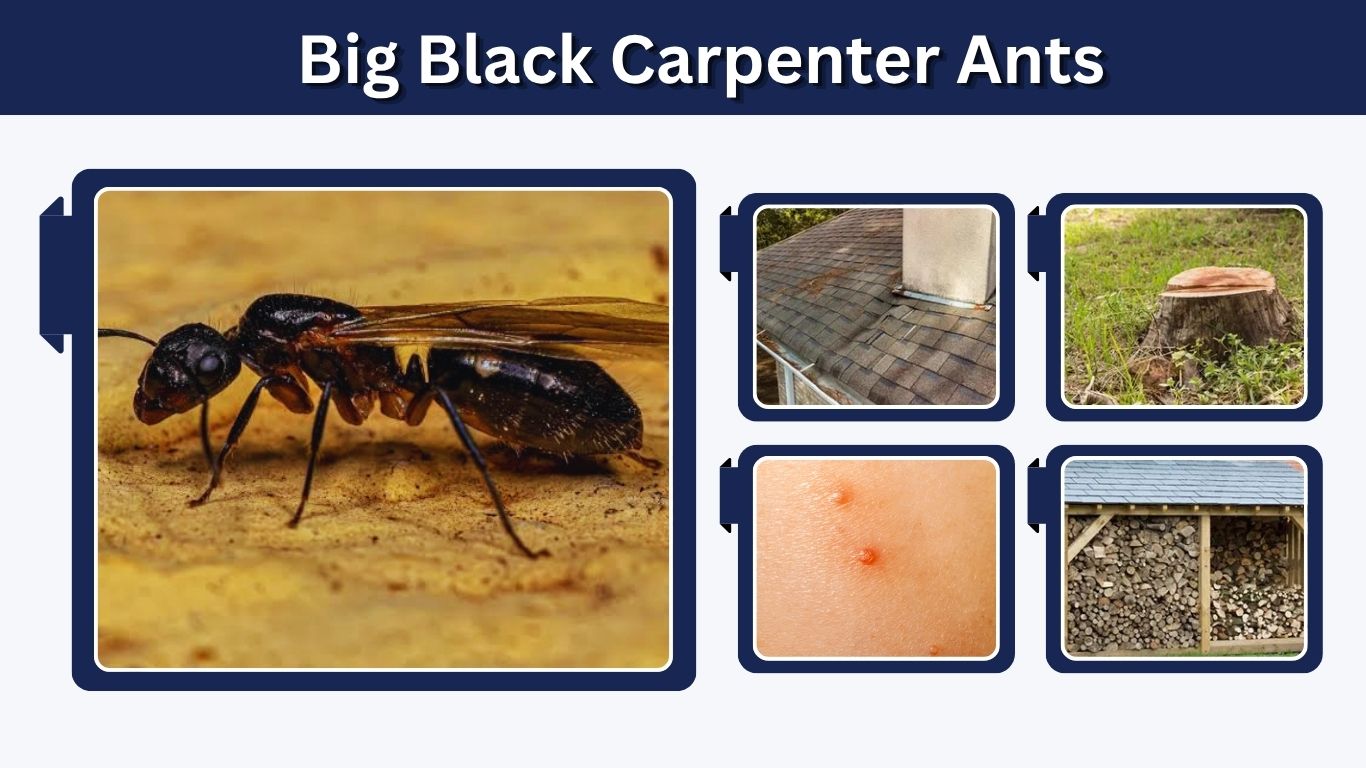
Big black carpenter ants are among the largest ants commonly found around homes, trees, decks, and other wooden structures. Their size and dark color often make people assume that every large black ant is a carpenter ant, but that is not always true. Carpenter ants are best identified by their body shape, behavior, and habit of nesting in wood. Seeing one large ant does not automatically mean your home is infested. This guide explains identification, size, bites, house infestations, look-alikes, damage, and control.
What Are Big Black Carpenter Ants?
Big black carpenter ants belong to the genus Camponotus. Several species can appear black or nearly black, including the Eastern Black Carpenter Ant. They are known for excavating galleries inside wood to create nesting areas, especially where moisture has already softened or damaged the material.
How to Identify Big Black Carpenter Ants
Look for these characteristics:
- Large black or dark brown body
- Workers of different sizes in the same colony
- Narrow waist
- Elbowed antennae
- Smooth, rounded upper thorax
- Strong jaws
- Six long legs
- Queens much larger than workers
- Winged reproductive ants at certain times of year
- Activity often strongest at night
Carpenter ants commonly travel in trails between their nest and food sources.
How Big Are Black Carpenter Ants?
Workers can range from roughly ¼ inch to ½ inch long, depending on their role within the colony and the species involved.
Queens may reach around ½ to ¾ inch, making them noticeably larger than ordinary household ants.
This variation is important because carpenter ant colonies contain minor and major workers. Finding ants of several different sizes traveling together can be one clue that you are dealing with carpenter ants.
Are All Big Black Ants Carpenter Ants?
No. Not every big black ant is a carpenter ant.
Several ant species can be relatively large and dark-colored. Size and color alone are not enough for reliable identification. You should also consider the ant’s body shape, nesting site, behavior, and whether wood debris is present.
Big Black Ant vs Carpenter Ant
Important differences can include:
- Carpenter ants: Frequently nest in wood
- Other large ants: May nest primarily in soil
- Carpenter ants: Workers vary considerably in size
- Some other ants: Workers are more uniform
- Carpenter ants: May leave sawdust-like debris
- Other ants: Usually do not excavate large wooden galleries
- Carpenter ants: Often active after dark
- Other ants: Activity patterns vary by species
If an ant is simply large and black but lives in a soil mound outdoors, it may not be a carpenter ant.
Big Black Ants That Are Not Carpenter Ants
Other ants that may be mistaken for carpenter ants can include large field ants and certain garden ants.
Field ants often establish colonies in soil, lawns, fields, or underneath rocks and landscape materials. Some species are large enough to cause confusion with carpenter ants.
The nesting location is therefore one of the best clues. Carpenter ants are strongly associated with hollow trees, decaying wood, tree stumps, wall voids, and moisture-damaged structural timber.
Big Black Carpenter Ants in the House
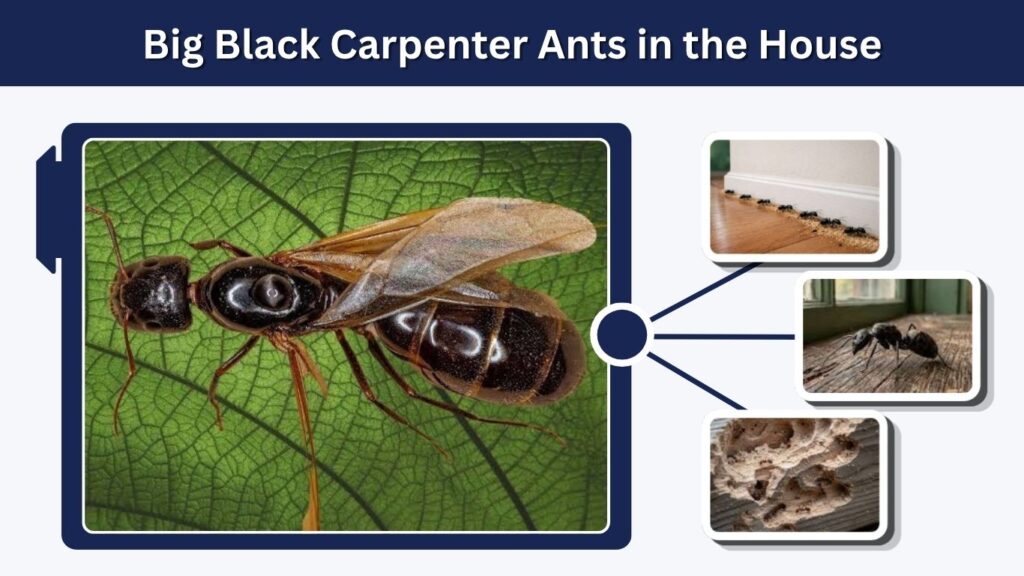
Finding one carpenter ant indoors does not always mean the colony is inside the building. Workers may travel a considerable distance while searching for food.
However, repeated sightings—particularly at night—deserve closer inspection.
Signs of a Carpenter Ant Infestation
Watch for:
- Numerous large black ants indoors
- Ants appearing regularly after sunset
- Sawdust-like material beneath wood
- Winged ants emerging indoors
- Ant trails leading into walls
- Rustling sounds inside wall voids
- Ants emerging from window or door frames
- Moisture-damaged wood
- Hollow or weakened wooden areas
The sawdust-like material carpenter ants push from galleries is often called frass. It may contain pieces of wood, insect remains, and other debris.
Where Carpenter Ants Nest Indoors
Common locations include:
- Window frames
- Door frames
- Roof eaves
- Attics
- Crawl spaces
- Wall voids
- Areas near leaking pipes
- Bathroom walls
- Wood beneath damaged roofing
- Decks and porches
- Wooden siding
Moisture is a major factor. A carpenter ant problem can sometimes indicate an unnoticed plumbing, roofing, or drainage issue.
Do Big Black Carpenter Ants Bite?
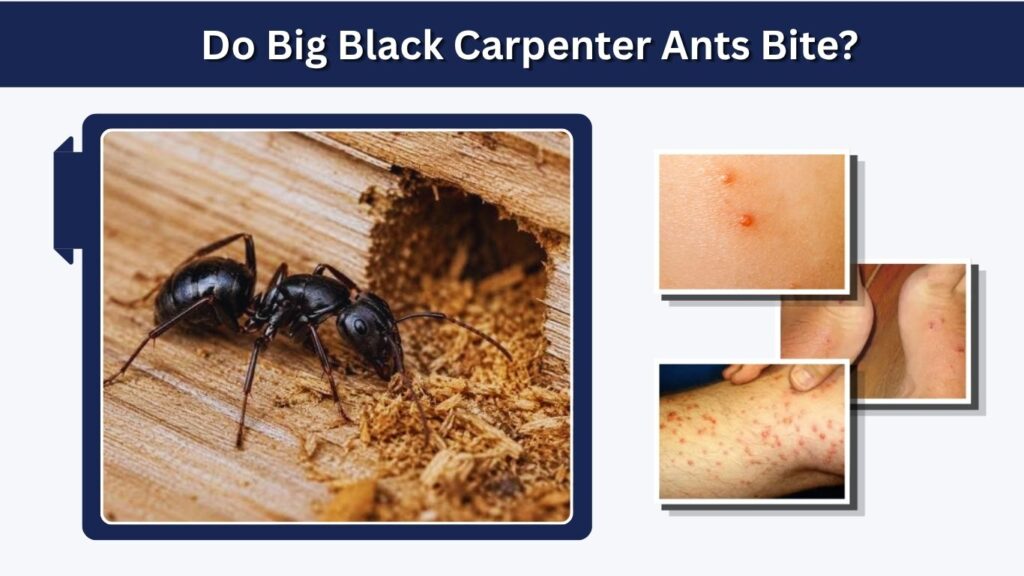
Yes. Carpenter ants have strong jaws and can bite when trapped, handled, or threatened.
Their bite is usually more surprising than medically serious.
Carpenter Ant Bite Symptoms
A bite may cause:
- Sharp pinching pain
- Mild redness
- Temporary swelling
- Burning
- Minor itching
- Local irritation
Carpenter ants do not sting in the same way as fire ants or wasps.
Some carpenter ants can release formic acid around a bite, which may increase the burning sensation.
Wash the area with soap and water and avoid scratching it. Serious reactions are uncommon, but medical attention is appropriate if unusual or severe symptoms develop.
Do Big Black Carpenter Ants Destroy Wood?
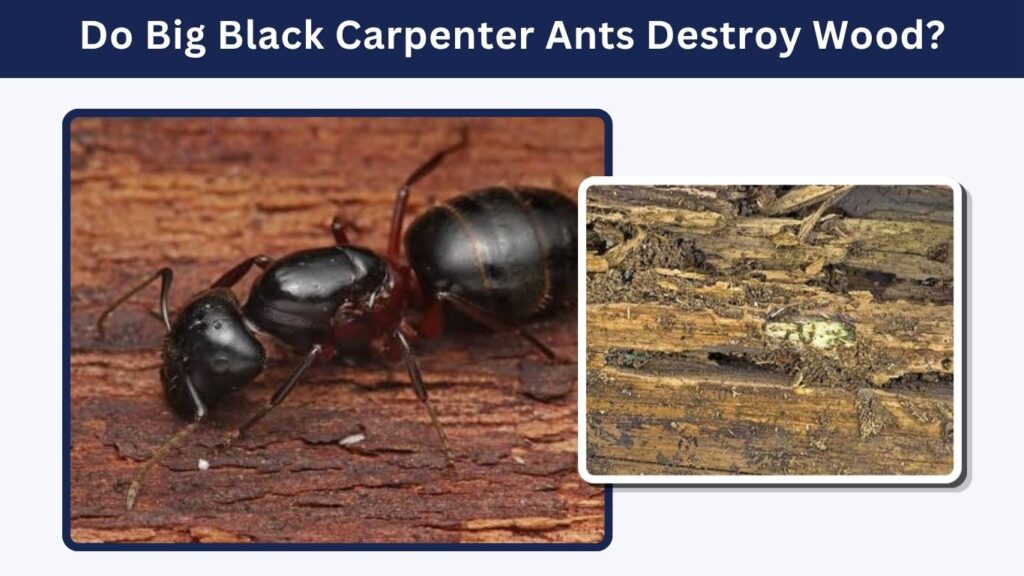
Carpenter ants can damage wood, but they do not eat it.
They use their strong jaws to remove pieces of wood and create smooth nesting galleries.
Carpenter Ant Damage
Damage may include:
- Hollow wooden sections
- Smooth tunnels inside timber
- Frass accumulating below holes
- Enlarged galleries in old nest sites
- Weakening of trim or framing
- Damage around moist window frames
- Tunnels extending through insulation
A large colony nesting in structural wood for several years can create significant damage.
However, carpenter ants often begin in wood that is already damp or decaying. Correcting the moisture problem is therefore essential.
Carpenter Ant vs Termite
People often confuse carpenter ant damage with termite damage because both insects may occur inside wooden structures.
Their appearance and behavior are quite different.
Carpenter Ant vs Termite Identification
Carpenter ants have:
- Narrow waists
- Elbowed antennae
- Unequal-sized wings on reproductive ants
- Smooth excavated galleries
- Visible wood debris around some nests
Termites have:
- Broad waists
- Straight antennae
- Wings of approximately equal length
- A diet that actually includes wood cellulose
- Different tunnel and damage patterns
Correct identification matters because termite and carpenter ant infestations require different management strategies.
What Attracts Big Black Carpenter Ants?
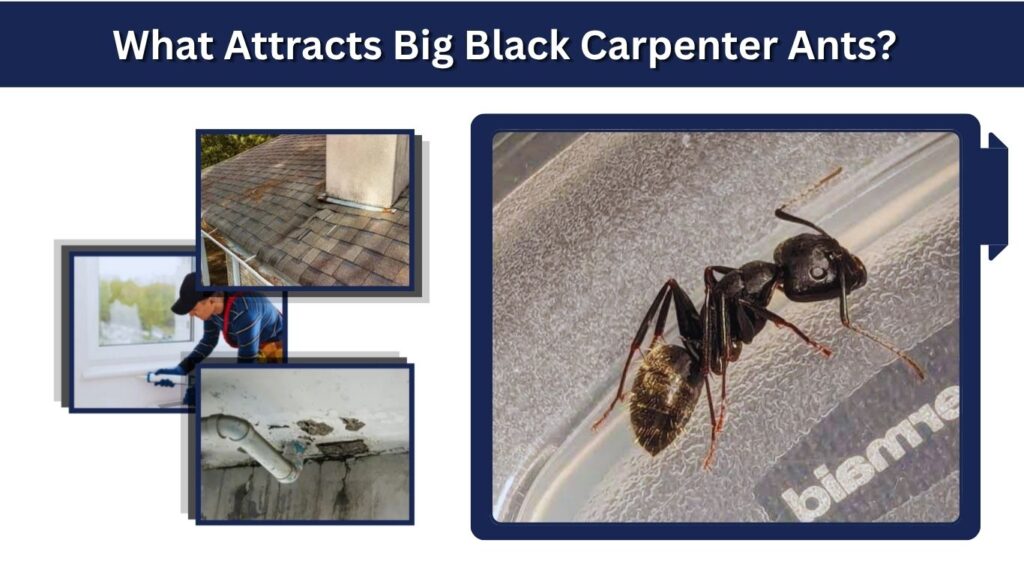
Carpenter ants are attracted to both suitable nesting areas and reliable food sources.
Outdoors, they commonly nest in old trees, logs, stumps, and damaged wood.
Things That Attract Carpenter Ants
Common attractants include:
- Damp wood
- Leaking roofs
- Plumbing leaks
- Rotten window frames
- Dead trees
- Tree stumps
- Firewood piles
- Sugary spills
- Pet food
- Honeydew-producing insects
- Dead insects
- Greasy foods
Carpenter ants are omnivorous and do not depend on the wood in their nests for food.
Workers may travel outside every night to collect insects, sugar, nectar, and honeydew.
How to Find a Big Black Carpenter Ant Nest
Finding the actual nest is one of the most important parts of successful control.
Simply killing workers on your countertop may have little effect on the colony.
How to Locate the Nest
Try these steps:
- Watch where ants travel after dark.
- Follow trails toward cracks or wall openings.
- Look for frass beneath wooden structures.
- Inspect areas with moisture damage.
- Check window and door frames.
- Examine decks, porches, and rooflines.
- Look around nearby trees and stumps.
- Listen for faint rustling in quiet wall areas.
Carpenter ants may maintain a parent colony outdoors and one or more satellite nests inside a building.
How to Get Rid of Big Black Carpenter Ants
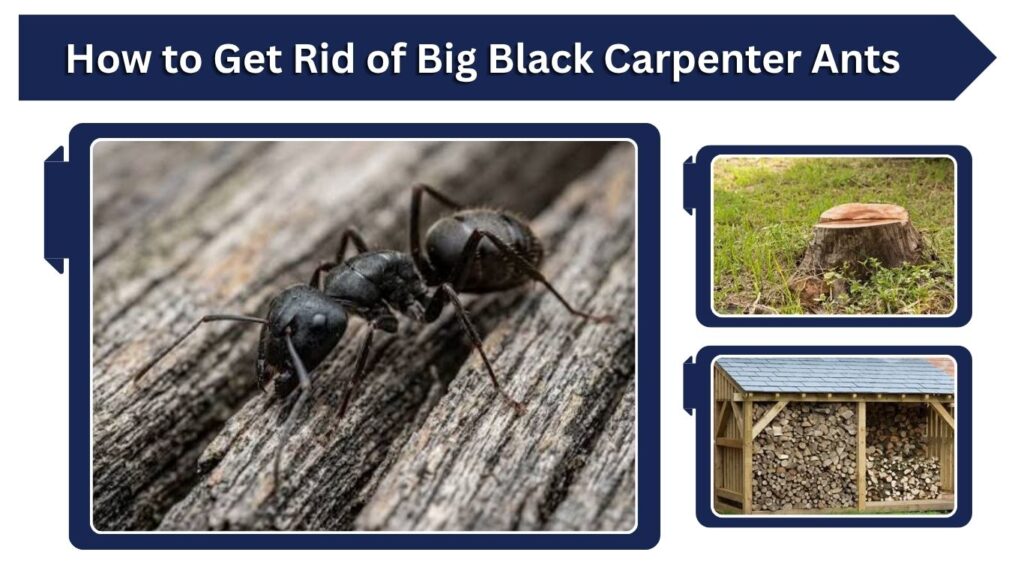
Effective carpenter ant control focuses on the colony rather than individual ants.
Correcting environmental problems is just as important as killing the insects.
Carpenter Ant Control Steps
Use these measures:
- Repair leaking pipes and roofs.
- Replace badly damaged wood.
- Remove rotten stumps near the home.
- Store firewood away from the building.
- Trim tree branches touching the roof.
- Clean food spills.
- Keep pet food sealed.
- Follow ant trails to nesting areas.
- Use carpenter-ant bait according to label directions.
- Seal cracks after the colony is controlled.
Avoid immediately spraying every worker you see if you are trying to locate the nest. Following active workers can help reveal where the colony is hidden.
Large or inaccessible colonies inside structural wood may require professional pest control.
FAQs
1. Are all big black ants carpenter ants?
No. Several ant species can be large and black. Carpenter ants are identified through a combination of size, body shape, nesting behavior, worker variation, and association with wooden galleries.
2. Does seeing one big black ant mean I have carpenter ants?
Not necessarily. A single worker may have wandered indoors while searching for food. Repeated sightings, frass, winged ants, or ants emerging from walls are more concerning.
3. Do big black carpenter ants bite?
Yes. They can bite with their jaws when threatened, although bites are usually mild and carpenter ants are not normally aggressive toward people.
4. What kills big black carpenter ants?
Properly labeled carpenter ant baits and targeted treatments can control colonies, but removing moisture problems and locating the nest are crucial for long-term success.
5. Are big black carpenter ants harmful to a house?
They can be. Established colonies excavating structural wood over time may cause damage, particularly when they occupy damp or partially decayed timber.