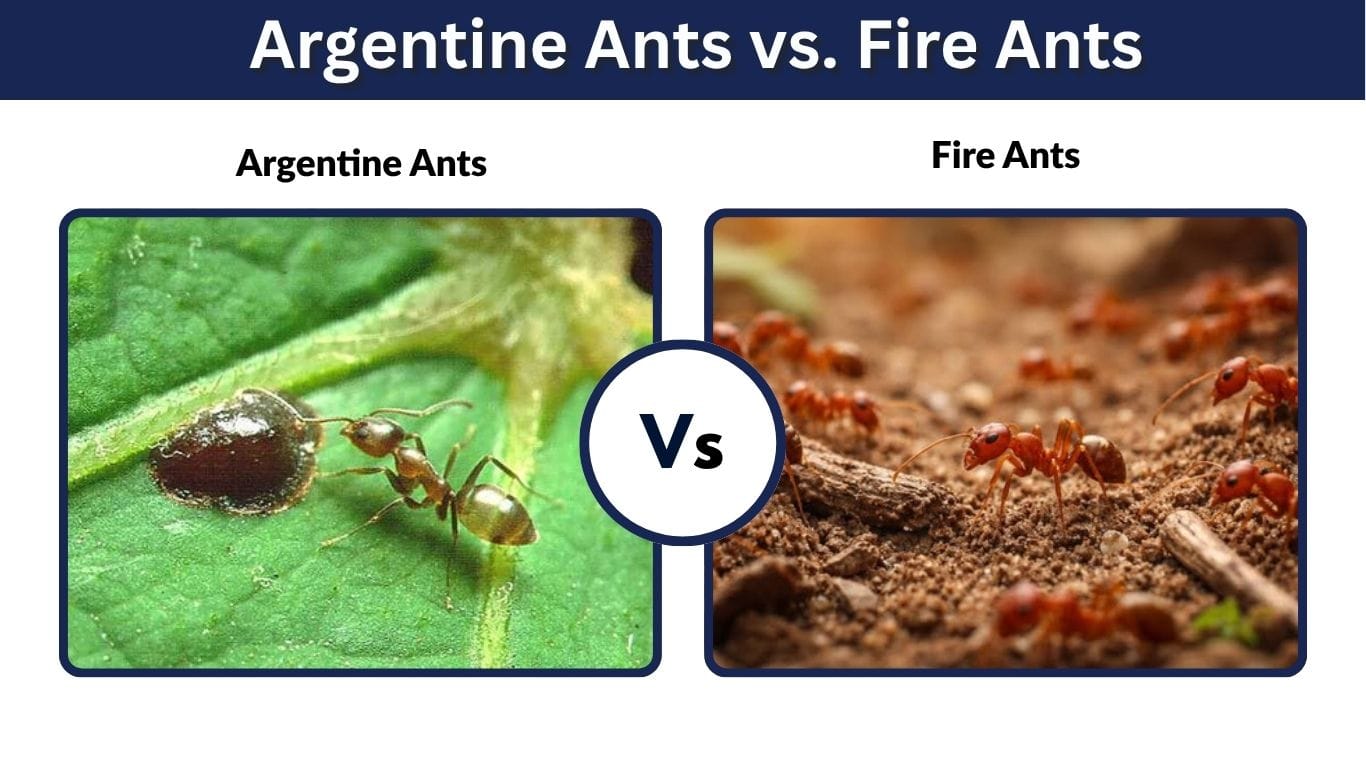
Argentine ants vs. fire ants can be difficult to distinguish at first glance because both are invasive ants originally associated with South America and both can build extremely large populations. However, they are very different insects. Argentine ants are small, uniformly brown ants that form long trails and usually do not sting people. Red imported fire ants are larger, reddish-brown, highly defensive ants that build noticeable soil mounds and deliver painful venomous stings. Their differences in appearance, nesting, colony structure, aggression, and danger make identification important.
Argentine Ant vs. Fire Ant: Quick Comparison
For this comparison, “fire ant” primarily refers to the red imported fire ant (Solenopsis invicta), one of the most important invasive fire ants in the United States.
| Feature | Argentine Ant | Red Imported Fire Ant |
| Scientific name | Linepithema humile | Solenopsis invicta |
| Worker size | About 1/8 inch | About 1/8–1/4 inch |
| Worker sizes | Nearly uniform | Noticeably variable |
| Color | Dull light to dark brown | Reddish brown to dark |
| Petiole nodes | 1 | 2 |
| Sting | No functional sting threat | Painful venomous sting |
| Nest | Shallow, inconspicuous | Large soil mounds |
| Colony | Many queens, supercolonies | One or multiple queens |
| Typical behavior | Long organized trails | Aggressive mound defense |
| Main human concern | Household invasion | Painful stings |
UC IPM describes Argentine ant workers as uniformly dull brown and about 1/8 inch long, while USDA reports imported fire ant workers ranging from roughly 1/8 to 1/4 inch.
What Is an Argentine Ant?
The Argentine ant (Linepithema humile) is a small invasive ant famous for creating enormous interconnected colonies.
Workers cooperate across many nests, and colonies often contain numerous queens. Instead of individual colonies constantly fighting neighboring nests of the same population, Argentine ants can form huge supercolonies.
UC IPM notes that colonies may contain millions of ants, multiple queens, and many interconnected subcolonies.
Argentine Ant Identification
Look for:
- Small workers around 1/8 inch
- Uniform brown coloration
- Workers approximately the same size
- One petiole node
- Long, highly organized trails
- Musty odor when crushed
- Large numbers entering homes
Argentine ants commonly travel along foundations, sidewalks, tree branches, baseboards, irrigation lines, and kitchen surfaces.
They are particularly attracted to sweets and honeydew produced by aphids, scale insects, and other plant pests.
What Is a Fire Ant?
Several ants are called fire ants, but the best-known invasive species in the United States is the red imported fire ant (Solenopsis invicta).
It is especially famous for its aggressive colony defense and painful sting.
Red Imported Fire Ant Identification
Look for:
- Reddish-brown coloration
- Darker abdomen
- Workers of noticeably different sizes
- Approximately 1/8–1/4 inch body length
- Two nodes between thorax and abdomen
- Large soil mounds
- Very aggressive reaction when nest is disturbed
USDA reports that hundreds of workers may rapidly swarm out of a disturbed mound, climb onto people or animals, and sting.
Argentine Ant vs. Fire Ant Appearance
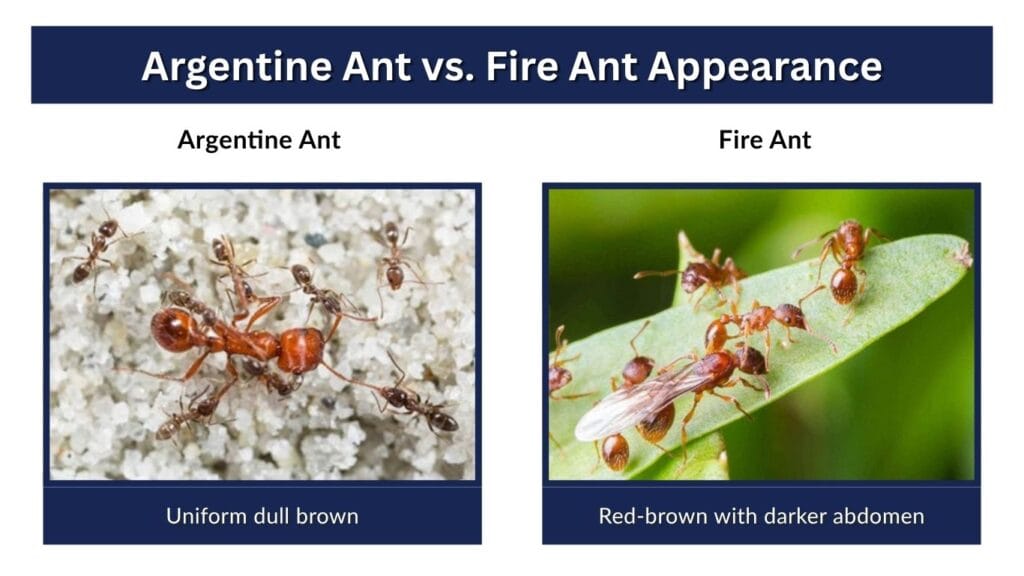
Size variation is one of the easiest differences to notice.
Argentine ant workers in a trail tend to look almost identical in size.
Fire ant colonies contain workers of several different sizes.
| Identification | Argentine Ant | Fire Ant |
| Color | Uniform dull brown | Red-brown with darker abdomen |
| Worker variation | Little | Considerable |
| Body | Slim | More robust |
| Nodes | 1 | 2 |
| Trail | Very obvious trails | Often around mound/food |
| Mound | Usually inconspicuous | Often prominent |
Argentine ant nests may occur under mulch, boards, debris, concrete slabs, and other protected objects. Their nests are often very shallow—sometimes only 1–2 inches beneath the soil.
Fire ants can construct large dome-shaped mounds in lawns, fields, parks, pastures, and other open sunny areas.
Argentine Ant vs. Fire Ant Sting
The difference in sting risk is dramatic.
Do Argentine Ants Sting?
Argentine ants are not considered stinging ants of concern to people.
They may crawl over skin when populations are large, but their primary pest status comes from invading homes, contaminating food, and disrupting ecosystems rather than injuring humans.
UC IPM specifically describes Argentine ants in vineyards as ants that do not bite or sting.
Do Fire Ants Sting?
Yes.
Fire ants have a venomous sting and may sting repeatedly.
Typical reactions include:
- Immediate burning pain
- Redness
- Itching
- Swelling
- Small pustules or blisters
A single fire ant can sting multiple times. When a mound is disturbed, many workers may attack simultaneously.
Severe allergic reactions can occur in susceptible people and require emergency medical attention.
Are Argentine Ants and Fire Ants From the Same Place?
Both originated in South America, but they are not the same species and do not have identical native distributions.
Argentine ants originated in southern South America.
Red imported fire ants are also native to South America and were introduced into the United States through human commerce, probably arriving in soil associated with cargo ships. USDA notes that imported fire ants were introduced from South America decades ago.
The name “Argentine ant” therefore does not mean “fire ant from Argentina.”
They belong to different genera:
- Argentine ant — Linepithema
- Fire ant — Solenopsis
Argentine Ant vs. Fire Ant Colonies
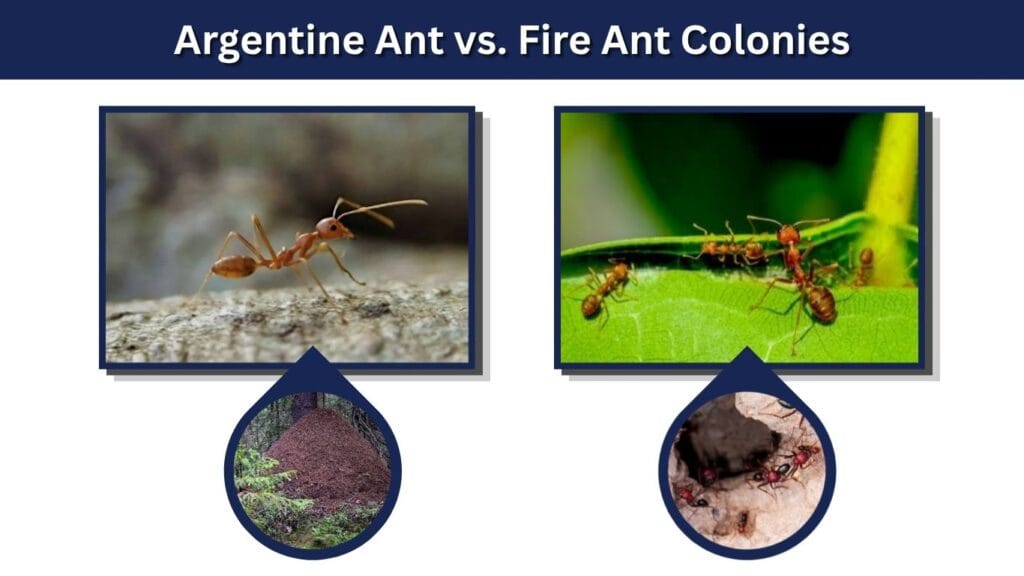
Their social organization is another major difference.
Argentine Ant Supercolonies
Argentine ants are unusually cooperative.
Multiple queens may occupy interconnected nests, and workers frequently move between them.
Colonies expand through budding, in which queens leave with groups of workers and establish nearby nests.
This allows Argentine ants to dominate huge areas.
Fire Ant Colonies
Red imported fire ants may have either:
- A single queen, or
- Multiple queens
Their colonies generally remain centered around recognizable underground nests and mounds.
They aggressively defend these nests from disturbance.
Argentine Ant vs. Fire Ant Diet
Both species are opportunistic feeders, but their feeding habits differ somewhat.
| Food | Argentine Ant | Fire Ant |
| Sugary liquids | Very important | Yes |
| Honeydew | Very important | Yes |
| Dead insects | Yes | Yes |
| Live insects | Some | Common |
| Seeds | Occasionally | Yes |
| Human food | Yes | Yes |
| Plant damage | Indirect/common via honeydew pests | Can directly damage plants |
Argentine ants commonly protect aphids, scales, whiteflies, and mealybugs because these insects produce sugary honeydew. This protection can indirectly increase plant pest problems.
Fire ants are more aggressive predators and scavengers and may also damage seedlings, crops, and young trees.
Do Argentine Ants Kill Fire Ants?
Argentine ants and red imported fire ants can fight and compete with each other.
Both species compete strongly for food and territory.
Research in their native range in northern Argentina found that removing either species allowed the other to increase, suggesting that they naturally limit one another through competition. Neither species consistently dominated the other under all conditions.
Therefore, the outcome of an Argentine ant vs. fire ant encounter depends on factors such as:
- Colony size
- Number of workers
- Number of queens
- Food resources
- Temperature
- Nest location
- Local population density
Fire ants are individually better armed because they possess powerful stings, while Argentine ants can compensate through extremely large numbers and coordinated colony organization.
The Argentine Ant vs. Fire Ant “War”
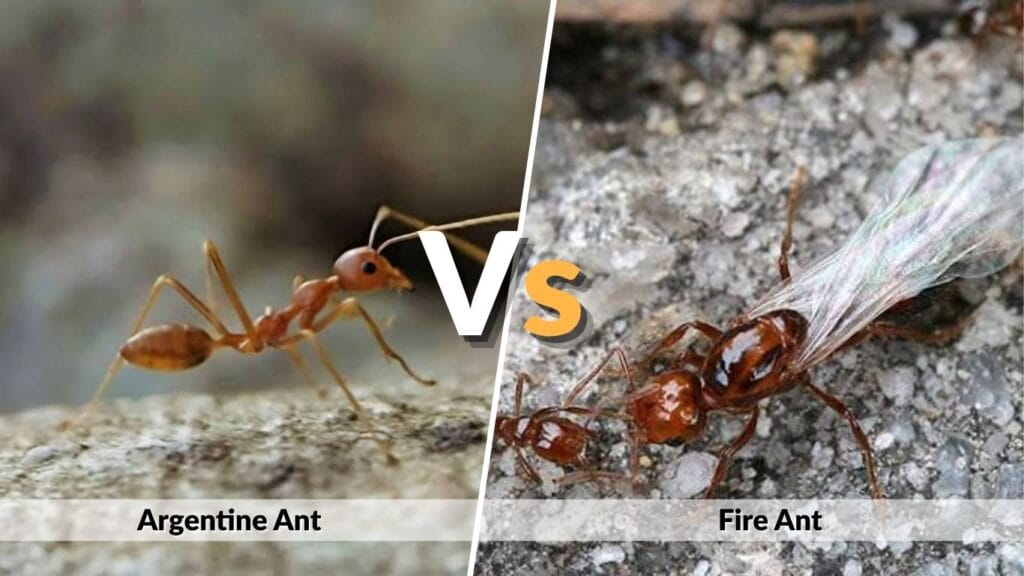
The phrase “Argentine ant vs. fire ant war” describes genuine aggressive interactions, but it should not be interpreted as one continuous organized war across California or the United States.
Laboratory studies have documented aggressive encounters between Linepithema humile and Solenopsis invicta. Researchers describe them as natural competitors where their native ranges overlap.
In Southern California, interaction is particularly interesting because established red imported fire ant populations can encounter areas already occupied by enormous Argentine ant populations.
The border between colonies can therefore become a competitive zone where ants fight over food and territory.
Which Is More Dangerous: Argentine Ant or Fire Ant?
For human safety, fire ants are considerably more dangerous.
Argentine ants mainly create problems by:
- Invading homes
- Contaminating food
- Protecting plant pests
- Displacing native ants
- Altering ecosystems
Fire ants can cause all of these types of ecological problems while also delivering painful venomous stings.
USDA additionally warns that imported fire ants can injure livestock, wildlife, pets, and people.
Will Fire Ant Killer Work on Argentine Ants?
Not necessarily.
Ant control depends heavily on:
- Active ingredient
- Bait formulation
- Species
- Season
- Food preference
A bait formulated specifically for mound-building fire ants may not be the best choice for Argentine ants.
Argentine ants are strongly attracted to sweet liquid foods, although their preference for protein may increase during periods of brood production. UC IPM recommends matching bait type to the ant species and its feeding preferences.
Correct identification should therefore come before treatment.
FAQs
1. Are Argentine ants the same as fire ants?
No. Argentine ants are Linepithema humile, while red imported fire ants are Solenopsis invicta. Argentine ants are smaller, uniformly brown, and mainly nuisance pests. Fire ants vary in worker size and can inflict painful venomous stings.
2. Do Argentine ants sting humans?
Argentine ants are not considered dangerous stinging ants. They may enter homes in enormous numbers but generally do not bite or sting people. Their main problems involve food contamination, household infestations, and displacement of native insects.
3. Can Argentine ants kill fire ants?
Yes, individuals of the two species can fight and kill one another. Large colonies also compete for territory and food. Research indicates that neither species is guaranteed to win; local population size and environmental conditions strongly influence the outcome.
4. Which is worse, Argentine ants or fire ants?
For people and pets, fire ants are generally worse because their venomous stings are painful and can occasionally cause serious allergic reactions. Argentine ants can be more difficult household pests because their enormous multi-queen colonies readily invade buildings.
5. How can I tell fire ants apart from Argentine ants?
Argentine ant workers are small, uniformly brown, and almost identical in size. Fire ant workers range noticeably in size, usually have reddish-brown bodies, and commonly emerge from obvious soil mounds. Disturbing a fire ant nest can trigger an aggressive swarming response.