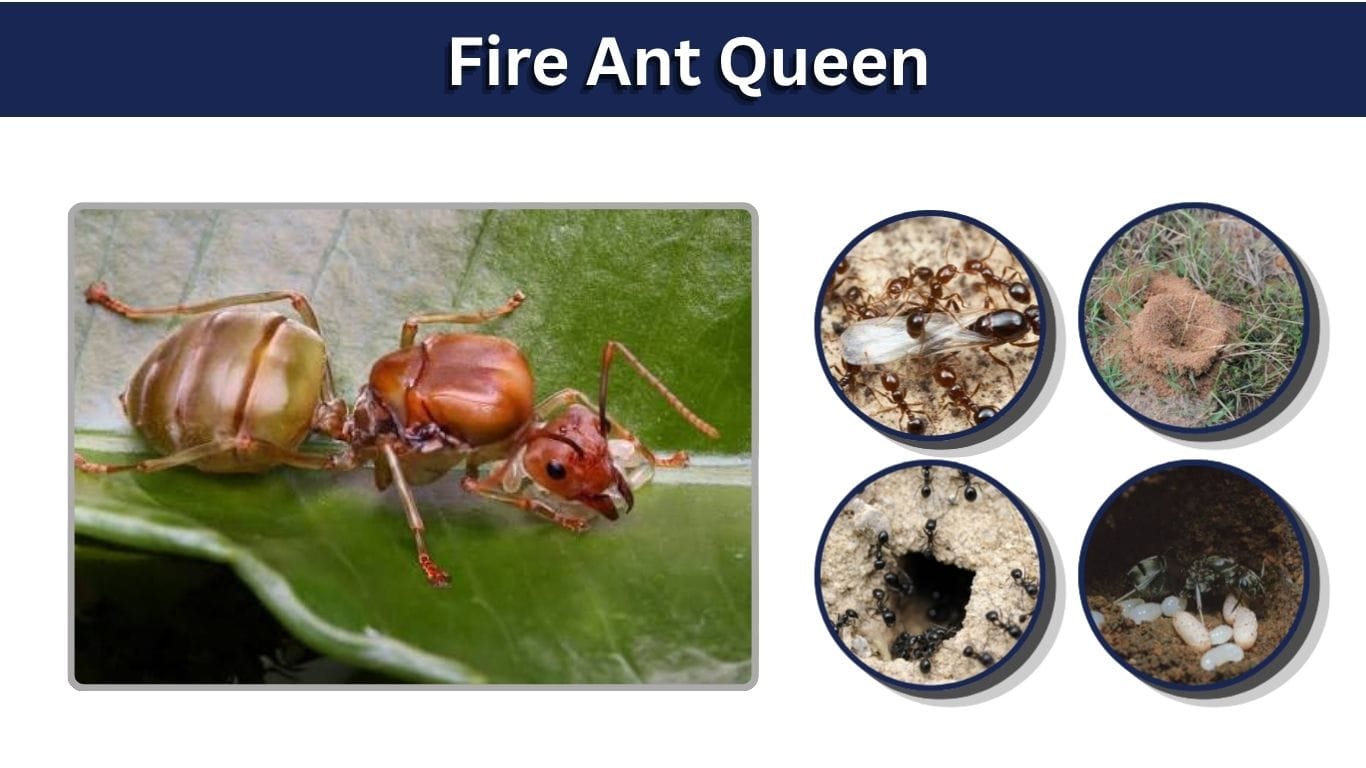
A fire ant queen is the reproductive center of a fire ant colony. In the red imported fire ant (Solenopsis invicta), a mature queen can produce hundreds of eggs each day and survive for years while workers feed, protect, and move her within the underground nest. Young queens initially have wings and leave their birth colonies on mating flights. After mating, they land, shed their wings, dig small chambers, and begin new colonies. Identifying the queen is relatively easy because she is much larger and heavier-bodied than ordinary worker ants.
What Is a Fire Ant Queen?
A fire ant queen is a reproductive female whose main role is producing eggs.
This article primarily refers to the red imported fire ant (Solenopsis invicta), the invasive fire ant common across much of the southern United States.
A colony contains several castes:
- Queen or queens
- Sterile female workers
- Winged reproductive females
- Winged males
- Eggs
- Larvae
- Pupae
Workers handle nearly everything except reproduction. They forage, maintain tunnels, defend the mound, care for brood, and feed the queen.
| Feature | Fire Ant Queen |
| Species discussed | Solenopsis invicta |
| Size | About 10 mm after mating |
| Color | Reddish-brown with darker abdomen |
| Wings | Present before mating; usually shed afterward |
| Primary function | Egg production |
| Eggs per day | Up to roughly 800–1,000 |
| Lifespan | Several years |
| Nest location | Protected underground chambers |
What Does a Fire Ant Queen Look Like?
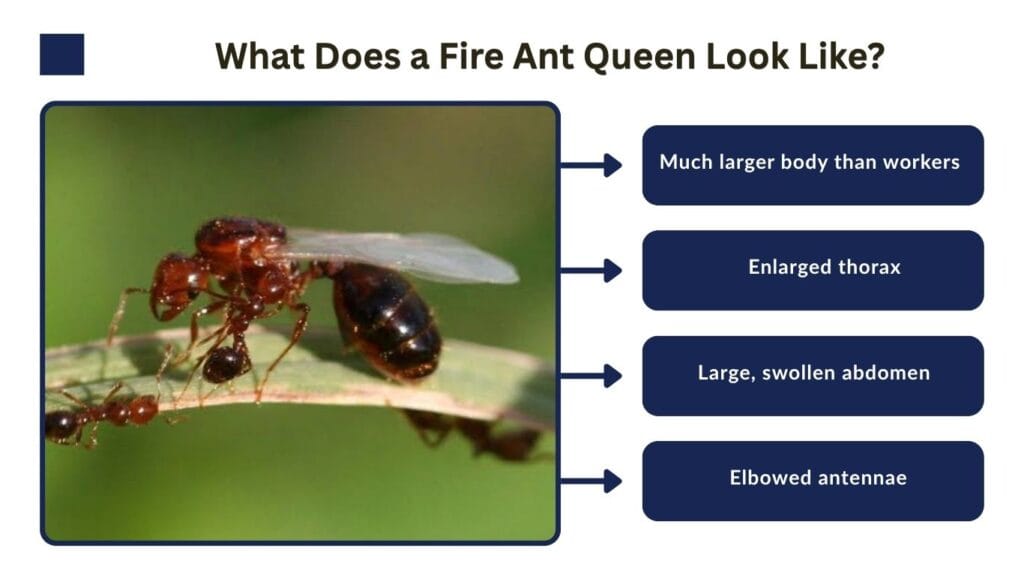
A queen is considerably larger than the workers surrounding her.
A newly mated red imported fire ant queen measures about 3/8 inch, or 10 mm, according to UF/IFAS.
Fire Ant Queen Identification
Look for:
- Much larger body than workers
- Enlarged thorax
- Large, swollen abdomen
- Reddish-brown body
- Darker abdomen
- Elbowed antennae
- Narrow ant-like waist
- Wings or visible wing scars
The enlarged thorax is especially helpful because reproductive females need powerful flight muscles for their mating flight.
After a queen removes her wings, small scars remain where the wings were attached.
Fire Ant Queen vs. Worker
Fire ant workers are much smaller and vary noticeably in size.
USDA reports imported fire ant workers at roughly 1/8 to 1/4 inch long, whereas a newly mated queen can reach around 3/8 inch.
| Feature | Queen | Worker |
| Size | Around 10 mm | About 3–6 mm |
| Abdomen | Large and swollen | Smaller |
| Thorax | Broad and heavy | Relatively narrow |
| Wings | Before mating | Never |
| Reproduction | Lays eggs | Sterile |
| Main job | Reproduction | Foraging, defense, brood care |
Workers may surround a queen continuously, feeding and grooming her.
Do Queen Fire Ants Have Wings?
Young reproductive queens have wings.
They remain in their parent colony until conditions are suitable for a mating flight.
Fire ant mating flights occur particularly often during spring and fall, usually following warm rainy weather. Winged males and females leave their colonies and mate in flight.
What Happens After Mating?
After mating, a female:
- Lands on the ground.
- Searches for a suitable location.
- Sheds her wings.
- Excavates a small chamber.
- Seals herself inside.
- Begins laying eggs.
The male dies shortly after mating.
A wingless queen found underground therefore usually has already completed her mating flight.
How Does a Fire Ant Queen Start a Colony?
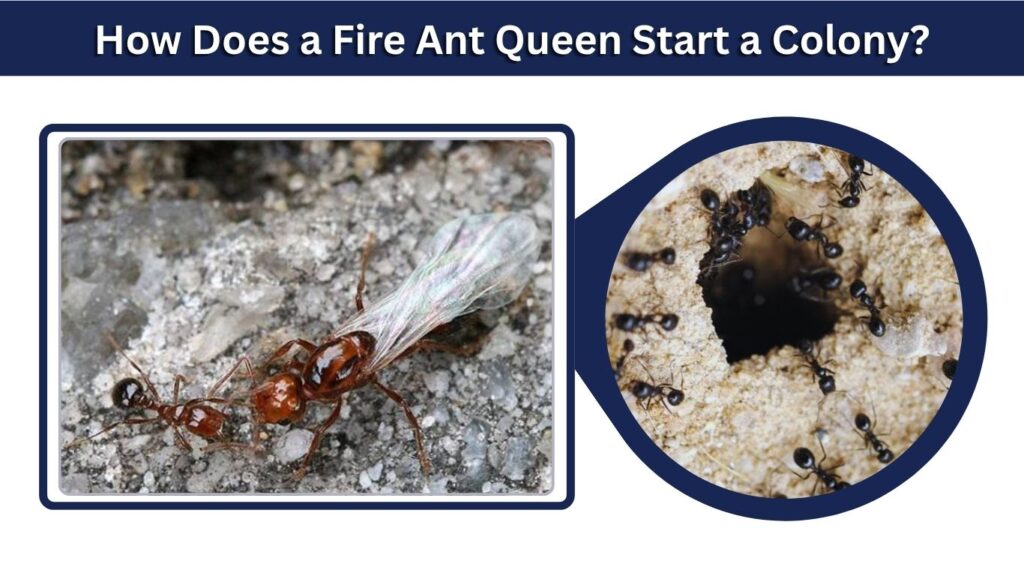
A newly fertilized queen can begin without workers.
USDA describes newly mated imported fire ant queens excavating a simple tunnel roughly 1–4 inches deep and sealing themselves inside. The first batch contains about 10–25 eggs.
Texas A&M similarly reports that a new queen typically begins with roughly a dozen eggs.
During this founding period, she relies on stored body reserves to support herself and her developing offspring.
First Workers
The first workers are unusually small and are sometimes called minims.
Once they emerge, they begin:
- Searching for food
- Feeding the queen
- Feeding larvae
- Expanding the nest
- Defending the colony
The queen can then concentrate almost entirely on producing eggs.
How Many Eggs Does a Fire Ant Queen Lay?
Once a colony is established and workers supply her with food, egg production increases dramatically.
Texas A&M reports that a well-fed queen can produce up to about 800 eggs per day, while UF/IFAS gives approximately 800–1,000 eggs per day under favorable conditions.
The first batch is much smaller because the founding queen has no workers to support her.
Fire ants develop through:
Egg → Larva → Pupa → Adult
Eggs may hatch in approximately 7–10 days. Larvae then develop for about 6–10 days, followed by a pupal period before adults emerge.
How Long Does a Fire Ant Queen Live?
A fire ant queen lives dramatically longer than an ordinary worker.
UF/IFAS reports queen lifespans of approximately 2–6 years, while Texas A&M notes that some queens can survive seven years or longer.
Workers generally survive for only weeks to several months depending on their size and environmental conditions.
The queen’s long lifespan helps a successful colony persist and grow for years.
Does Every Fire Ant Mound Have One Queen?
Not necessarily.
Red imported fire ants occur in two major social forms.
Single-Queen Colonies
Known as monogyne colonies, these contain one reproductive queen.
Workers strongly defend their territory against ants from neighboring colonies.
Multiple-Queen Colonies
Known as polygyne colonies, these can contain many reproductive queens.
Texas A&M reports that some colonies may contain dozens or even hundreds of queens, and workers may move freely between related mounds.
Multiple-queen populations can consequently develop extremely high mound densities.
Where Is the Fire Ant Queen Inside the Mound?
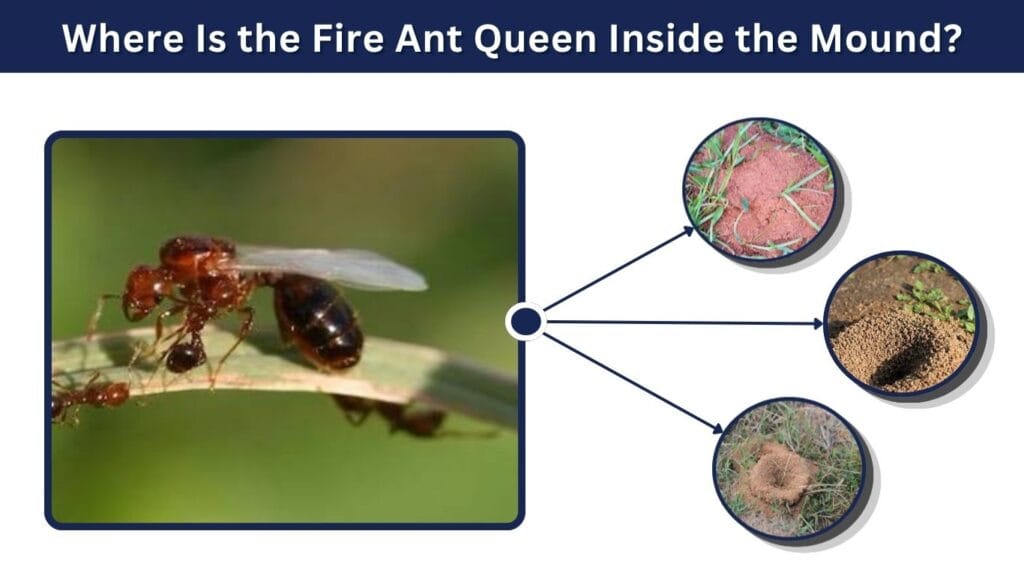
There is no single fixed depth where a queen will always be found.
Fire ant nests consist of complex underground chambers and tunnels.
Workers move queens and brood when:
- Temperature changes
- Soil becomes too dry
- Flooding occurs
- The colony is disturbed
- Conditions elsewhere in the mound are better
Texas A&M reports that mature fire ant nest galleries can extend as much as about 1.2 meters underground, although that does not mean the queen always sits at the deepest point.
Trying to dig directly to a queen is therefore unreliable and can provoke hundreds of workers.
Does a Fire Ant Queen Bite or Sting?
Fire ant queens possess the anatomical structures associated with stinging, but they spend almost all their mature lives protected underground.
For people, worker fire ants are overwhelmingly the important sting risk.
Workers first grip skin with their mandibles and then sting, sometimes repeatedly. Disturbing a mound can cause hundreds of workers to rush upward and attack.
Finding or handling a queen is therefore unnecessary and potentially exposes you to the much larger worker population surrounding her.
How Fire Ant Workers Protect the Queen
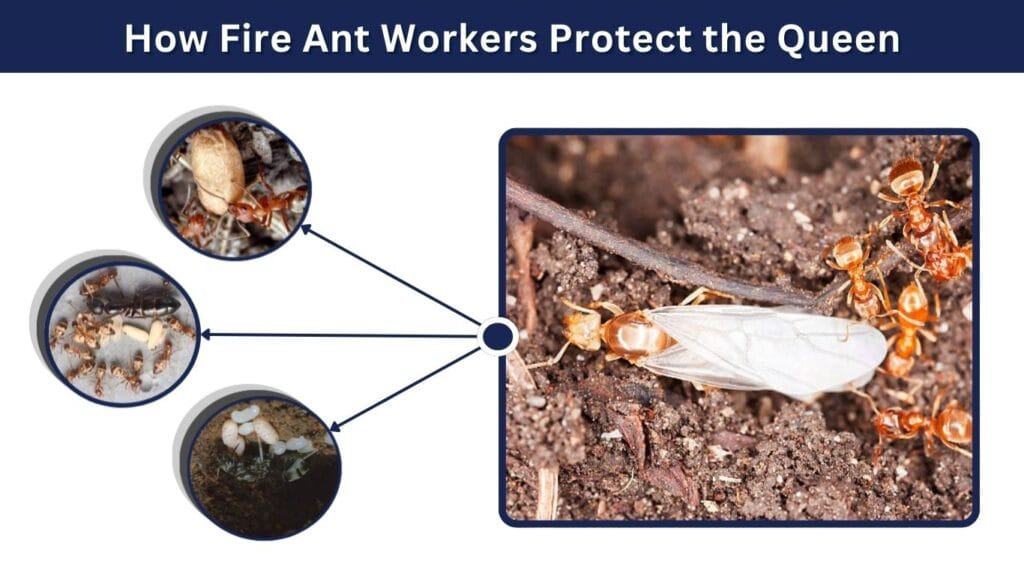
The queen is extremely well protected.
Workers:
- Feed her
- Groom her
- Carry her away from danger
- Defend surrounding chambers
- Tend her eggs
- Maintain proper nest conditions
Texas A&M notes that workers even feed the queen food that workers have consumed first.
This protective system helps explain why simply killing visible workers rarely eliminates an established colony.
Do Fire Ant Baits Reach the Queen?
Properly labeled fire ant baits are designed to exploit worker feeding behavior.
Foraging workers collect bait and return it to the colony, where the active ingredient can eventually affect the queen or colony reproduction. Texas A&M notes that workers share bait within the colony and that successful bait treatments can kill the queen or cause infertility, depending on the product.
Slow action is important because a product that kills workers too quickly may prevent them from transferring it through the colony.
Always use a product specifically labeled for fire ants and follow its directions.
Fire Ant Queen Pheromones
Chemical communication is essential inside a fire ant colony.
Queens produce chemical signals that help workers recognize and tend them. Research on Solenopsis invicta has shown that queen-produced chemicals also influence the reproductive development and behavior of other female reproductives.
These signals help maintain the social organization of the colony.
Can You See a Fire Ant Queen Above Ground?
Usually not.
A mature egg-laying queen normally remains deep inside the protected colony.
You are more likely to see a queen when:
- Winged reproductives are swarming
- A newly mated queen has landed
- A colony has been disturbed
- A colony is relocating
A large winged fire ant seen after warm rain may therefore be a reproductive female preparing to start a colony.
Interesting Fire Ant Queen Facts
- A newly mated queen is about 10 mm long.
- Young queens have wings.
- Queens usually shed their wings after mating.
- A new queen initially lays only about a dozen eggs.
- Established queens can produce hundreds of eggs daily.
- Queens can live for several years.
- Some colonies contain only one queen.
- Other colonies may contain many queens.
- Workers feed and protect the queen.
- The queen normally remains underground.
- Killing visible workers alone does not necessarily eliminate a colony.
- New colonies can begin with just one fertilized queen.
FAQs
1. What does a fire ant queen look like?
A fire ant queen is significantly larger than worker ants, with a broad thorax and enlarged abdomen. Young reproductive females have wings, while established queens usually have wing scars after shedding their wings following mating.
2. How big is a fire ant queen?
A newly mated red imported fire ant queen is approximately 10 mm, or 3/8 inch long. She is noticeably larger and heavier-bodied than workers, which generally measure about 1/8 to 1/4 inch.
3. How long does a fire ant queen live?
Queens can survive for several years. UF/IFAS reports approximately two to six years, while Texas A&M notes that queens can sometimes live seven years or more under favorable conditions.
4. How many eggs can a fire ant queen lay?
A mature queen supported by workers may produce roughly 800 or more eggs per day under favorable conditions. A newly mated queen begins much more slowly, initially producing only around a dozen eggs.
5. How deep is the fire ant queen underground?
There is no fixed queen depth. New queens initially construct shallow founding chambers, but mature colonies contain extensive tunnel networks. Workers can move the queen deeper or shallower depending on temperature, moisture, disturbance, and other environmental conditions.