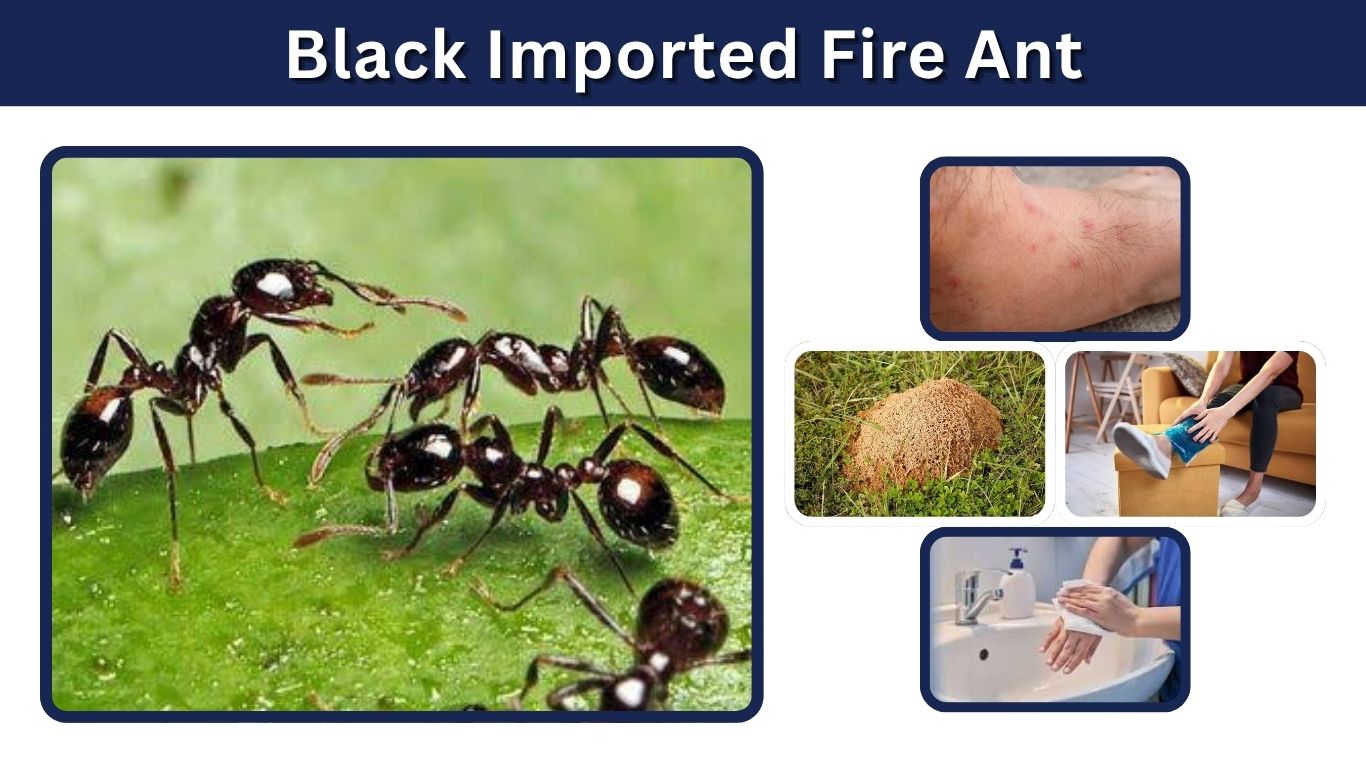
The black imported fire ant is an invasive, mound-building ant known for aggressively defending its nest. Scientifically named Solenopsis richteri, it is closely related to the better-known red imported fire ant. Workers are generally dark brown or black, but color alone cannot reliably identify them because hybrids and other fire ants can look similar. When their colony is disturbed, workers swarm rapidly, bite to grip the skin, and deliver repeated venomous stings that cause burning pain, itching, and small pustules.
What Is a Black Imported Fire Ant?
The black imported fire ant belongs to the family Formicidae and the genus Solenopsis. It is native to South America and was accidentally introduced near Mobile, Alabama, during the early 1900s. It arrived before the red imported fire ant, which was introduced through the same port several decades later.
| Classification | Details |
| Scientific name | Solenopsis richteri |
| Common name | Black imported fire ant |
| Order | Hymenoptera |
| Family | Formicidae |
| Native region | South America |
| Introduced range | Southeastern United States |
| Main defense | Venomous sting |
| Typical habitat | Lawns, fields, pastures, and roadsides |
The red imported fire ant gradually displaced the black species from much of its former US range. However, populations of S. richteri remain near the cooler northern edge of imported fire ant territory, particularly in northern Mississippi, northwestern Alabama, and southern Tennessee.
Black Imported Fire Ant Identification
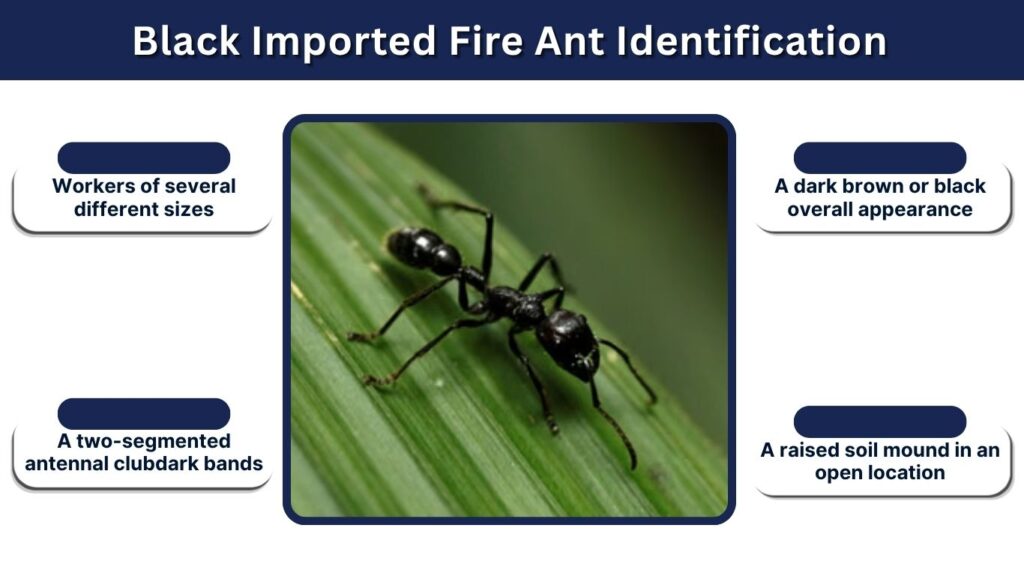
Black imported fire ant workers vary in size, generally measuring about ⅛ to ¼ inch long. They have two nodes between the thorax and abdomen, elbowed antennae, and a two-segmented antennal club. Their bodies are usually dark reddish brown, brownish black, or nearly black.
Key Identification Features
Look for the following characteristics:
- Workers of several different sizes
- A dark brown or black overall appearance
- A darker abdomen and antennal scapes
- Two nodes between the thorax and abdomen
- A two-segmented antennal club
- Aggressive swarming when the nest is disturbed
- A raised soil mound in an open location
Color is not enough for a definite identification. Black and red imported fire ants interbreed and produce fertile hybrids. These hybrids may look almost identical to black imported fire ants, and specialists sometimes use chemical analysis to distinguish them accurately.
Black Imported Fire Ant Nest
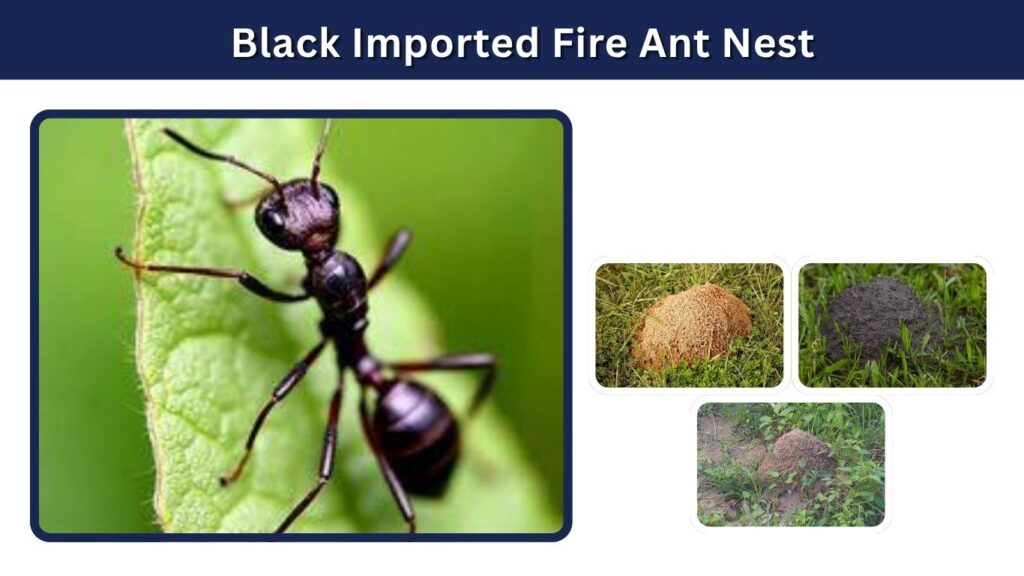
Black imported fire ants build large soil mounds in open, sunny, and disturbed environments. Common nesting locations include lawns, parks, pastures, hayfields, roadsides, sports fields, gardens, and agricultural land.
A mature nest may appear as a dome-shaped mound without an obvious entrance hole at the center. Workers enter through underground tunnels extending away from the mound. Imported fire ant mounds can become large enough to interfere with mowing, cultivation, and harvesting equipment.
Signs of an Active Nest
An active colony may show:
- Fresh, loose soil forming a raised mound
- No clear central entrance
- Numerous ants emerging after disturbance
- Underground trails around the colony
- White eggs, larvae, or pupae exposed after damage
- Increased activity during warm, mild conditions
Do not kick, step on, or open a suspected mound. Hundreds of workers may emerge quickly, climb vertical surfaces, and sting repeatedly.
Do Black Imported Fire Ants Bite?
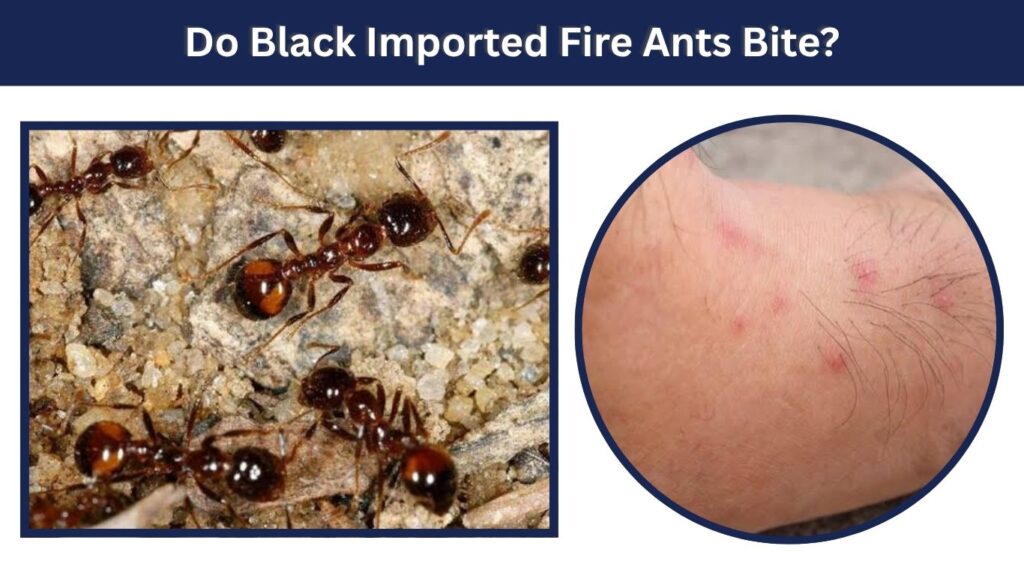
Black imported fire ants both bite and sting, but the sting causes most of the pain and skin reaction.
A worker first uses its mandibles to grip the skin. While holding on, it bends its abdomen forward and injects venom through a stinger. It may rotate around the bite point and sting several times before being removed. One disturbed colony can therefore produce numerous stings within seconds.
Black Imported Fire Ant Sting Symptoms
Common symptoms include:
- Immediate burning or stinging pain
- Localized redness or discoloration
- Itching and swelling
- A raised welt
- A small white, fluid-filled pustule
- Tenderness around the affected area
The white pustule often develops after the initial burning sensation. Avoid scratching or opening it because damaged skin can become infected.
How to Treat Black Imported Fire Ant Stings

Move away from the nest immediately and brush the ants from your skin. Fire ants grip tightly, so shaking the affected limb may not remove all of them.
For a mild reaction:
- Wash the area with soap and water.
- Apply a cold compress for 10–20 minutes.
- Avoid scratching or breaking any pustules.
- Ask a pharmacist about suitable treatment for pain or itching.
- Monitor the area for signs of infection or a worsening reaction.
Most local insect-sting reactions can be managed with basic first aid, but fire ant venom can cause a severe allergic response in susceptible people.
Seek emergency medical help for difficulty breathing, throat tightness, facial or tongue swelling, widespread hives, dizziness, fainting, vomiting, or other symptoms affecting areas beyond the sting site. These may indicate anaphylaxis.
Black Imported Fire Ant vs. Red Imported Fire Ant
Black and red imported fire ants have similar colony behavior, mound construction, life cycles, and stinging habits. The most noticeable difference is usually body color, although this is not completely reliable.
| Feature | Black Imported Fire Ant | Red Imported Fire Ant |
| Scientific name | Solenopsis richteri | Solenopsis invicta |
| General color | Dark brown to black | Reddish brown with darker abdomen |
| US introduction | Early 1900s | 1930s or early 1940s |
| Climate preference | Better adapted to cooler areas | More tropical or subtropical |
| Current US range | Comparatively restricted | Much more widespread |
| Sting | Painful and venomous | Painful and venomous |
| Hybridization | Hybridizes with red fire ants | Hybridizes with black fire ants |
The red imported fire ant occupies a much larger area and is generally considered the more widespread pest. The black species persists mainly along the northern portion of the imported fire ant range, while a broad hybrid zone occurs where the two meet.
Are Black Imported Fire Ants in Oklahoma?
Imported fire ants are established in quarantined parts of Oklahoma. In 2024, USDA APHIS expanded the federal quarantine to include all of Haskell County after confirming that imported fire ants were established there.
However, the federal imported fire ant designation covers S. invicta, S. richteri, and their hybrids. It does not mean every Oklahoma colony is a pure black imported fire ant colony. Because the species and hybrids can be difficult to separate visually, samples should be identified by a local extension office or regulatory agency.
Do Black Widow Spiders Eat Imported Fire Ants?
Southern black widow spiders have been observed capturing red imported fire ants in cotton fields, where the ants formed a substantial part of their recorded prey. However, this evidence specifically concerns red imported fire ants, not confirmed black imported fire ants. It should not be assumed that black widows provide dependable control of S. richteri colonies.
FAQs
Are black imported fire ants dangerous?
They can be dangerous when their nest is disturbed. Workers attack in large numbers and sting repeatedly. Most people experience localized burning, itching, and pustules, but susceptible individuals may develop a serious allergic reaction requiring emergency treatment.
What is the scientific name of the black imported fire ant?
Its scientific name is Solenopsis richteri. It is closely related to the red imported fire ant, Solenopsis invicta. The two species can interbreed and produce fertile hybrids that may be difficult to identify visually.
Where do black imported fire ants live?
They favor sunny, disturbed environments such as lawns, fields, parks, roadsides, pastures, and agricultural land. In the United States, pure populations are concentrated mainly in northern Mississippi, northwestern Alabama, and southern Tennessee.
How can you distinguish black and red imported fire ants?
Black imported fire ants are generally darker, while red imported fire ants have reddish-brown heads and thoraxes with darker abdomens. However, body color varies, and hybrids share features of both species. Laboratory testing may be needed for reliable confirmation.
What should you do after finding a black imported fire ant nest?
Keep children and pets away, avoid disturbing the mound, and contact a local extension office or licensed pest-control professional when identification or treatment is needed. Use only products labeled for imported fire ants and the specific treatment site.