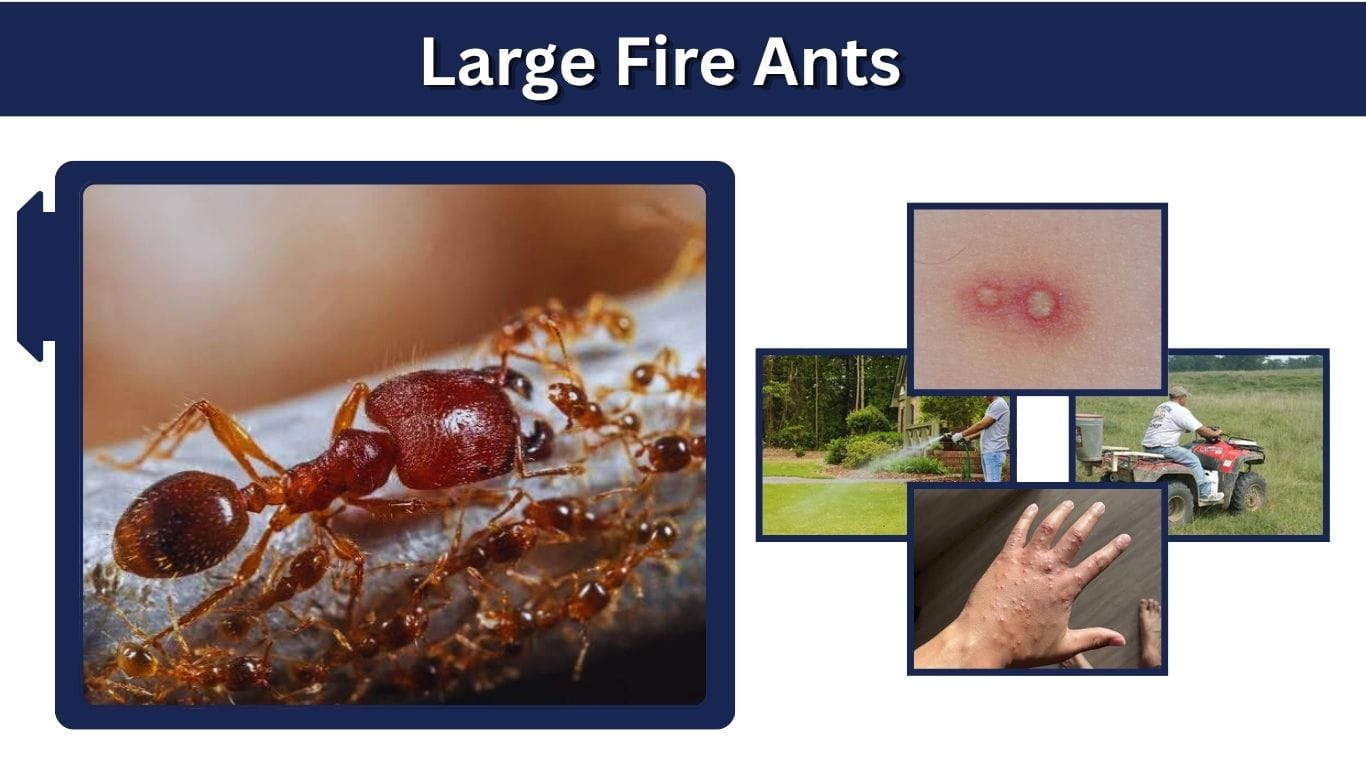
Large fire ants are usually not a separate species. The phrase often describes the biggest workers in an imported fire ant colony, winged reproductive ants, queens, or unusually large red ants found near a mound. Imported fire ants vary noticeably in size and defend their nests aggressively, delivering painful stings that can produce burning, swelling, and pus-filled blisters. This guide explains how large fire ants look, how big their colonies become, how to treat stings, and the most effective ways to control them across large yards or acreage.
How Large Are Fire Ants?
Imported fire ant workers are small, despite sometimes being described as “large.” Depending on the species and colony, workers generally measure approximately 1/12 to 3/16 inch long. Larger workers have broader heads and heavier bodies than smaller workers from the same nest.
| Colony member | General appearance |
| Minor worker | Very small, narrow-bodied worker |
| Medium worker | Intermediate-sized worker |
| Major worker | Larger head and heavier body |
| Winged male | Darker, larger and equipped with wings |
| Winged female | Larger than workers and initially winged |
| Queen | Largest colony member with an enlarged abdomen |
Worker size varies considerably within a single imported fire ant colony. All workers are female, and both small and large workers are capable of stinging. Reproductive males, females, and queens are larger than ordinary workers.
Are Large Red Ants Always Fire Ants?
No. Several red, reddish-brown, or two-toned ant species can be mistaken for fire ants. Carpenter ants, red wood ants, field ants, and Allegheny mound ants may be larger than imported fire ants.
Imported fire ants commonly have:
- Workers of several different sizes in one colony
- Reddish-brown bodies with darker abdomens
- Two nodes between the thorax and abdomen
- Ten-segmented antennae ending in a two-segmented club
- Aggressive swarming when their mound is disturbed
- A painful, burning sting
Identification should not be based on color or size alone. The presence of differently sized workers and aggressive mound defense provides stronger evidence.
Are Black Fire Ants Larger Than Red Fire Ants?
Black imported fire ants and red imported fire ants overlap in size. One species is not consistently much larger than the other, and individual worker size varies within every colony.
Black imported fire ants, red imported fire ants, and their hybrids occur in parts of the southern United States. Positive identification may require an extension specialist or pest-management professional because color and size are not always reliable.
How Large Is a Fire Ant Mound?
Fire ant mound size reflects factors such as colony age, population, soil, moisture, temperature, and mowing or disturbance. A young colony may produce only a small patch of loose soil, while an established colony may create a conspicuous dome-shaped mound.
A large mound can contain more than 200,000 workers, and every worker is capable of delivering repeated stings. The visible mound represents only the upper part of a much larger underground nest.
Unlike many other ant nests, an imported fire ant mound may have no obvious opening at the top. Workers enter and leave through underground tunnels that surface away from the mound.
Never kick, step on, dig into, or stand over a suspected fire ant mound. Disturbance can cause thousands of ants to rush upward and climb onto nearby people or animals.
Best Fire Ant Control for Large Yards
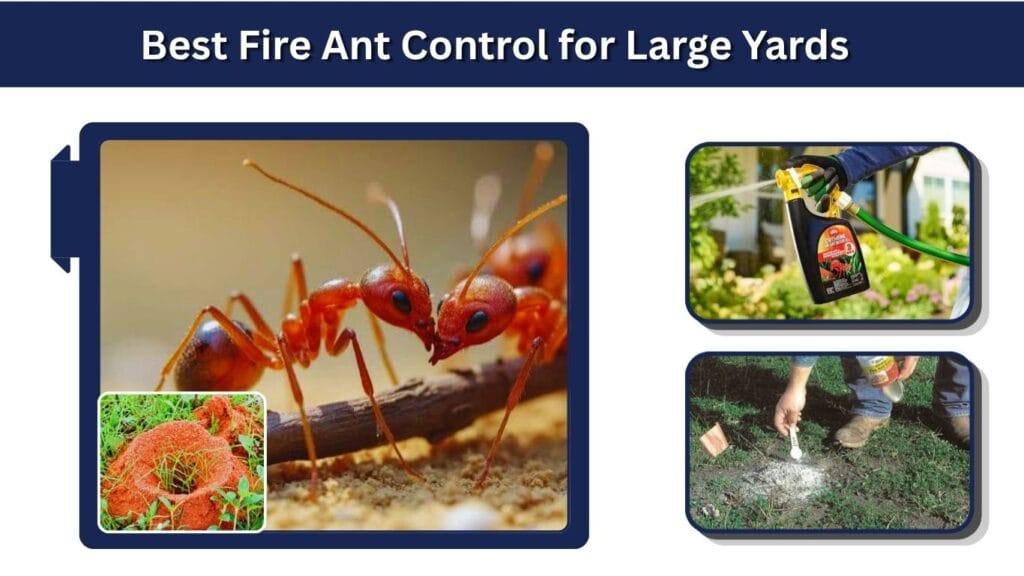
The most practical strategy for a heavily infested lawn is usually the two-step method:
- Broadcast a slow-acting fire ant bait over the entire infested area.
- Treat remaining problem mounds individually after the ants have collected the bait.
Broadcast bait reaches colonies that are too small, flat, or hidden to locate individually. Spot treatment then provides faster control around playgrounds, paths, doors, kennels, gardens, and other sensitive locations.
Step 1: Broadcast Fire Ant Bait
Choose a fire ant bait whose label permits broadcast application to the intended site. Apply it evenly at the label rate rather than placing large piles directly on mounds.
Workers collect the granules and distribute the active ingredient through the colony. Most fire ant baits are applied at surprisingly low rates—often roughly one to 1.5 pounds per acre—so overapplication wastes bait and may prevent effective collection.
For the best results:
- Apply when the ground and grass are dry.
- Do not apply immediately before expected rain.
- Treat when ants are actively foraging.
- Use fresh bait that has been stored properly.
- Follow the label rate exactly.
- Keep people and pets away as required by the label.
- Do not mix bait with fertilizer unless specifically permitted.
Place a plain, oily potato chip in the area before treatment. If fire ants find it within approximately 30 minutes, they are likely actively foraging and able to collect bait.
Step 2: Treat Remaining Mounds
Wait several days after broadcasting bait before treating individual mounds. Treating them immediately may kill foragers before they carry the bait into the colony.
Approved mound-treatment options may include:
- Dry mound powders
- Granular mound treatments
- Liquid drenches
- Individual-mound bait
- Labelled contact insecticides
Liquid mound treatments require enough solution to reach the colony rather than merely wetting the mound’s surface. Depending on mound size, an effective drench may require one to two gallons of properly mixed solution.
Use only products labelled for the exact location. Products permitted on lawns may not be permitted near vegetables, livestock, ponds, playgrounds, or food-producing plants.
Large-Acreage Fire Ant Control
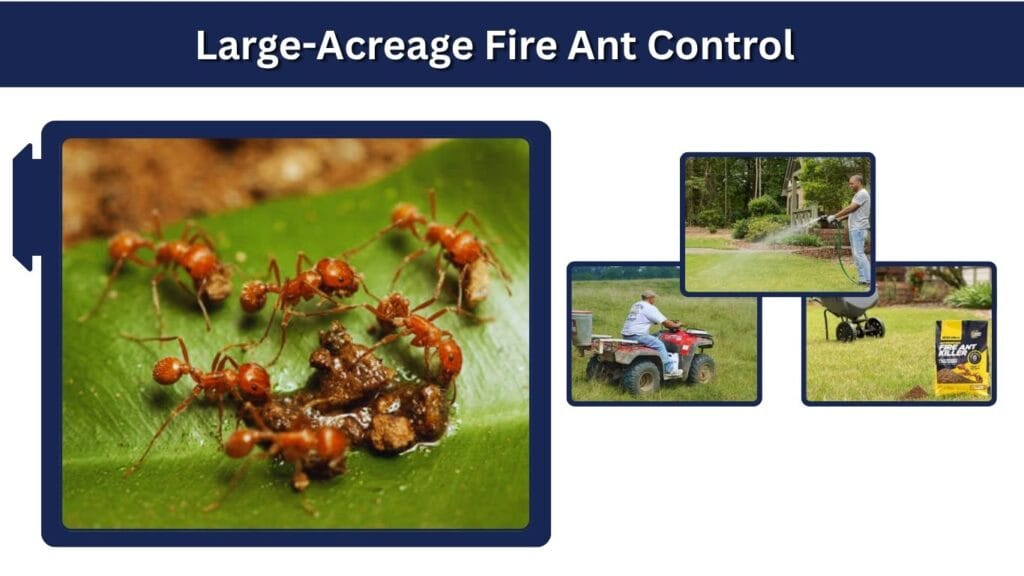
Broadcast bait is generally more practical than individual mound treatment on pastures, hayfields, parks, sports fields, and other large properties. ATV-, tractor-, or mower-mounted spreaders can distribute the very small amount of bait required per acre, provided the equipment is calibrated for that specific product.
Baits work gradually. Significant suppression may take several weeks, and one treatment will not permanently eradicate fire ants. On pastures and similar properties, properly applied bait may produce about 80% control within one or two months. Preventive applications may be needed in spring, midsummer, and fall where labels and local guidance allow.
For large acreage:
- Confirm that fire ants are actively foraging.
- Measure the treatment area accurately.
- Calibrate the spreader before application.
- Use only bait labelled for the property type.
- Observe grazing, harvest, and animal restrictions.
- Keep written application records.
- Reinspect after the expected control period.
- Spot-treat dangerous mounds in high-traffic areas.
A licensed applicator or local extension office should be consulted for farms, schools, public areas, environmentally sensitive sites, and properties crossing state quarantine boundaries.
Methods You Should Avoid
Do not use gasoline, diesel, bleach, motor oil, or other household chemicals on fire ant mounds. These substances can damage soil and plants, contaminate water, create fire hazards, and expose people or animals to toxic chemicals.
Flour, cornmeal, and ordinary household foods do not reliably eliminate colonies. Burning ants with a magnifying or Fresnel lens creates a serious fire and injury risk while leaving most of the underground colony unaffected.
Boiling water can cause severe burns and may damage surrounding vegetation. Even when it reduces activity, surviving ants can relocate or form satellite mounds.
Large Fire Ant Bites and Blisters
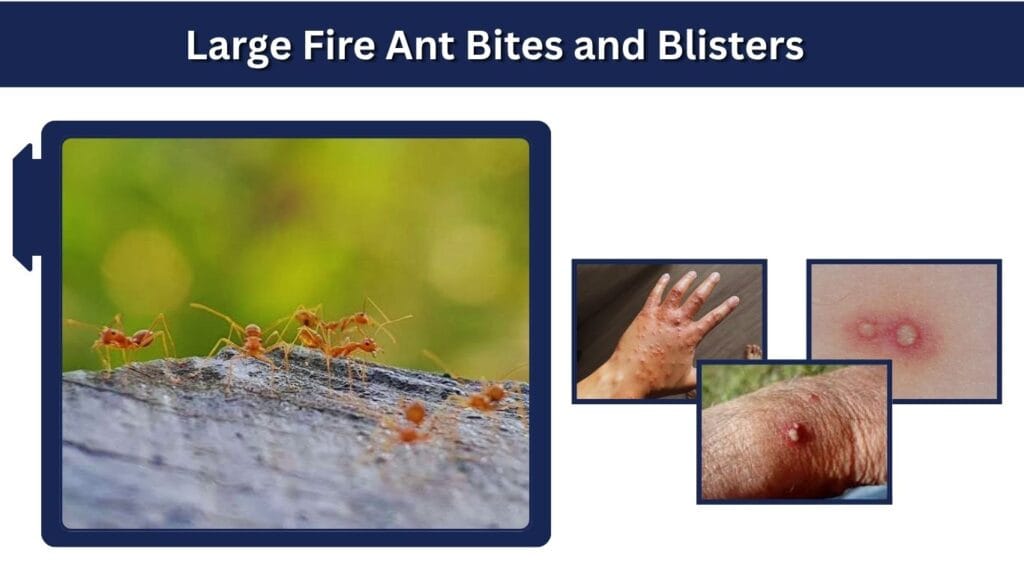
Fire ants first grip the skin with their jaws and then sting, often rotating and stinging more than once. The initial burning sensation may be followed by redness, itching, swelling, and a white pustule or blister.
A large local reaction can cause swelling extending well beyond the sting site. The affected area may remain painful or itchy for several days.
How to Treat a Large Fire Ant Blister
For a mild or moderate reaction:
- Move away from the mound and brush off all ants.
- Wash the area gently with soap and water.
- Apply wrapped ice for about 10 minutes, remove it for 10 minutes, and repeat as needed.
- Elevate the affected arm or leg when swelling is substantial.
- Avoid scratching or breaking the blister.
- Ask a pharmacist about an appropriate antihistamine or anti-itch treatment.
Do not deliberately pop the white pustule. Opening it increases the risk of infection.
Seek medical care for spreading redness, worsening pain, warmth, pus, fever, extensive swelling, or a reaction affecting the face or eyes. Call emergency services for trouble breathing, throat tightness, facial or tongue swelling, severe dizziness, confusion, or fainting. Severe allergic reactions require immediate treatment.
FAQs
What is the best fire ant killer for a large area?
A broadcast fire ant bait labelled for the treatment site is usually the most efficient option. Follow it with individual treatment of surviving nuisance mounds. The best product depends on the property type, local regulations, desired speed, and restrictions involving pets, livestock, gardens, or water.
How often should a large yard be treated?
Treatment frequency depends on the product and local fire ant pressure. Some properties need seasonal broadcast applications followed by year-round spot treatment. Never apply more frequently than the label permits, even when new mounds appear soon after treatment.
Why did a fire ant sting cause a large blister?
Fire ant venom commonly causes a small sterile pustule. A much larger blister or extensive swelling may represent a strong local reaction. Keep it clean and intact, and obtain medical advice when swelling continues expanding, pain worsens, or infection develops.
Can one large mound contain multiple queens?
Some imported fire ant colonies have one queen, while others have multiple queens. Multiple-queen colonies may form dense networks of connected nests with less obvious mound boundaries, making whole-area baiting more practical than treating only visible mounds.
Can fire ants enter a kitchen?
Yes. Indoor fire ant activity usually originates from an outdoor colony near the foundation. Remove accessible food, clean spills, inspect exterior walls, and treat the outdoor infestation. Avoid placing outdoor pesticides inside unless the label specifically permits indoor use.