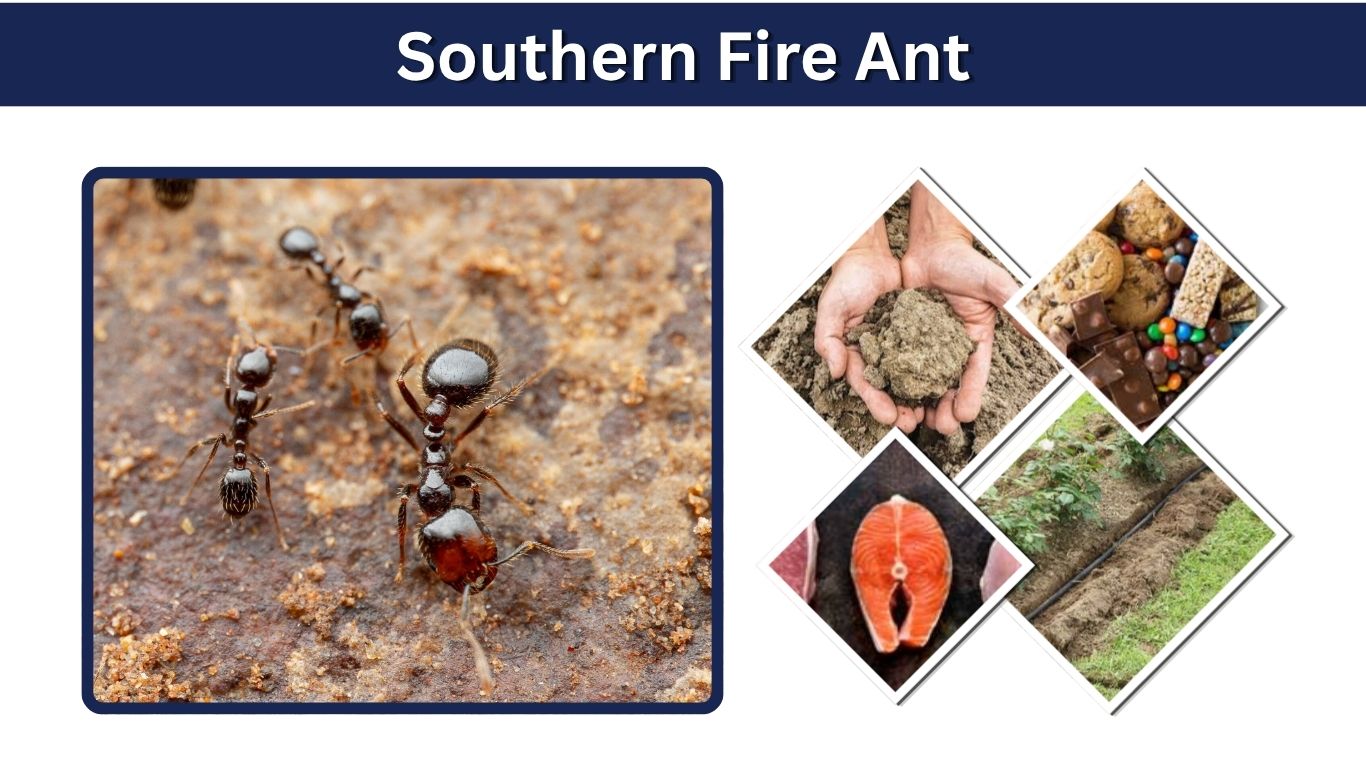
The southern fire ant (Solenopsis xyloni) is a native North American ant found in warm, dry regions, particularly across parts of California, Arizona, and the southwestern United States. It has reddish-brown front body sections, a darker abdomen, workers of several sizes, and a painful defensive sting. Southern fire ants commonly nest in lawns, orchards, gardens, bare soil, and irrigated landscapes. Although they resemble imported fire ants, their nest structure, colour, behaviour, and microscopic features can help separate the two species.
What Is a Southern Fire Ant?
The southern fire ant belongs to the family Formicidae and the genus Solenopsis. It is sometimes called the native fire ant or California fire ant.
Unlike the invasive red imported fire ant, the southern fire ant is native to parts of North America. It can become troublesome around homes and agricultural land, but it also acts as a predator of other insects.
Southern Fire Ant Classification
| Classification | Name |
| Kingdom | Animalia |
| Phylum | Arthropoda |
| Class | Insecta |
| Order | Hymenoptera |
| Family | Formicidae |
| Genus | Solenopsis |
| Scientific name | Solenopsis xyloni |
Southern Fire Ant Identification
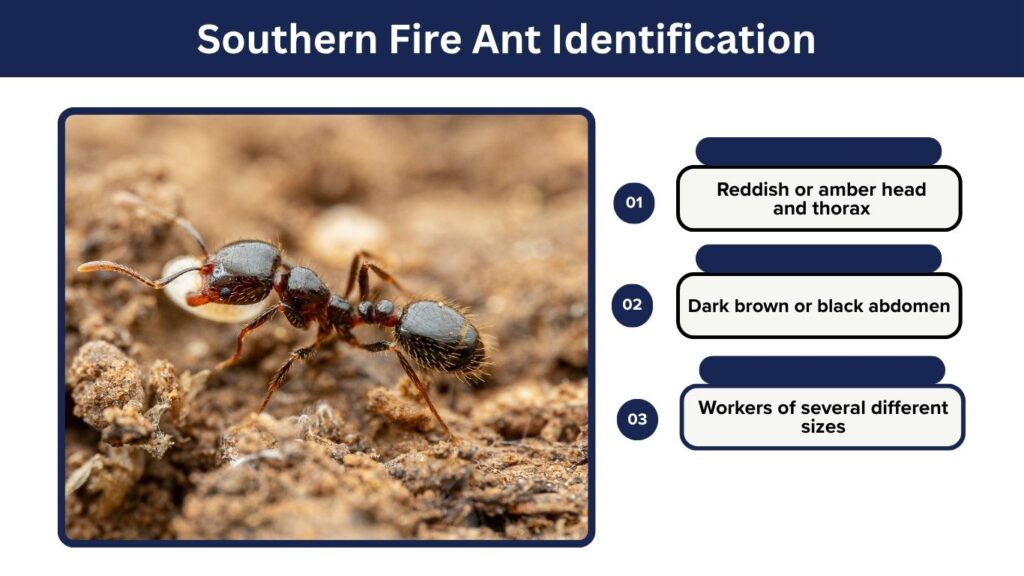
Southern fire ants are small, reddish ants with workers that vary noticeably in size. This variation within one colony is known as polymorphism.
Size and Colour
Southern fire ant workers are generally around 2–6 mm long. Their head and thorax are usually amber, reddish brown, or light brown, while the abdomen is much darker and may appear almost black. Workers of different sizes can be seen together around the same nest.
Important identification features include:
- Reddish or amber head and thorax
- Dark brown or black abdomen
- Workers of several different sizes
- Two nodes between the thorax and abdomen
- A two-segmented club at the end of each antenna
- Strong swarming behaviour when the nest is disturbed
- Ability to bite and sting repeatedly
Definitive separation from imported fire ants may require microscopic examination. The southern fire ant has two lateral clypeal teeth, while the red imported fire ant has three.
Southern Fire Ant Queen
The queen is considerably larger than the workers and is responsible for laying eggs. A mature colony may contain thousands of workers that feed the queen, care for the young, defend the nest, and gather food.
Winged queens and males leave established colonies for mating flights. After mating, a queen sheds her wings, finds a protected location, and begins producing a new colony.
Southern Fire Ant Mounds and Holes
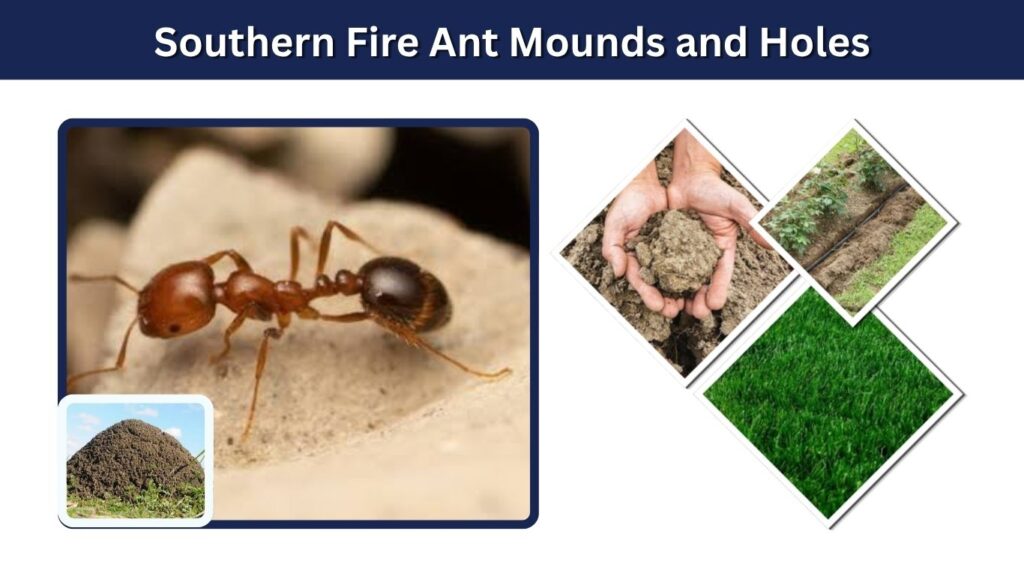
Southern fire ants do not always create the large, dome-shaped mounds commonly associated with imported fire ants. Their nests may look like patches of disturbed soil with several small, difficult-to-see entrances.
In California, nests can resemble small craters with central holes. A colony may produce several crater-like entrances across the same area. In Arizona, nests are often found in sunny bare soil near moisture, and the disturbed soil may be barely noticeable.
Common nesting locations include:
- Lawns and turf edges
- Bare or compacted soil
- Irrigated gardens
- Beneath stones and landscaping materials
- Around sidewalks and foundations
- Orchards and agricultural fields
- Potted plants and nursery containers
- Areas near leaking irrigation equipment
Southern Fire Ant Habitat and Range
Southern fire ants prefer warm regions and are particularly well documented in California and Arizona. They can tolerate dry environments but often establish nests close to irrigated soil or another moisture source.
They are commonly active in the morning and early evening. Activity may decline during the hottest part of the day, especially in desert climates.
Not every fire ant found in the southern United States is Solenopsis xyloni. Red imported fire ants dominate many southeastern areas, while native southern fire ants are especially important in the Southwest. Location alone is therefore insufficient for identification.
What Do Southern Fire Ants Eat?
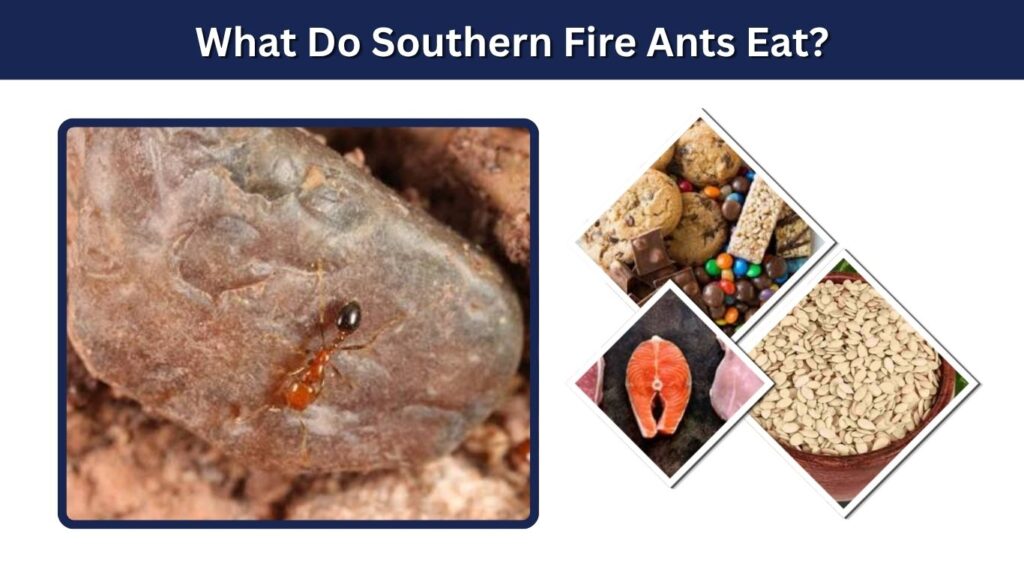
Southern fire ants are opportunistic omnivores. They consume both animal and plant-based food, including:
- Living and dead insects
- Greasy or oily food
- Seeds
- Meat and other proteins
- Sweet food
- Honeydew produced by aphids and scale insects
- Food scraps around homes
Oil-based and protein-containing foods are particularly attractive to them. This feeding preference is why solid grain-and-oil baits are generally more suitable than liquid sugar baits for controlling fire ants.
Southern Fire Ant Life Cycle
Southern fire ants undergo complete metamorphosis through four stages:
- Egg
- Larva
- Pupa
- Adult
The immature stages remain inside the underground nest, where workers feed and protect them. Adult workers are sterile females, while winged males and queens are produced for reproduction.
Colony growth depends on food, moisture, soil conditions, temperature, and the queen’s reproductive success. A colony may expand into several connected entrances rather than creating one obvious mound.
Southern Fire Ant Sting and Bite
Southern fire ants defend their nests aggressively. A worker first bites the skin to anchor itself and then bends its abdomen forward to sting. It may sting more than once before being removed.
What Does the Sting Feel Like?
A southern fire ant sting may cause:
- Immediate burning or sharp pain
- Redness around the sting site
- Localised swelling
- Itching
- A raised bump
- Tenderness lasting several hours or days
The reaction varies between individuals. UC Agriculture and Natural Resources describes the sting as painful and capable of producing visible swelling.
Treating a Southern Fire Ant Sting
Wash the skin with soap and water and apply a cold compress wrapped in cloth. Avoid scratching or breaking any blister because damaged skin may become infected.
Seek urgent medical assistance when a sting causes breathing difficulty, faintness, widespread hives, vomiting, or swelling of the face, lips, tongue, or throat. People with a known severe insect-sting allergy should follow their prescribed emergency plan.
Southern Fire Ant vs Imported Fire Ant
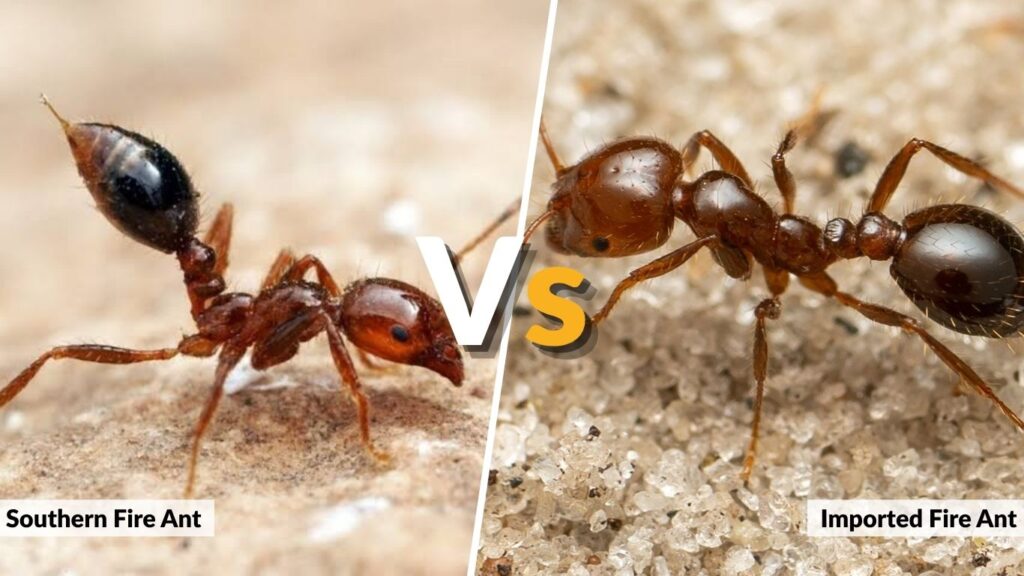
The southern fire ant can easily be confused with the red imported fire ant because both have mixed-size workers and painful stings.
| Feature | Southern fire ant | Red imported fire ant |
| Scientific name | Solenopsis xyloni | Solenopsis invicta |
| Status in the US | Native | Invasive |
| General colour | Red front, dark abdomen | More uniformly reddish brown |
| Nest entrances | Often several small entrances | Usually no visible opening on mound |
| Mound | Irregular, scattered, or crater-like | Often large and dome-shaped |
| Clypeal teeth | Two lateral teeth | Three teeth |
| Aggressiveness | Defensive and capable of swarming | Usually more aggressive in large numbers |
The number of clypeal teeth is one of the most dependable distinctions, but it requires magnification and experience. Suspected imported fire ants outside an established infestation area should be reported to the appropriate state agriculture agency.
Best Southern Fire Ant Treatment for Lawns
The most effective lawn program usually combines baiting, targeted mound treatment, and landscape management. Spraying every visible worker rarely eliminates a colony because the queen and most workers remain underground.
Use an Oil-Based Fire Ant Bait
Fire ant baits contain food that workers collect and carry into the nest. A slow-acting active ingredient can then spread among workers, larvae, and queens.
Apply only a product whose current label permits use against fire ants in the intended location. Baits work best when:
- Ants are actively foraging
- The grass and ground are dry
- Rain is not expected soon
- The temperature is approximately 70–90°F
- Fresh bait is used
- Irrigation is delayed according to the label
A potato chip or another small oily food can be placed near the nest. If ants find it within approximately 30 minutes, they are likely active enough to collect bait.
Treat Individual Mounds Carefully
For a small number of nests, use a mound treatment specifically labelled for fire ants and lawns. Follow the application rate, watering instructions, protective precautions, and re-entry period printed on the label.
Do not pour petrol, bleach, boiling oil, or other household chemicals into a mound. These substances can injure people, contaminate soil, damage plants, and may fail to reach the queen.
Manage the Lawn
Southern fire ants benefit from bare, compacted, closely cut ground. Improving turf coverage, avoiding excessively low mowing, fixing irrigation leaks, and reducing unnecessary bare soil can make a lawn less favourable.
Fire Ants in Potted Plants
Potted plants can transport ants when colonies nest inside the potting medium. Move an infested pot away from the house and other containers before treating it.
UC IPM advises that some potted plants can be submerged for at least 20 minutes in a properly diluted insecticidal-soap solution. However, plant sensitivity and product directions must be considered, and this approach may not be suitable for every plant or container.
Never apply a lawn pesticide to a potted edible plant unless the label specifically permits that use.
Large-Acreage Southern Fire Ant Control
Where treatment is genuinely necessary, broadcast bait can be more practical than treating every nest individually. However, the product must be labelled for the exact site, such as pasture, rangeland, orchard, lawn, or landscaped ground.
Avoid applying bait immediately before rain or irrigation. Protect waterways, pollinators, livestock, poultry, children, and pets according to the label. Large properties may benefit from guidance provided by a local Cooperative Extension office or licensed pest-management professional.
FAQs
Are southern fire ants native?
Yes. Solenopsis xyloni is a native North American fire ant, unlike the invasive red imported fire ant. It is particularly common in warm areas of the southwestern United States.
Do southern fire ants build large mounds?
They generally produce smaller, less obvious nests than imported fire ants. A nest may appear as scattered loose soil, a shallow crater, or several small entrance holes rather than one large dome.
Can southern fire ants enter houses?
Workers may enter buildings while searching for sweet, greasy, or protein-rich food. However, the main colony is usually outdoors in soil, beneath landscaping materials, or inside a nearby potted plant.
When are southern fire ants most active?
They commonly forage in the morning and early evening. During extremely hot weather, activity often declines around midday and may increase again as temperatures fall.
Will chickens eliminate southern fire ants?
Chickens may consume individual ants or exposed brood, but they rarely destroy the underground queen and entire colony. Birds can also be stung when disturbing nests, so baiting and habitat management are more dependable control methods.