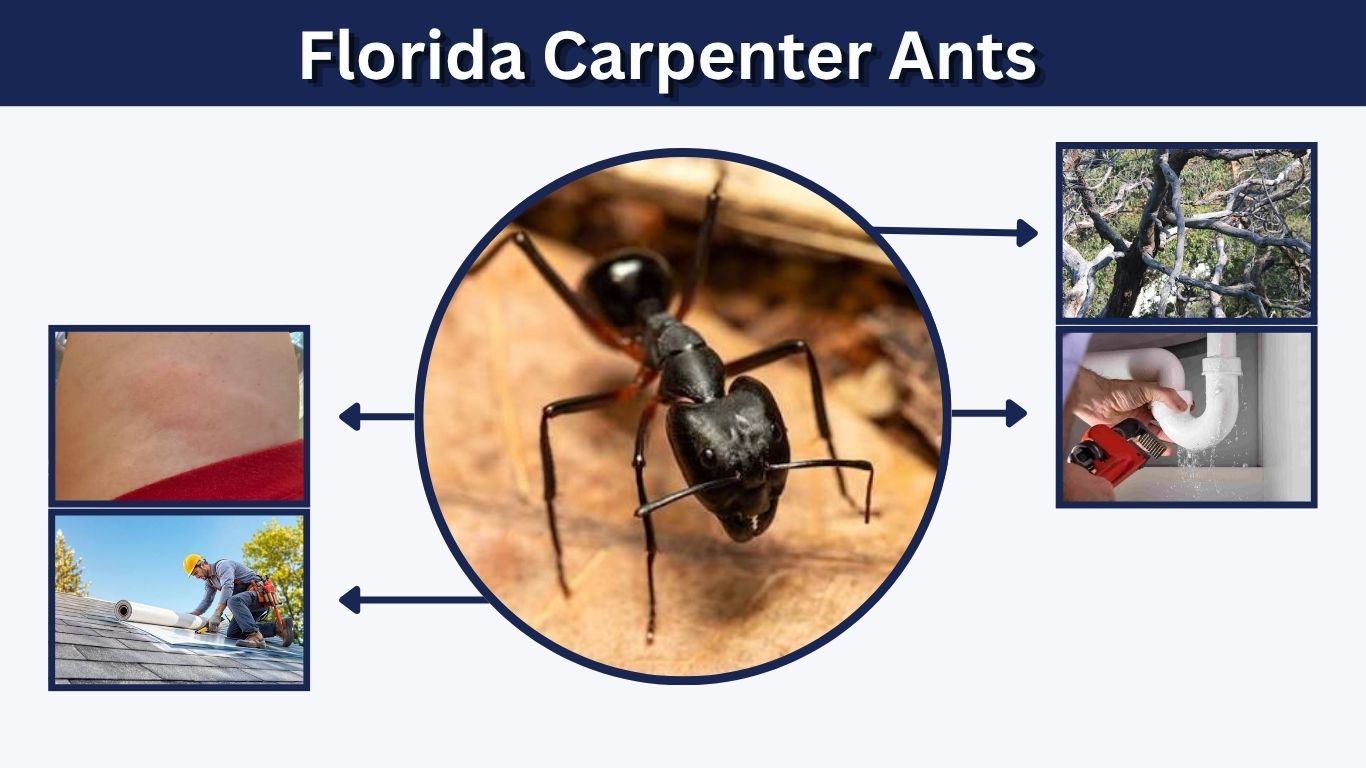
Florida carpenter ants are large ants commonly found around homes, trees, gardens, and wooded areas throughout Florida. One of the best-known species is the Florida carpenter ant (Camponotus floridanus), recognized by its reddish-orange head and thorax and darker abdomen. These ants do not eat wood like termites, but they may excavate cavities for nesting. They can also enter homes while searching for food and moisture. Understanding their appearance, nesting habits, bites, and control methods makes it easier to determine whether the ants around your Florida home require treatment.
What Do Florida Carpenter Ants Look Like?
Florida carpenter ants are relatively large and easy to notice compared with many common household ants. Their reddish-and-black coloration is one of their most recognizable features.
Florida Carpenter Ant Identification
Common characteristics include:
- Workers approximately 5–11 mm long
- Reddish-orange to reddish-brown head and thorax
- Dark brown or black abdomen
- Elbowed antennae
- Narrow waist with one node
- Smooth, rounded thorax
- Large workers with powerful mandibles
- Noticeable size differences among workers
Color can vary, so not every carpenter ant found in Florida will look exactly the same.
Florida Carpenter Ant Size
Workers occur in different sizes within the same colony. Smaller workers handle many everyday colony duties, while larger major workers have noticeably bigger heads.
Queens are considerably larger and have a thicker thorax because they originally develop wings.
Because of their size, large Florida carpenter ants are sometimes mistaken for small wasps or other insects when seen from a distance.
Where Do Florida Carpenter Ants Live?
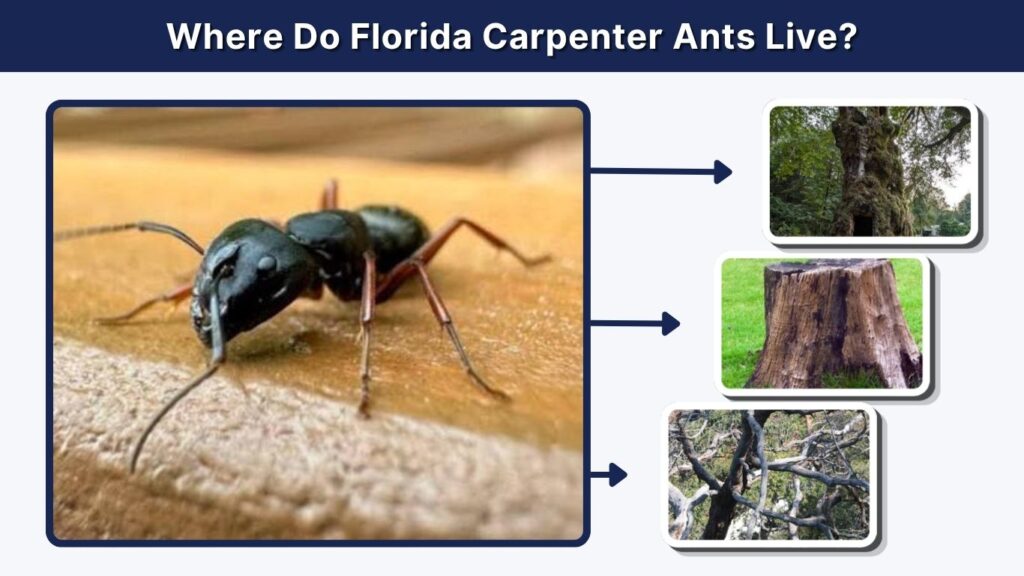
Florida’s warm climate allows carpenter ants to remain active for much of the year.
They are commonly encountered around trees, landscaping, buildings, patios, and wooded areas.
Florida Carpenter Ant Habitat
Typical nesting locations include:
- Hollow trees
- Tree stumps
- Dead branches
- Logs
- Landscaping timbers
- Spaces beneath bark
- Wall voids
- Roof areas
- Window and door frames
- Areas containing moisture-damaged wood
Outdoor nests are extremely common, and ants entering a house may simply be workers traveling from a nearby colony.
Are Carpenter Ants Common in South Florida?
Yes. Carpenter ants occur throughout Florida, including central and South Florida.
Warm temperatures can provide extended periods of activity compared with regions that experience long, cold winters.
Homeowners may notice ants indoors throughout much of the year, particularly around kitchens, bathrooms, doors, windows, and areas with moisture.
Florida Carpenter Ants in the House
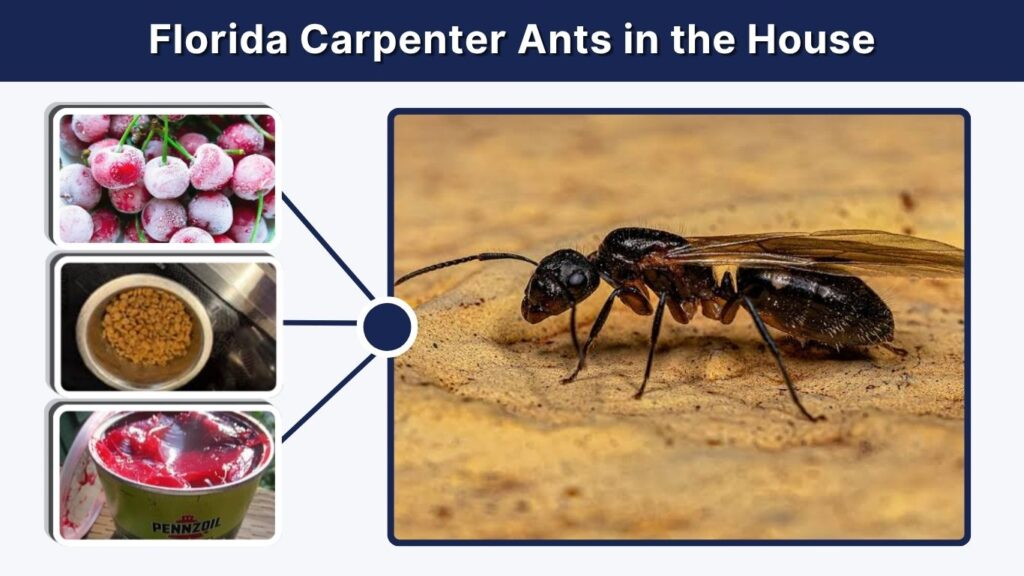
Seeing one or two carpenter ants does not necessarily mean there is a colony inside the building.
Workers can travel substantial distances while searching for food.
Why Are Florida Carpenter Ants Coming Inside?
They may enter homes looking for:
- Sweet foods
- Syrup
- Fruit
- Pet food
- Grease
- Protein-rich foods
- Water
- Moisture
Ants commonly use cracks around doors, windows, utility lines, roof edges, and foundations as entry points.
Repeated sightings of numerous ants may deserve closer investigation.
Signs of an Indoor Nest
Possible signs include ants repeatedly emerging from the same wall opening, activity around damp wood, winged ants appearing indoors, or debris accumulating beneath nesting areas.
Carpenter ants may produce sawdust-like material while excavating their nests.
Finding this material near wood can provide an important clue to the location of a colony.
Do Florida Carpenter Ants Eat Wood?
No. Florida carpenter ants do not eat wood.
This is an important difference between carpenter ants and termites.
Why Do Carpenter Ants Damage Wood?
Carpenter ants use their mandibles to excavate cavities in wood and create protected nesting chambers.
They remove wood particles rather than digesting them.
They often prefer:
- Moist wood
- Decaying wood
- Previously damaged timber
- Hollow spaces
Correcting leaks and moisture problems can therefore make a building less attractive to carpenter ants.
Florida Carpenter Ants With Wings
Winged Florida carpenter ants are reproductive members of mature colonies.
These ants are commonly called swarmers or alates.
Why Do Florida Carpenter Ants Have Wings?
Mature colonies produce winged males and females that leave their nests to reproduce.
After mating, a fertilized female searches for a protected place where she can establish a new colony.
She eventually sheds her wings and becomes the colony’s queen.
Finding a few winged ants outdoors is normal. Finding numerous winged carpenter ants emerging from inside a house may indicate a mature colony within or close to the structure.
Winged Carpenter Ant vs Termite
Winged ants have:
- Elbowed antennae
- Narrow waists
- Front wings longer than rear wings
Winged termites generally have:
- Straight antennae
- Broad waists
- Four wings of approximately equal length
Correct identification is important because treatment methods differ.
Florida Carpenter Ant Queen
The queen is the reproductive center of an established colony.
What Does a Florida Carpenter Ant Queen Look Like?
A queen is typically larger than workers and has:
- Large abdomen
- Thick thorax
- Strong reddish coloration
- Darker abdomen
- Wings before mating
- Wing scars after shedding her wings
A young colony begins with relatively few workers. Over time, it can develop into a much larger population containing workers of different sizes and eventually reproductive ants.
Do Florida Carpenter Ants Bite?
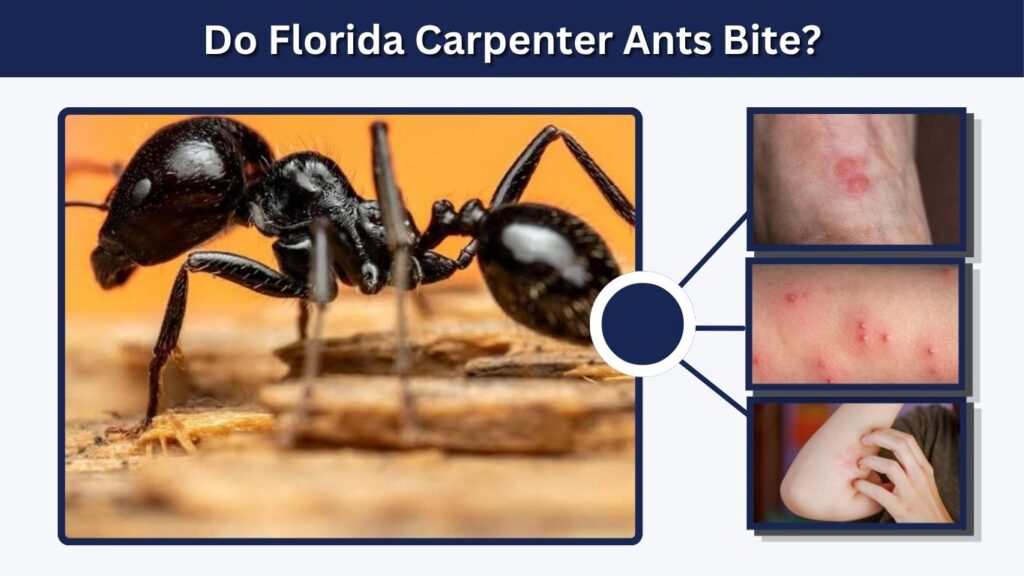
Yes. Florida carpenter ants can bite, particularly when trapped, handled, or defending their nest.
They use strong mandibles to pinch the skin.
Florida Carpenter Ant Bite Symptoms
A bite may cause:
- Brief sharp pain
- Burning sensation
- Mild swelling
- Redness
- Itching
- Local irritation
Carpenter ants can sometimes apply formic acid to the irritated area, which may increase the burning sensation.
Are Florida Carpenter Ants Dangerous?
Florida carpenter ants are not considered highly dangerous to people.
They do not normally seek humans as prey, and bites are generally defensive.
Wash a bite with soap and water and avoid scratching it. Seek medical attention if severe swelling, trouble breathing, widespread hives, or signs of infection develop.
Florida Carpenter Ant vs Fire Ant
Florida carpenter ants and fire ants can both have reddish coloration, but they are very different.
Main Differences
Florida carpenter ants are generally larger and often have a red-orange head and thorax with a darker abdomen. They commonly nest in cavities, trees, wood, and structural spaces.
Fire ants are smaller and typically build colonies in soil, often producing noticeable mounds.
Another major difference is defense.
Carpenter ants primarily bite with their jaws. Fire ants can grip the skin and repeatedly sting, often leaving painful bumps that may later develop small pustules.
How to Get Rid of Florida Carpenter Ants
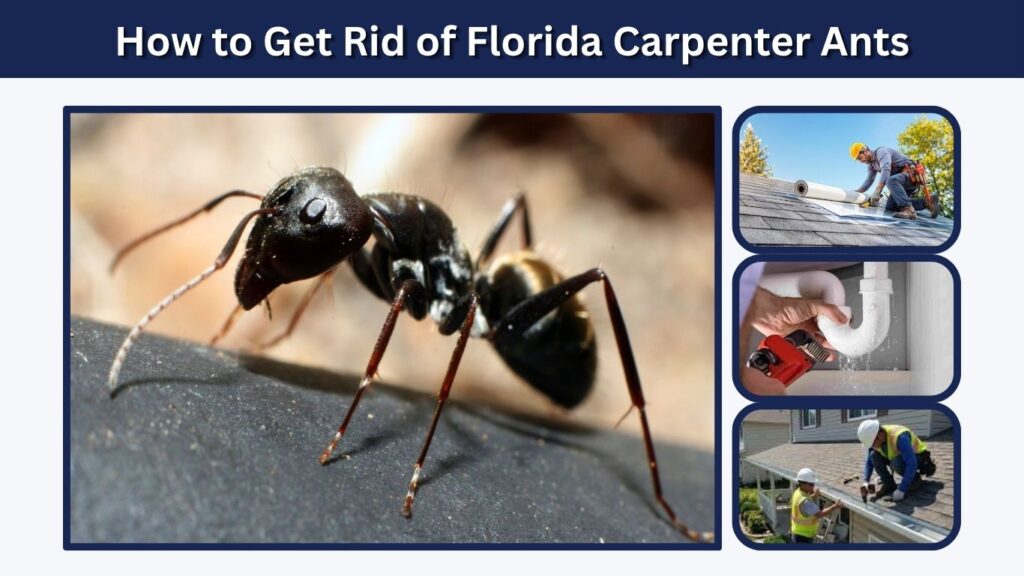
Effective Florida carpenter ant control focuses on finding the nest, eliminating favorable conditions, and preventing workers from repeatedly entering the building.
Locate Ant Trails
Observe where ants are traveling, especially during periods of high activity.
Follow trails toward possible nesting areas around:
- Trees
- Rooflines
- Windows
- Doors
- Plumbing
- Attics
- Exterior walls
Locating the colony makes treatment significantly more effective.
Fix Moisture Problems
Repair leaking pipes, roofs, gutters, and window frames.
Replace badly rotted wood where necessary.
Reducing moisture is one of the most useful long-term prevention measures.
Use Carpenter Ant Bait
Properly selected ant bait may allow workers to carry treatment back toward the colony.
Place bait along active trails rather than randomly throughout the property, and always follow the product label.
Avoid spraying repellent insecticides directly around bait stations because this may discourage ants from reaching the bait.
Seal Entry Points
Seal gaps around:
- Windows
- Doors
- Pipes
- Utility cables
- Roof edges
- Foundation openings
Trim branches touching the building because ants can use vegetation as a bridge into the structure.
Consider Professional Pest Control
Persistent carpenter ants, large indoor populations, or repeated winged ants may indicate a nest that is difficult to reach.
A pest-control professional can identify nesting sites and determine whether targeted baiting, void treatments, or other control methods are appropriate.
FAQs
Are there carpenter ants in Florida?
Yes. Carpenter ants are common throughout Florida. Camponotus floridanus is one of the best-known carpenter ant species in the state.
Do Florida carpenter ants bite?
Yes. They can bite when disturbed or handled, although they generally do not aggressively seek out people.
Do Florida carpenter ants eat wood?
No. They excavate wood to create nesting spaces but do not consume it for nutrition like termites.
Why are Florida carpenter ants in my house?
They may be searching for food or water, entering from an outdoor colony, or nesting in a protected cavity within the building.
What kills Florida carpenter ants?
Appropriate carpenter ant baits and targeted pest-control treatments can eliminate colonies when correctly applied. Finding the nest, correcting moisture problems, and sealing entry points are also important for preventing the ants from returning.