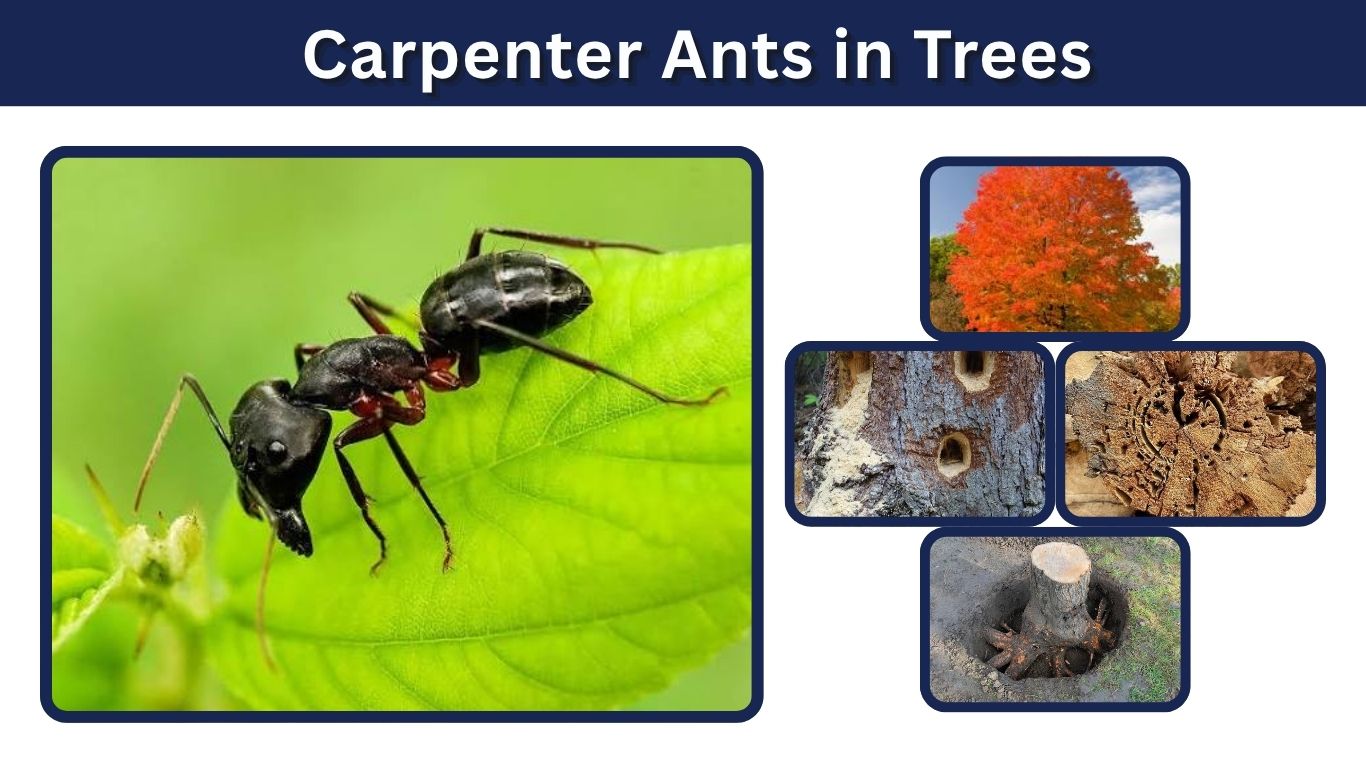
Carpenter ants in a tree usually indicate that decay was already present before the colony arrived. These ants do not eat living wood or feed on the tree’s sap. Instead, they excavate soft, rotting heartwood to create smooth nesting galleries. Their presence rarely kills an otherwise healthy tree, but it can reveal hidden cavities, moisture damage, or structural weakness. Treatment is often unnecessary unless the tree could fall, the ants are entering a nearby house, or the nest occupies a stump or landscape feature where ant activity is unwanted.
Why Do Carpenter Ants Live in Trees?
Trees provide carpenter ants with shelter, moisture, food, and access to nearby foraging areas. Older trees are especially likely to contain the cracks and internal cavities these ants need.
Common Nesting Conditions
Carpenter ants frequently occupy trees with:
- Internal heartwood decay
- Old pruning wounds
- Broken branches
- Lightning damage
- Trunk cracks
- Woodpecker holes
- Insect-borer tunnels
- Frost injuries
- Hollow trunks
- Wet cavities
- Dead roots or branches
The ants enter through an existing opening and enlarge spaces within weakened wood. Their galleries may eventually extend into firmer heartwood, but they generally do not attack healthy outer tissues.
What Carpenter Ants Eat
Carpenter ants do not eat wood. They discard excavated wood outside the nest and feed on:
- Living and dead insects
- Aphid and scale-insect honeydew
- Flower nectar
- Ripe or damaged fruit
- Other sweet plant secretions
- Food found around buildings
Ants traveling up and down a trunk may simply be visiting aphids in the canopy. Ant activity alone does not confirm that the colony is inside the tree.
Signs of Carpenter Ants in a Tree
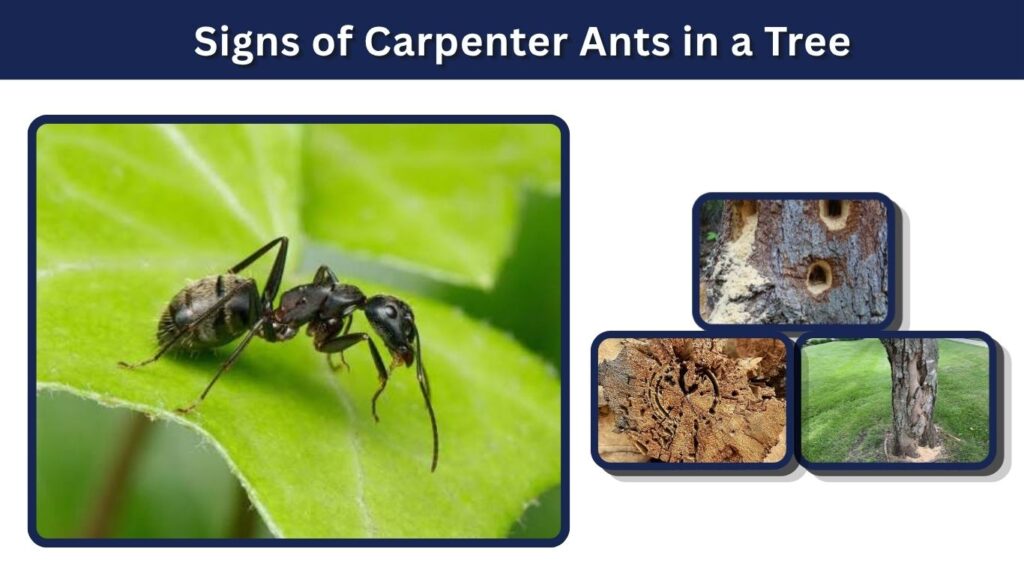
Inspect suspected trees after sunset, when carpenter ants are most active. Use a flashlight to watch where workers enter and exit.
Common Signs
Look for:
- Large black, reddish, or red-and-black ants
- Regular trails moving up and down the trunk
- Ants entering a crack, knot, or cavity
- Coarse sawdust collecting at the tree’s base
- Wood fragments mixed with dead insect parts
- Winged ants emerging from a trunk opening
- Hollow areas or soft, crumbling wood
- Woodpecker excavation around a cavity
- Ant activity beneath loose bark
- Ants moving between the tree and a building
The sawdust-like debris is often called frass. Because carpenter ants keep their galleries relatively clean, they push wood shavings and other waste out through small openings.
Finding the Nest
Begin inspecting approximately 15 to 30 minutes after sunset. Follow workers returning toward the trunk rather than those traveling into the canopy.
A nest entrance may be hidden beneath bark, inside a branch union, at the base of the trunk, or between exposed roots. Ants may use the same trails repeatedly, making nighttime observation more reliable than randomly searching during the day.
Can Carpenter Ants Kill a Tree?
Carpenter ants usually do not kill trees. Their presence commonly reveals wood that was already dead, weakened, or decaying because of age, injury, disease, drought, or another insect.
Ant Damage vs. Existing Decay
The tree’s living tissues are concentrated near the outer trunk, beneath the bark. A tree can sometimes remain healthy and produce a full canopy even when part of its central heartwood is hollow.
Carpenter ants primarily occupy this nonliving central wood. Removing the colony does not stop existing fungal decay or restore the tree’s lost strength.
The University of Minnesota Extension states that carpenter ants take advantage of preexisting weak wood and generally do not require control for the tree’s health.
Can Their Galleries Make Damage Worse?
Large nests can expand through already compromised wood and sometimes into sound heartwood. This excavation may contribute to weakness within a decayed section, but the underlying rot remains the main concern.
A tree containing ants should be assessed for structural stability rather than removed automatically.
Are Carpenter Ants Bad for Oak, Maple, or Fruit Trees?
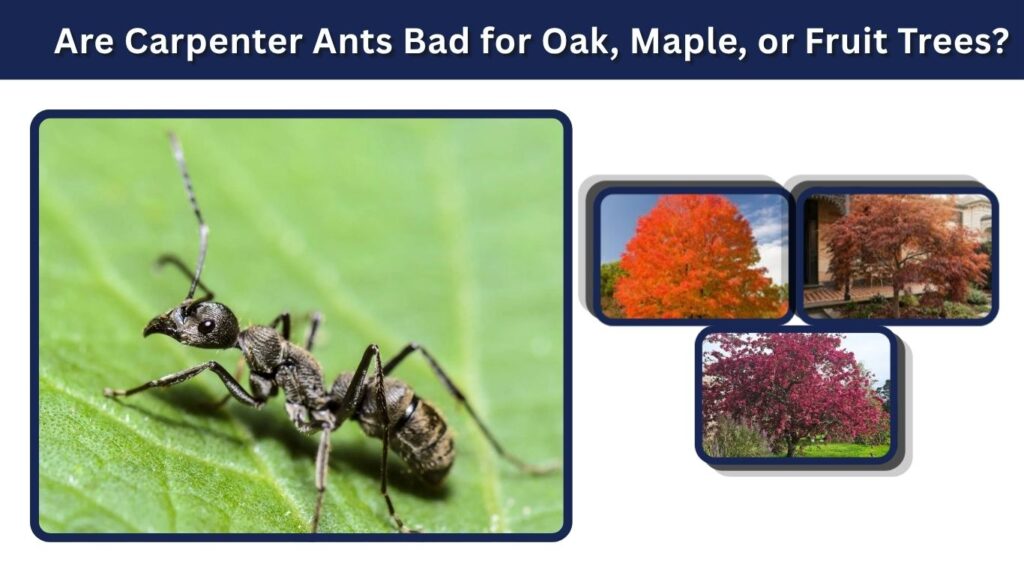
Carpenter ants are not limited to one tree species. They may nest in oak, maple, apple, cherry, willow, cedar, pine, palm, and numerous other trees when suitable cavities or decayed wood are available.
Oak and Maple Trees
Large mature oaks and maples often develop hollow trunks while maintaining healthy outer growth. Carpenter ants may occupy these internal spaces for years without directly killing the tree.
However, a hollow tree beside a house, road, or play area should receive a professional risk assessment.
Apple and Cherry Trees
Fruit trees can develop decay around old pruning cuts, trunk injuries, graft unions, or broken limbs. Carpenter ants may use these cavities while also feeding on ripe fruit or honeydew from aphids.
Never apply a pesticide to an edible fruit tree unless the product label specifically permits that use.
Pine and Cedar Trees
Carpenter ants may establish colonies in dead sections, old wounds, stumps, or decaying roots of conifers. Needles turning brown or branches dying are more likely to result from disease, drought, root problems, or another insect than from carpenter ants.
Carpenter Ants and Tree Safety
The important question is not simply whether ants are present. It is whether decay has reduced the tree’s ability to support itself.
Warning Signs of a Hazardous Tree
Contact a certified arborist if the tree has:
- A large cavity near its base
- Mushrooms or fungal conks on the trunk
- Major vertical cracks
- A sudden or increasing lean
- Large dead branches
- A hollow-sounding trunk
- Soil lifting around the roots
- Extensive root decay
- A cavity extending through most of the trunk
- A position where failure could injure someone or damage property
Carpenter ants serve as a warning to investigate the decay, not as proof that the tree must be removed.
Can a Tree With Carpenter Ants Be Saved?
Many trees containing carpenter ants can remain standing when the living tissues are healthy and the trunk retains sufficient structural strength.
When Saving the Tree Is Possible
Retention may be reasonable when:
- The canopy remains healthy
- Decay is limited
- Major roots are stable
- No large cracks are present
- The tree is not leaning dangerously
- Failure would not threaten people or structures
- An arborist considers the remaining wood adequate
Removing the ants alone does not save the tree. Managing soil compaction, drought, wounds, root damage, and disease is more important for its long-term health.
When Removal May Be Necessary
Removal may be appropriate when the tree is dead, structurally unstable, severely hollow, or positioned where falling branches or trunk failure would create an unacceptable risk.
Do not cut down a viable tree only because carpenter ants are present. Purdue University notes that sealing cavities and applying wound dressings are not recommended and will not prevent decay or ant activity.
How to Get Rid of Carpenter Ants in Trees
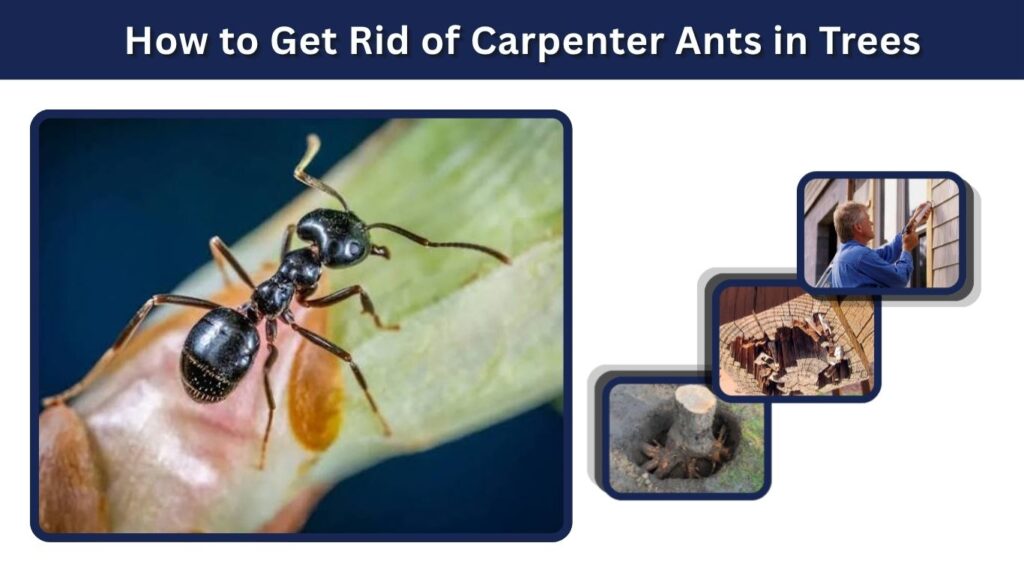
Before treating, decide whether control is actually needed. Colonies in woodland trees normally provide ecological benefits by helping break down dead wood.
Treatment may be justified when ants repeatedly enter a home, occupy a stump beside a structure, or create a serious nuisance in a heavily used area.
Natural and Nonchemical Options
Consider these approaches first:
- Remove a dead or unwanted infested stump.
- Clear rotting logs and buried lumber near the house.
- Store firewood away from buildings.
- Trim branches touching the roof or siding.
- Seal openings where utility lines enter the house.
- Repair moisture-damaged wood on nearby structures.
- Vacuum ants found indoors instead of spraying them.
- Monitor the tree after dark to identify travel routes.
- Have structural decay evaluated by an arborist.
Removing a dead stump can eliminate the nesting site. Removing a live tree solely for ant control is rarely justified.
Using Carpenter-Ant Bait
A slow-acting bait labeled specifically for carpenter ants may help when workers are traveling between the tree and a nearby building. Place it beside active trails only where the product label permits and where children, pets, and wildlife cannot access it.
Workers must carry the bait into the colony. Do not spray repellent insecticide near a bait station because this may stop ants from feeding on it.
Treating the Tree Cavity
Directly treating an identified nest may reduce the colony, but applications inside living trees should be handled carefully. A licensed pest professional or arborist can determine whether a labeled dust, foam, or bait is appropriate.
Control may be temporary because the decayed cavity remains suitable for another colony. Retreatment could eventually be necessary.
Practices to Avoid
Do not pour the following into a tree cavity:
- Gasoline or diesel
- Bleach
- Ammonia
- Salt
- Vinegar
- Boiling water
- Undiluted household cleaners
- Unlabeled pesticides
These substances can injure roots, damage living tissue, contaminate soil, and endanger wildlife without reliably eliminating the queen.
Do not drill random holes into a living tree or fill cavities with concrete, expanding foam, or wound sealant.
Carpenter Ants in a Tree Near the House
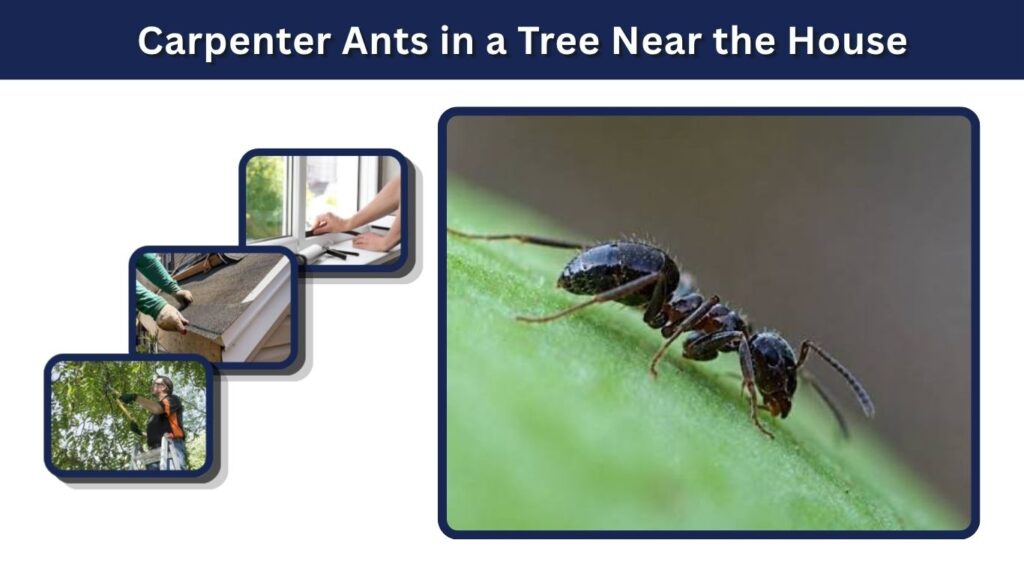
A tree colony does not guarantee that the house will become infested, but nearby workers can enter buildings while searching for food and moisture. A parent colony in a tree may also establish a satellite nest inside a wall void.
Protecting the House
- Keep branches several feet from the roof and siding.
- Repair damaged screens, fascia, and soffits.
- Seal cracks around pipes, cables, doors, and windows.
- Correct roof and plumbing leaks.
- Keep gutters clear.
- Move firewood and lumber away from exterior walls.
- Follow nighttime trails to determine whether ants enter the building.
- Arrange an inspection if winged ants emerge indoors.
Eliminating conditions inside the house is usually more important than trying to remove every outdoor carpenter ant colony.
FAQs
Do carpenter ants eat live trees?
No. They do not digest wood. They excavate dead, damp, or decayed wood to create nesting galleries.
Will killing carpenter ants save a damaged tree?
Not necessarily. Killing the colony does not repair decay, cavities, or structural weakness. The tree’s condition must be assessed separately.
Should I remove a tree stump containing carpenter ants?
Removing an unwanted stump is an effective nonchemical way to eliminate the nesting site, especially when it is close to the house.
Why are carpenter ants at the base of my tree?
They may be entering decayed roots or a trunk cavity, following a trail, or collecting honeydew and other food. Inspect the area after dark to locate their destination.
Can carpenter ants move from a tree into my house?
Yes. A tree colony may send workers indoors or establish a satellite nest in moisture-damaged wood or wall voids, particularly when branches touch the building.