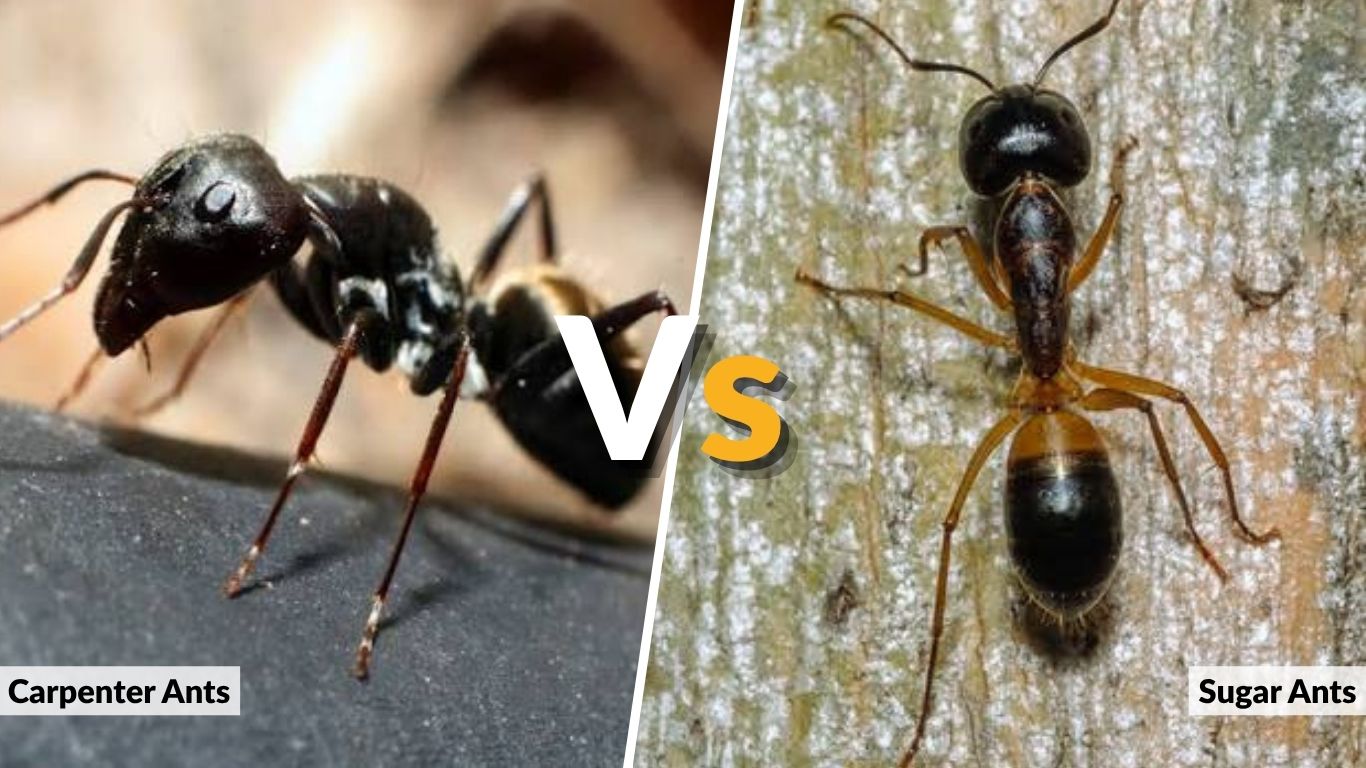
Carpenter ants vs sugar ants can be difficult to compare because “sugar ant” is a common name rather than one precise group everywhere. In North America, the term often describes small household ants attracted to sweet foods, while in Australia some Camponotus species are themselves called sugar ants. Carpenter ants are generally larger and are best known for nesting in wood. Understanding their size, appearance, diet, nesting habits, and behavior can help you determine which ants are invading your home and choose the right control method.
Carpenter Ants vs Sugar Ants: Quick Comparison
The biggest differences between carpenter ants and typical household sugar ants are their size and nesting behavior. Carpenter ants are usually noticeably larger and may excavate galleries inside damp or damaged wood. Small ants commonly called sugar ants are more likely to nest in soil, wall gaps, under objects, or other protected spaces.
| Feature | Carpenter Ants | Sugar Ants |
| Typical size | About 6–13+ mm | Often about 2–5 mm |
| Color | Black, brown, red, or mixed | Varies by species |
| Main attraction | Sugar and protein | Especially sweet foods |
| Nest | Wood, trees, stumps, structures | Soil, cracks, walls, outdoor sites |
| Wood damage | Possible | Usually not |
| Activity | Often nighttime | Depends on species |
| Bite | Possible | Usually mild or uncommon |
| Wings | Reproductive ants have wings | Reproductive ants may have wings |
Exact characteristics vary because both terms can refer to multiple species.
What Do Carpenter Ants and Sugar Ants Look Like?
Carpenter ants belong to the genus Camponotus. They are among the larger ants commonly found around houses. Their body may be black, reddish brown, dark brown, or a combination of colors.
The ants people call sugar ants can look quite different depending on where they live. In the United States, the name is often casually applied to small ants that enter kitchens for sweets. In Australia, “sugar ant” may refer to larger native ants, including the banded sugar ant.
Carpenter Ant Identification
Look for:
- Relatively large workers
- Workers of noticeably different sizes within one colony
- A smoothly rounded thorax when viewed from the side
- Black, brown, reddish, or mixed coloration
- Elbowed antennae
- Narrow waist
- Winged reproductive ants during mating periods
Finding large ants repeatedly emerging from wooden walls, window frames, or other structural areas deserves closer inspection.
Sugar Ant Identification
Typical small household ants called sugar ants may have:
- Smaller bodies than carpenter ants
- Brown, black, yellowish, or reddish coloration
- Narrow trails leading toward food
- Strong attraction to sweets
- Nests hidden in soil, cracks, walls, or beneath objects
Because “sugar ant” is not always a precise species name, identification should be based on the actual ant rather than the nickname alone.
Sugar Ant vs Carpenter Ant Size
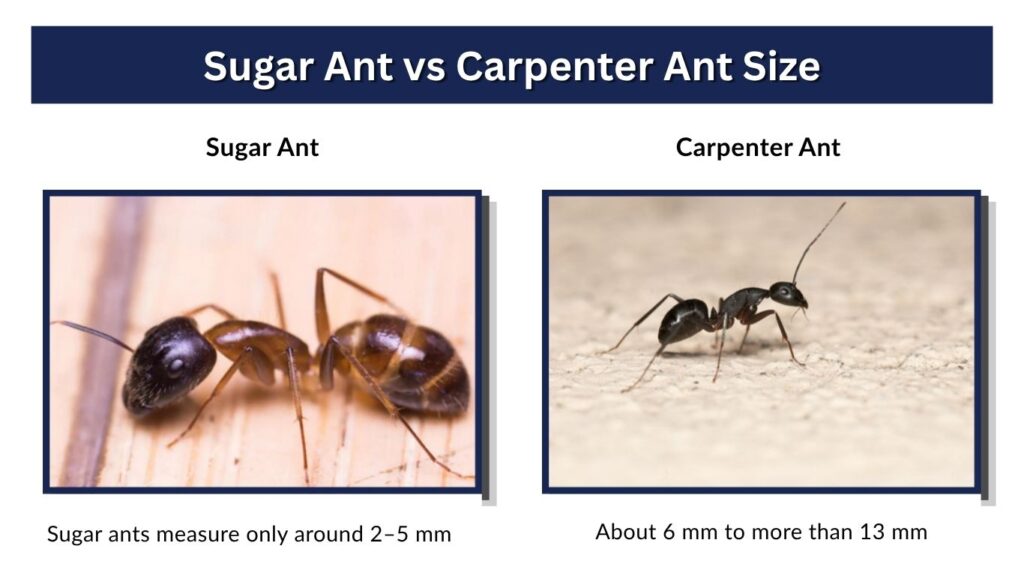
Size is one of the easiest clues when comparing sugar ants vs carpenter ants.
Carpenter ant workers commonly range from about 6 mm to more than 13 mm, depending on species and worker caste. A single colony can contain both small and large workers.
Many ants casually called household sugar ants measure only around 2–5 mm.
However, size alone can sometimes be misleading. The Australian banded sugar ant, for example, belongs to the genus Camponotus and can be quite large. Therefore, a large “sugar ant” is not automatically a different type from a carpenter ant.
Are Carpenter Ants the Same as Sugar Ants?
Not necessarily.
Carpenter ant refers specifically to ants in the genus Camponotus. “Sugar ant” is a common term based largely on an ant’s attraction to sugary foods and can refer to different species in different regions.
This creates an important overlap: some Camponotus ants are commonly called sugar ants, particularly in Australia.
In everyday North American pest-control language, however, “sugar ants” usually refers to small sweet-seeking household ants, so people normally use the two terms to describe different pest problems.
Carpenter Ant vs Sugar Ant Nest
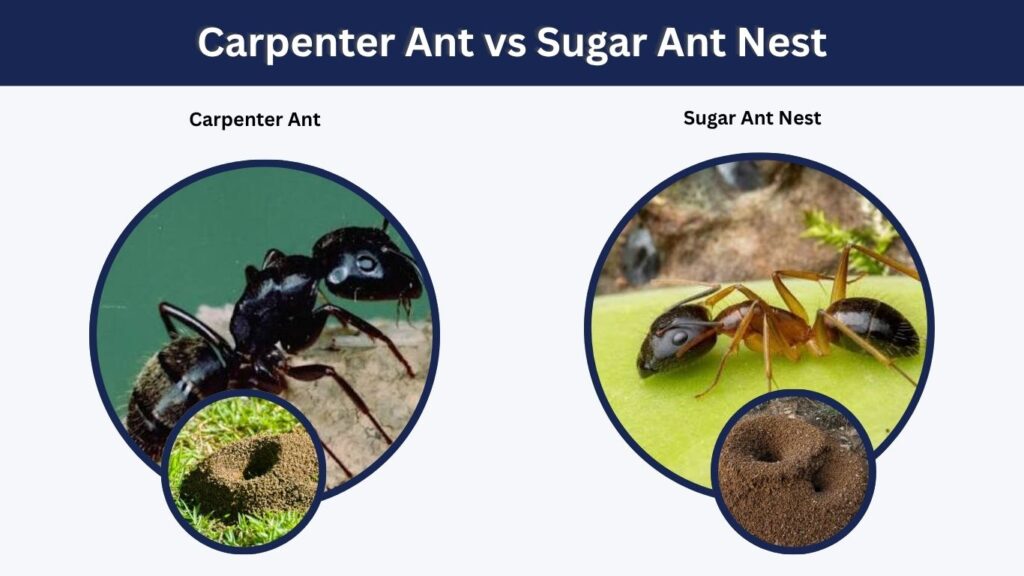
Where the ants are nesting can provide an even stronger identification clue than color.
Carpenter ants are famous for establishing colonies in wood. They do not eat wood like termites. Instead, they excavate it to create smooth internal galleries.
They frequently prefer wood affected by moisture.
Common Carpenter Ant Nest Locations
- Damp wall framing
- Window and door frames
- Roof areas
- Decks and porches
- Tree cavities
- Dead branches
- Stumps
- Logs
- Wood near plumbing leaks
Small household sugar ants commonly establish nests in soil, beneath stones, around foundations, inside wall voids, or in other protected locations rather than excavating extensive wooden galleries.
Do Carpenter Ants Eat Sugar?
Yes. Carpenter ants eat and are attracted to sugar, which is one reason people sometimes confuse them with sugar ants.
Workers need carbohydrates for energy and commonly feed on sweet liquids in nature. Honeydew produced by aphids and other sap-feeding insects can be an important food source.
Inside homes, carpenter ants may investigate:
- Honey
- Syrup
- Fruit
- Juice
- Soda
- Candy
- Sweet crumbs
- Sugar water
However, carpenter ants do not survive on sugar alone.
Do Carpenter Ants Like Sugar or Protein?
They consume both carbohydrates and protein.
Sugary foods provide workers with quick energy, while protein is especially important for developing larvae. Carpenter ants may obtain protein by hunting insects, scavenging dead insects, or finding protein-rich household foods.
Their preference can change depending on the colony’s nutritional needs. This is one reason an ant may ignore one bait today but readily consume another food source later.
Carpenter Ants vs Sugar Ants in the House
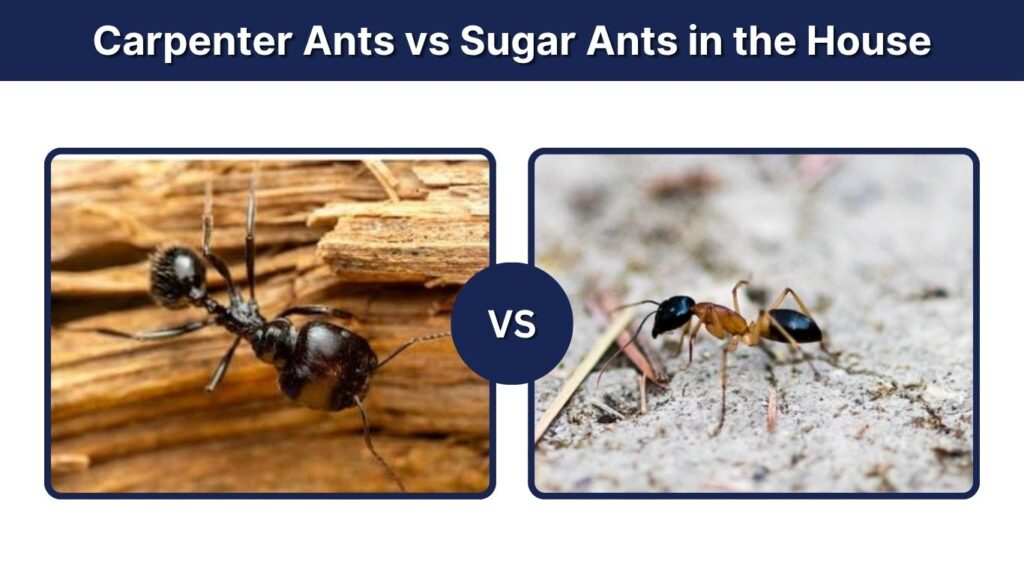
Both types of ants may enter homes looking for food and water, but carpenter ants deserve additional attention because an indoor colony may indicate a moisture or wood problem.
A few carpenter ants wandering indoors do not automatically mean they are nesting in your house. Workers can travel considerable distances from outdoor nests.
Signs that warrant closer investigation include repeated appearances of large ants, activity at night, ants disappearing into wooden areas, piles of sawdust-like debris, or numerous winged ants emerging indoors.
Small sugar-seeking ants are more commonly noticed around kitchens, cupboards, sinks, pet food, garbage bins, and sweet spills.
Borax and Sugar for Carpenter Ants: Does It Work?
A mixture involving borax and sugar can kill carpenter ants under certain circumstances because sugar attracts workers while borax can act as a slow-acting toxicant.
However, homemade borax bait has an important limitation: the concentration matters. If the mixture is too strong, ants may avoid it or die before carrying enough back toward the colony. If it is too weak, control may be poor.
Commercial ant baits generally provide a more predictable concentration and include directions for safe placement.
Boric Acid and Sugar for Carpenter Ants
Boric acid is also used in some ant-control products. Like borax, it may work better when ants consume a properly formulated bait and share it within the colony.
Avoid scattering borax or boric acid where children or pets can reach it, and never place homemade mixtures on food-preparation surfaces.
Does Baking Soda and Sugar Kill Carpenter Ants?
Powdered sugar and baking soda is frequently promoted as a homemade carpenter ant remedy, but it should not be considered a dependable method for eliminating an established colony.
Even if individual ants consume the mixture, there is little reason to rely on it when effective ant baits are available.
The larger issue with carpenter ants is finding and addressing the colony, especially when ants are nesting inside moisture-damaged wood. Simply killing workers walking across a countertop does not solve that underlying problem.
How to Get Rid of Carpenter Ants and Sugar Ants
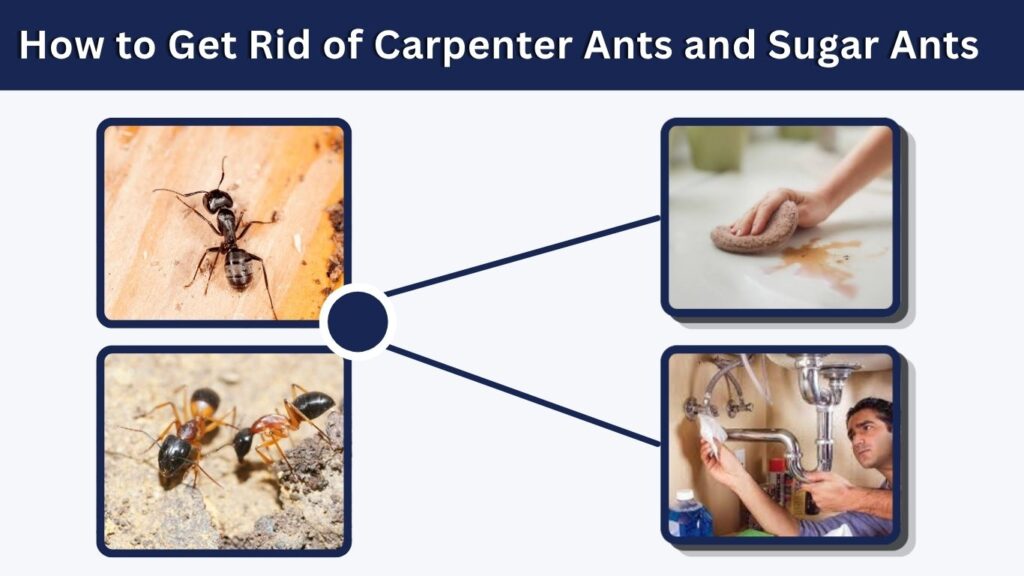
Successful ant control starts with determining where ants are traveling and what is attracting them. Spraying every visible worker can sometimes make it harder to trace ants back to their colony.
Effective Control Steps
- Clean up sweet foods. Wipe counters and clean sugary spills immediately.
- Store food in sealed containers. Pay particular attention to honey, sugar, syrups, and pet foods.
- Remove water sources. Repair leaking pipes, roofs, and faucets.
- Follow ant trails. Look for where workers enter walls, soil, or wood.
- Seal entry gaps. Close cracks around windows, doors, utility lines, and foundations.
- Trim vegetation. Keep branches from touching the building where possible.
- Use suitable ant bait. Choose a product labeled for the ant species and location.
- Replace damaged wood. Carpenter ant infestations are often associated with moisture problems.
- Consider professional treatment. Hidden structural colonies can be difficult to locate and eliminate.
For sugar-seeking ants, sanitation and properly placed bait can often provide good control. For carpenter ants, correcting moisture problems is especially important for preventing reinfestation.
FAQs
Are carpenter ants sugar ants?
Not always. Carpenter ants are members of the genus Camponotus, while “sugar ant” is a common name used for various ants attracted to sweets. Some Camponotus species are also called sugar ants.
Are carpenter ants attracted to sugar?
Yes. Carpenter ants readily consume sugary liquids and natural sources such as nectar and honeydew. They also require protein, particularly when feeding developing larvae.
Which is bigger, a sugar ant or carpenter ant?
Typical household sugar ants are usually smaller. Carpenter ants commonly measure around 6–13 mm or more, while many small sugar-seeking household ants are approximately 2–5 mm.
Will borax and sugar kill carpenter ants?
Borax can kill ants when incorporated into an appropriate bait, but homemade concentrations can be unreliable. Commercially formulated carpenter ant bait is generally easier to use correctly.
What is the main difference between carpenter ants and sugar ants?
Carpenter ants are defined by their genus and often excavate nests in wood. “Sugar ant” is a broad common name usually given to ants attracted to sweet food and does not refer to one universally defined species.