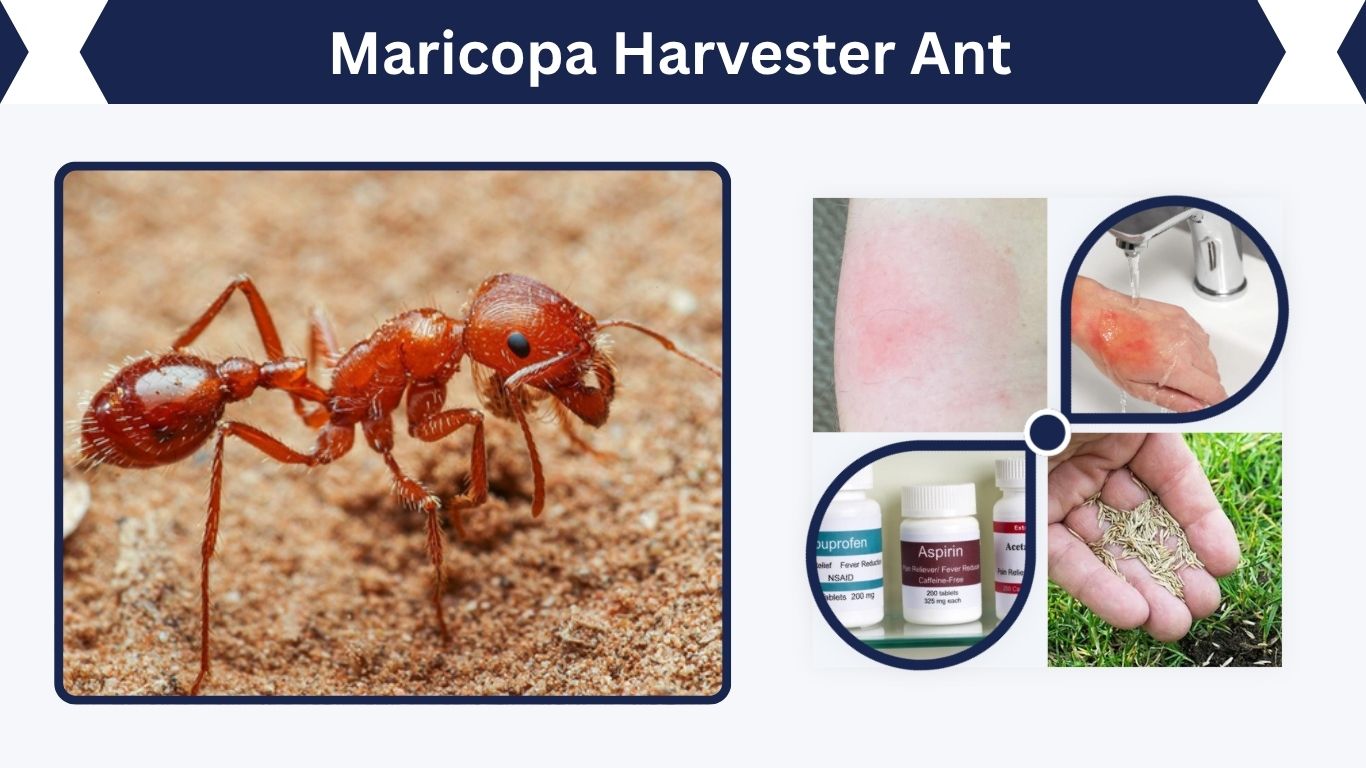
The Maricopa harvester ant is a reddish desert ant famous for one major reason: its extremely toxic venom. Scientifically known as Pogonomyrmex maricopa, this ant lives in dry regions of the southwestern United States and northwestern Mexico. It is not usually an ant that chases people, but it can deliver a very painful sting when disturbed. Because many people search for its bite, sting, venom, nest, size, and location, this guide explains how to identify the Maricopa harvester ant and what makes it so interesting.
What Is the Maricopa Harvester Ant?
The Maricopa harvester ant is a seed-harvesting ant in the genus Pogonomyrmex. These ants are adapted to hot, dry landscapes and are often seen around open soil, desert grassland, and sandy areas.
Scientific Name and Basic Overview
The scientific name of the Maricopa harvester ant is Pogonomyrmex maricopa. It was described by Wheeler in 1914 and is part of the ant family Formicidae. It is considered one of the common harvester ants in Arizona and is also recorded from several nearby U.S. states and Mexican states.
Harvester ants get their name because they collect seeds. Workers carry seeds back to the colony, store them underground, and use them as food. They may also scavenge dead insects and other small organic material.
Why This Ant Is Famous
The Maricopa harvester ant is famous because its venom has been described as the most toxic insect venom tested. Guinness World Records lists Pogonomyrmex maricopa as producing the most toxic insect venom, with an LD50 of 0.12 mg/kg when injected intravenously into mice.
This does not mean one sting will normally kill a healthy adult human. It does mean the venom is extremely potent in laboratory toxicity tests, and the sting should be taken seriously.
Maricopa Harvester Ant Identification
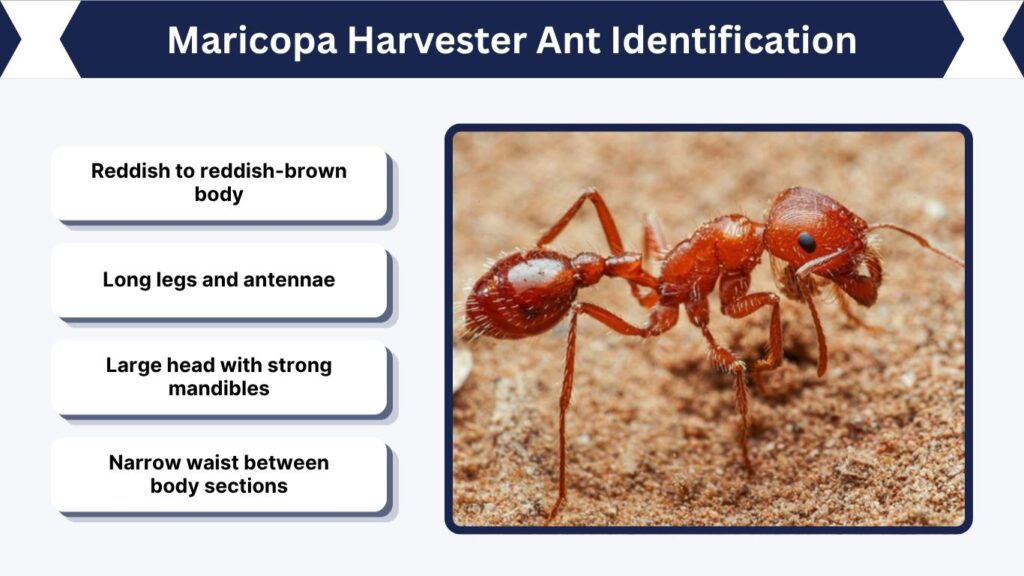
Maricopa harvester ants are usually reddish to reddish-brown ants with long legs, strong mandibles, and a narrow waist. They look similar to some other harvester ants, so exact identification can be difficult without close examination.
What Does a Maricopa Harvester Ant Look Like?
A Maricopa harvester ant is typically red, rust-colored, or reddish-brown. Its body is divided into the usual ant sections: head, thorax, and abdomen. The head is fairly large, and the legs are long enough to help it move quickly across hot, open ground.
From a distance, it may look like a large red desert ant. Under close view, it has a more slender shape than many household ants and a visible stinger at the rear.
Key Identification Features
- Reddish to reddish-brown body
- Long legs and antennae
- Large head with strong mandibles
- Narrow waist between body sections
- Smooth, rounded abdomen
- Workers often seen carrying seeds
- Usually found in dry, open habitats
- Nest mounds often include sand, pebbles, or gravel
Many red ants in desert areas can look similar, so nest location, behavior, and expert identification are often needed to confirm the species.
Maricopa Harvester Ant Size
Maricopa harvester ants are larger than many small household ants, but they are not giant insects. Their size helps them forage across exposed ground and carry seeds back to the nest.
How Big Is a Maricopa Harvester Ant?
Workers are usually medium-to-large ants compared with common indoor ants. Exact size can vary by colony and caste. Most people notice them because they are bigger, redder, and faster-moving than many tiny pavement or sugar ants.
Their size, color, and desert habitat make them easier to notice around bare soil, sandy areas, and ant mounds.
Maricopa Harvester Ant vs Common House Ant
| Feature | Maricopa Harvester Ant | Common House Ant |
| Color | Reddish to reddish-brown | Often black, brown, or yellowish |
| Habitat | Dry open soil, deserts, grasslands | Homes, walls, kitchens, gardens |
| Diet | Seeds and scavenged insects | Sugary foods, grease, scraps |
| Sting | Painful and venomous | Many household ants do not sting |
| Nest | Soil mound or underground colony | Soil, walls, cracks, indoor voids |
The Maricopa harvester ant is mostly an outdoor species. If red ants are nesting inside a home, they may be another species.
Maricopa Harvester Ant Location and Range
The Maricopa harvester ant is strongly associated with the southwestern United States and northwestern Mexico. Arizona is one of the best-known areas for this species.
Where Do Maricopa Harvester Ants Live?
Records show the Maricopa harvester ant from Arizona, California, Colorado, New Mexico, Nevada, Texas, and Utah in the United States, as well as Baja California, Chihuahua, Sinaloa, and Sonora in Mexico.
These ants are adapted to hot, dry environments. They are often found in deserts, sandy areas, open scrubland, dry grassland, and other arid habitats.
Maricopa Harvester Ant in Arizona
Arizona is closely linked with the Maricopa harvester ant. The species is considered one of the common harvester ants in the state.
In Arizona, it may occur in open desert landscapes, sandy flats, dry washes, and areas where seeds are available. Colonies are often easier to notice because workers clear space around the nest and build visible mounds.
Maricopa Harvester Ant Nest
Maricopa harvester ants build underground nests with surface mounds. These nests can be easier to see than nests of many smaller ants because the colony may clear vegetation around the entrance.
What Do Maricopa Harvester Ant Hills Look Like?
Maricopa harvester ant hills may appear as sandy or gravelly mounds on open ground. Some nests include rocks, pebbles, or gravel. In fine sand dune areas, the ants are known to build cemented caps over sand mound nests; these caps contain calcium carbonate and help protect the nest from wind erosion.
Nest Features
- Usually built in open soil
- May have a cleared area around the nest
- Can include sand, pebbles, gravel, or small rocks
- Entrances lead to underground chambers
- Seed storage may occur below ground
- Workers forage outward from the nest
AntWiki notes that Pogonomyrmex ants are common New World ants in arid habitats, and many species store large quantities of seeds in their nests.
Maricopa Harvester Ant Diet
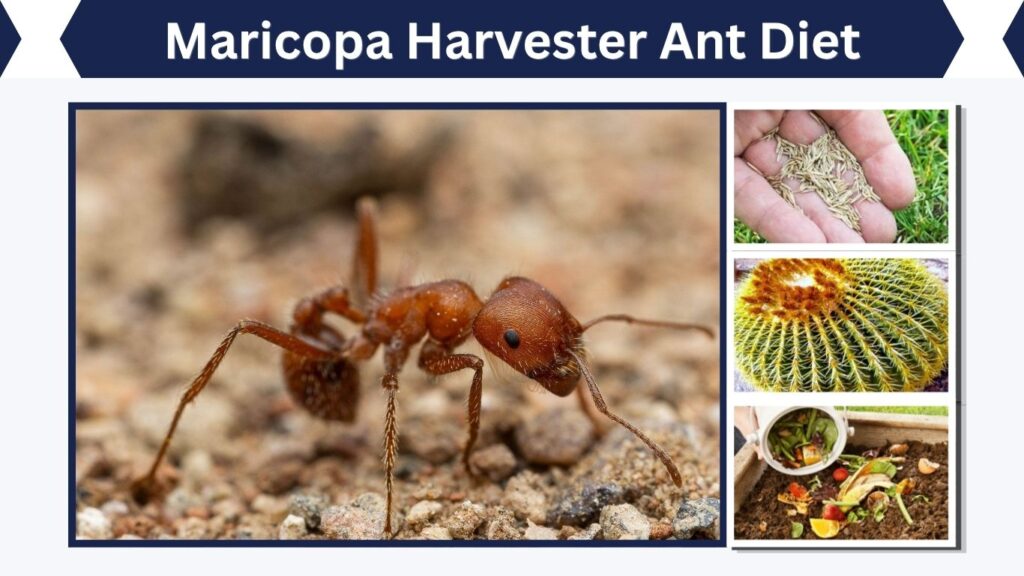
The Maricopa harvester ant is mainly a seed collector. Seeds are an important food source in dry habitats because they can be stored underground and used later.
What Do They Eat?
Maricopa harvester ants mostly collect seeds, but like many harvester ants, they may also feed on other available materials. AntWiki describes Pogonomyrmex ants as seed harvesters, while some also feed on other items, especially dead or dying insects.
Common foods include:
- Grass seeds
- Desert plant seeds
- Other small dry seeds
- Dead insects
- Tiny organic scraps
- Food stored underground
By collecting seeds and moving soil, harvester ants can affect desert soil structure and plant communities.
Maricopa Harvester Ant Sting
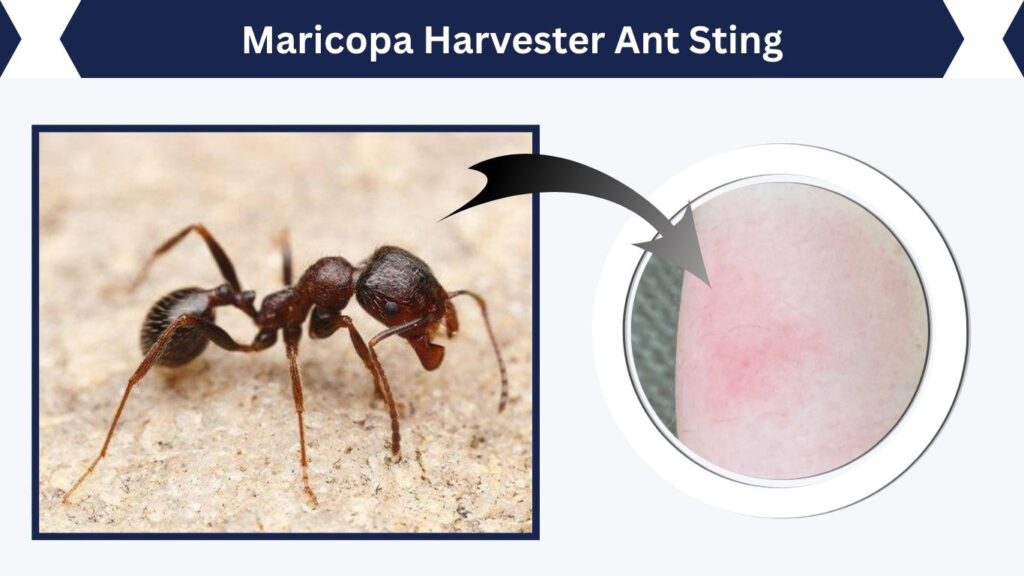
Many people search for “Maricopa harvester ant bite,” but the real concern is the sting. The ant may bite with its mandibles to grip the skin, then use its stinger to inject venom.
Bite vs Sting
A bite uses the jaws. A sting uses the stinger and venom. Maricopa harvester ants can do both, but the painful part is usually the sting. Like some other stinging ants, they may hold on with their mandibles and sting.
A sting can cause strong pain, redness, swelling, and a burning feeling. The pain may last for hours.
What Does the Sting Feel Like?
Reports describe harvester ant stings as very painful. The Maricopa harvester ant’s venom is especially notable because of its high toxicity in lab studies. A 2023 scientific paper on ant venom states that P. maricopa venom has an LD50 of 0.12 mg/kg in mice and is approximately 10 times more potent than P. barbatus venom in the same assay.
Again, lab toxicity does not directly equal typical human death risk from one sting, but the sting can be intense and should not be ignored.
Maricopa Harvester Ant Venom
Maricopa harvester ant venom is one of the most discussed insect venoms because of its toxicity. Researchers have studied Pogonomyrmex venoms for their effects on nervous systems.
Why Is the Venom So Potent?
Recent research explains that Pogonomyrmex venoms include peptide toxins that affect vertebrate voltage-gated sodium channels, which are important for nerve signaling. This helps explain why the venom can cause powerful effects in mammals.
The venom is thought to help defend colonies against predators. In dry habitats, some animals, such as horned lizards, feed on harvester ants, so strong defensive venom may provide survival value.
Can a Maricopa Harvester Ant Kill You?
A Maricopa harvester ant sting is painful, but a single sting is unlikely to kill a healthy adult. However, multiple stings, allergic reactions, small children, pets, or people with medical vulnerabilities can face greater risk.
Anyone who has trouble breathing, dizziness, swelling of the face or throat, widespread hives, chest tightness, or faintness after a sting needs emergency medical help.
Maricopa Harvester Ant Sting Treatment
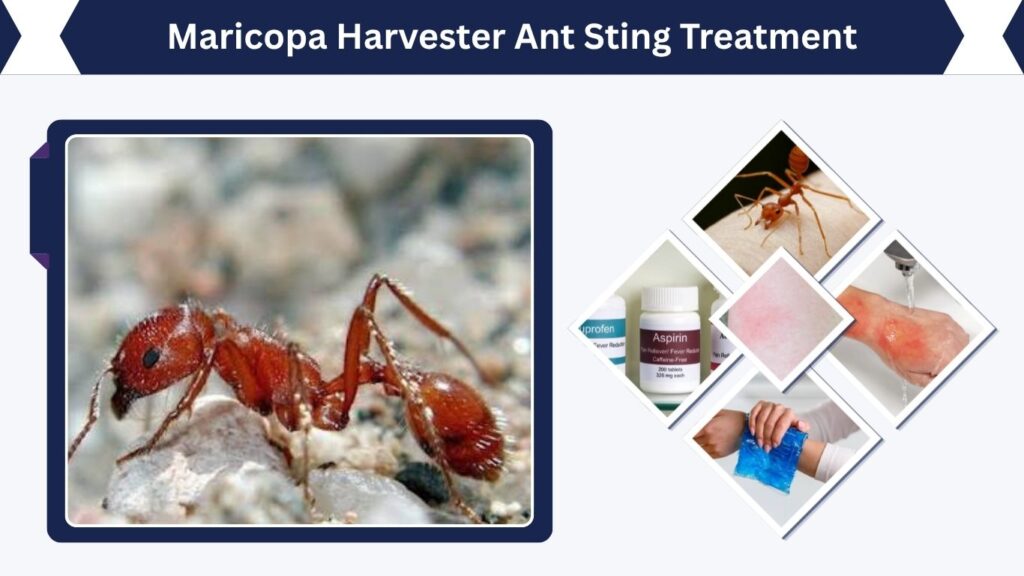
A Maricopa harvester ant sting should be treated carefully. Most mild stings can be managed with basic first aid, but severe symptoms need urgent care.
First Aid Steps
- Move away from the nest immediately
- Brush ants off your skin; do not stand near the mound
- Wash the sting area with soap and water
- Apply a cold pack wrapped in cloth
- Avoid scratching the sting area
- Use an over-the-counter pain reliever if suitable
- Consider an oral antihistamine for itching if safe for you
- Watch for allergic reaction symptoms
Do not squeeze or cut the sting area. Do not apply harsh chemicals to the skin.
When to Seek Medical Help
Seek urgent medical care if there are signs of allergic reaction, many stings, severe swelling, infection, worsening pain, or symptoms involving breathing or consciousness. Pets that are stung multiple times should be checked by a veterinarian.
Maricopa Harvester Ant vs Bullet Ant
The Maricopa harvester ant and bullet ant are both famous for painful stings, but they are different ants from different regions.
Main Differences
| Feature | Maricopa Harvester Ant | Bullet Ant |
| Scientific group | Pogonomyrmex | Paraponera clavata |
| Main fame | Extremely toxic insect venom | Extremely painful sting |
| Location | Southwestern U.S., northwestern Mexico | Central and South America |
| Habitat | Dry open areas | Tropical forests |
| Color | Reddish-brown | Dark brown to black |
| Main diet | Seeds and insects | Nectar, insects, plant fluids |
The bullet ant is usually discussed for sting pain, while the Maricopa harvester ant is famous for venom toxicity. Pain and toxicity are related but not the same.
Maricopa Harvester Ant vs Fire Ant
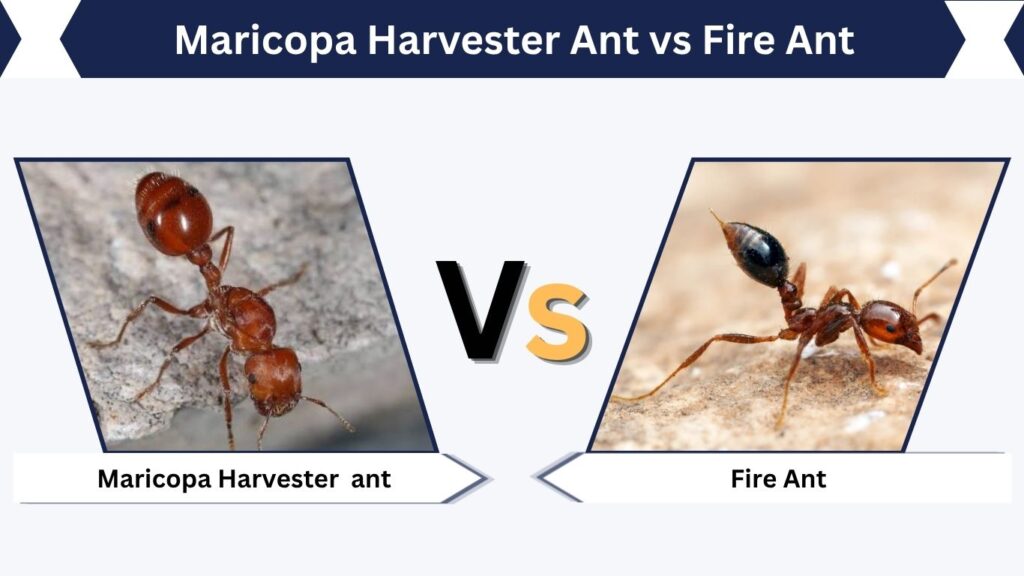
Maricopa harvester ants are also compared with fire ants because both can sting. However, they differ in behavior, nests, and appearance.
Main Differences
| Feature | Maricopa Harvester Ant | Fire Ant |
| Color | Reddish to reddish-brown | Reddish-brown to dark |
| Nest | Open soil mound, often gravelly | Soil mound, often in lawns |
| Diet | Mainly seeds and dead insects | Omnivorous, aggressive forager |
| Sting | Very painful, potent venom | Burning sting, pustules common |
| Habitat | Arid southwestern areas | Many warm regions, lawns, fields |
| Behavior | Often defends nest if disturbed | Often swarms aggressively |
Fire ants are more common around lawns and disturbed areas in many regions. Maricopa harvester ants are more tied to dry, open habitats.
Are Maricopa Harvester Ants Aggressive?
Maricopa harvester ants are defensive rather than randomly aggressive. They are most likely to sting when their nest is disturbed, stepped on, or handled.
How to Avoid Stings
Stay away from visible ant mounds in desert areas. Do not place hands or feet near a nest. Wear closed shoes when walking in arid areas, especially where red ants are active.
If you see many ants moving in and out of a mound, give the colony space. Children and pets should be kept away from active nests.
Are Maricopa Harvester Ants Useful?
Even though their sting is painful, Maricopa harvester ants are important in desert ecosystems. They collect seeds, move soil, and provide food for some predators.
Ecological Role
Harvester ants can influence seed distribution and soil turnover. Their underground nests mix soil layers and may help cycle nutrients. They also serve as prey for specialized predators in desert ecosystems.
Their role shows why dangerous animals can still be ecologically valuable.
FAQs
What is a Maricopa harvester ant?
A Maricopa harvester ant is a reddish seed-harvesting ant scientifically known as Pogonomyrmex maricopa. It lives mainly in dry areas of the southwestern United States and northwestern Mexico.
Is the Maricopa harvester ant venom dangerous?
Yes, its venom is extremely potent in laboratory tests and has been listed as the most toxic insect venom. A single sting is usually not fatal to a healthy adult, but it can be very painful and dangerous for allergic people or after multiple stings.
Where are Maricopa harvester ants found?
They are found in Arizona and other southwestern U.S. states, including California, Colorado, New Mexico, Nevada, Texas, and Utah. They also occur in parts of northwestern Mexico.
What does a Maricopa harvester ant nest look like?
The nest is usually an underground colony with a surface mound of sand, soil, gravel, or pebbles. Some nests may have cleared areas around them, and sandy nests may include cemented caps.
What should you do after a Maricopa harvester ant sting?
Move away from the nest, brush off ants, wash the area, apply a cold pack, and monitor symptoms. Seek emergency help if you have breathing trouble, face or throat swelling, dizziness, faintness, or many stings.