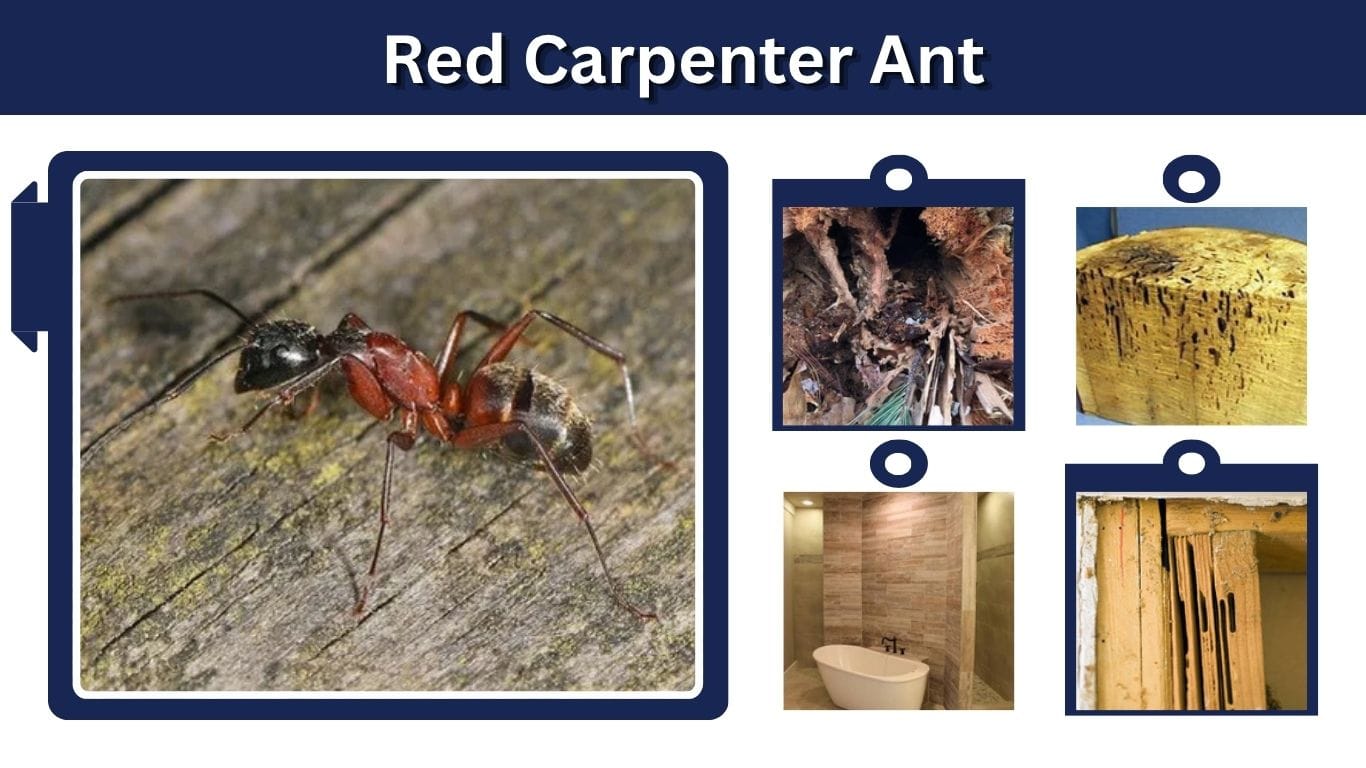
Red carpenter ants are large ants known for their reddish-and-black coloration and their habit of excavating galleries inside damaged or decaying wood. In eastern North America, the name commonly refers to Camponotus chromaiodes, although several other carpenter ant species can also appear red, reddish-brown, or black and red. These ants do not eat wood like termites; they remove it to create nesting chambers. Outdoors they are useful decomposers, but a colony inside moisture-damaged structural wood can become a household pest requiring attention.
What Is a Red Carpenter Ant?
The red carpenter ant is a member of the genus Camponotus. The species most commonly given this exact common name in the United States is Camponotus chromaiodes, also called the ferruginous or rust-colored carpenter ant. It is particularly recognizable by the contrast between reddish body sections and darker areas of the head and abdomen.
Red Carpenter Ant Identification
- Scientific name: Camponotus chromaiodes
- Family: Formicidae
- Workers roughly 6–14 mm long
- Head commonly black or very dark
- Thorax often deep red or rust-colored
- Abdomen usually dark with golden hairs
- One node between thorax and abdomen
- Thorax smoothly rounded when viewed from the side
- Workers within one colony occur in different sizes
Color can vary considerably, so some workers may appear almost completely dark while others have obvious reddish areas.
Red Carpenter Ant Size
Carpenter ants are among the larger ants likely to enter houses.
Workers of C. chromaiodes are approximately 6–14 mm long. Carpenter ant colonies contain both smaller minor workers and much larger major workers, which is why two ants from the same nest may look surprisingly different in size.
Winged queens can be substantially larger than ordinary workers.
Are Carpenter Ants Red or Black?
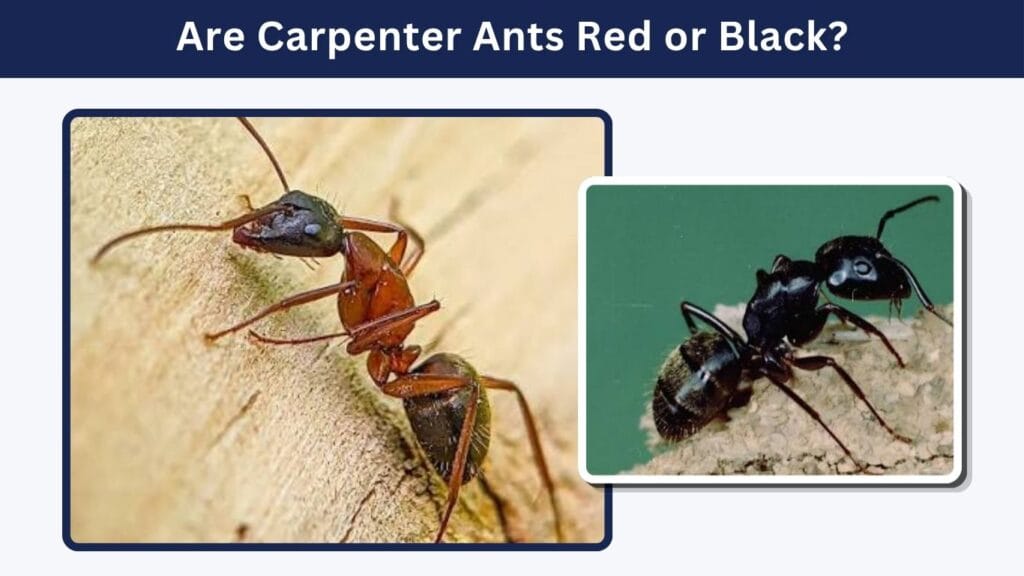
Carpenter ants are not always black. The genus includes black, brown, red, yellowish, and mixed-color species. Red-and-black workers are therefore entirely normal for some carpenter ants. Color by itself should not be used to identify an ant because fire ants, field ants, and several other groups may also appear reddish.
Red and Black Carpenter Ants
The classic red carpenter ant, C. chromaiodes, commonly has a dark head, reddish thorax, dark abdomen, and reddish legs.
However, coloration varies even within the species.
Another useful characteristic is the smoothly rounded profile of the thorax. Carpenter ants also have a single waist node, whereas several other common household ants have two nodes.
Red Carpenter Ants in Florida and Texas
Seeing a red carpenter ant in Florida or Texas does not automatically mean it is C. chromaiodes.
Florida, for example, has other Camponotus species, including the Florida carpenter ant. Different regions support different carpenter ant communities.
For accurate identification, consider location, size, body structure, hair patterns, and coloration rather than relying on the word “red” alone.
Red Carpenter Ant Queen and Winged Ants
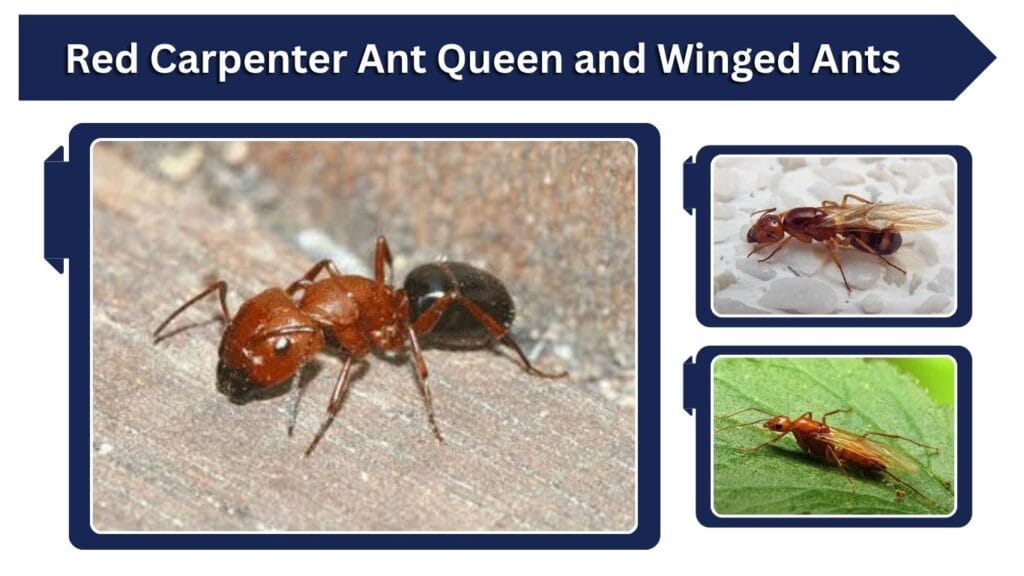
A mature carpenter ant colony eventually produces reproductive males and females. These ants develop wings and leave the nest during mating flights. Because winged carpenter ants suddenly appearing inside a house may resemble termites, recognizing their body shape is important. Finding numerous winged carpenter ants emerging indoors can also indicate a mature nest within or very close to the structure.
Red Carpenter Ant Queen
A queen is larger and more robust than ordinary workers.
Young queens initially have wings. After mating, a female sheds her wings and searches for a protected site where she can begin a new colony.
Her enlarged thorax contains the muscles that powered her wings, while her abdomen becomes important for producing eggs.
Red Carpenter Ants With Wings
Winged carpenter ants are reproductive ants rather than a separate species.
They have:
- Elbowed antennae
- Narrow waists
- Two pairs of wings
- Front wings longer than hind wings
- Clearly divided body sections
Termite swarmers have straighter antennae, broader waists, and two pairs of wings that are much more similar in length.
How Many Red Carpenter Ants Live in a Colony?
Carpenter ant colonies start very small when a newly mated queen establishes a nest. The population increases over several years as more workers are produced. Mature colonies may contain thousands of ants and can sometimes establish satellite nests away from the original parent colony.
Red Carpenter Ant Colony Size
Published accounts for C. chromaiodes report nests ranging from fewer than 100 individuals in developing colonies to several thousand workers in mature ones; some references report populations reaching roughly 3,000–12,000 workers.
A building can therefore contain ants from more than one nesting site.
Parent carpenter ant nests usually need relatively moist conditions, while satellite nests containing workers and older larvae can occur in somewhat drier wall voids or insulation.
Where Do Red Carpenter Ants Nest?
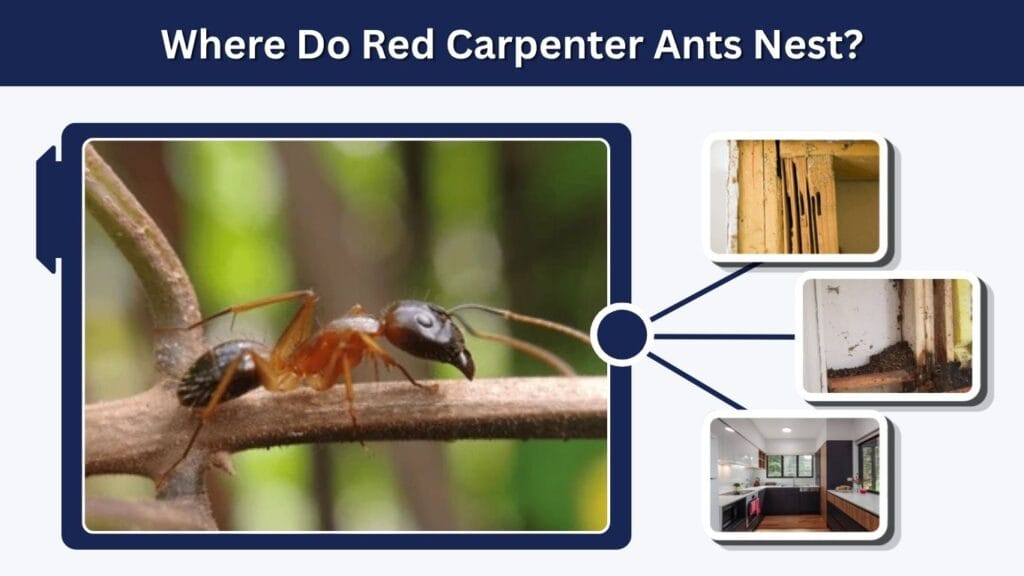
In nature, red carpenter ants commonly use existing dead or deteriorating wood rather than attacking healthy material from the beginning. Rotten logs, stumps, dead trees, and decayed sections of living trees provide suitable nesting locations. C. chromaiodes may also establish colonies in moisture-damaged wood inside buildings.
Red Carpenter Ants in the House
Indoor nesting locations may include areas:
- Around leaking windows
- Behind bathroom walls
- Around sinks and dishwashers
- Beneath damaged roofing
- Inside wall voids
- Around wet insulation
- Near deteriorated window frames
- Beneath floors affected by moisture
Seeing a few workers indoors does not prove the colony is inside. They may simply be foraging from an outdoor nest.
Repeated sightings, especially during winter or the appearance of winged ants indoors, deserve closer investigation.
Do Red Carpenter Ants Damage Wood?
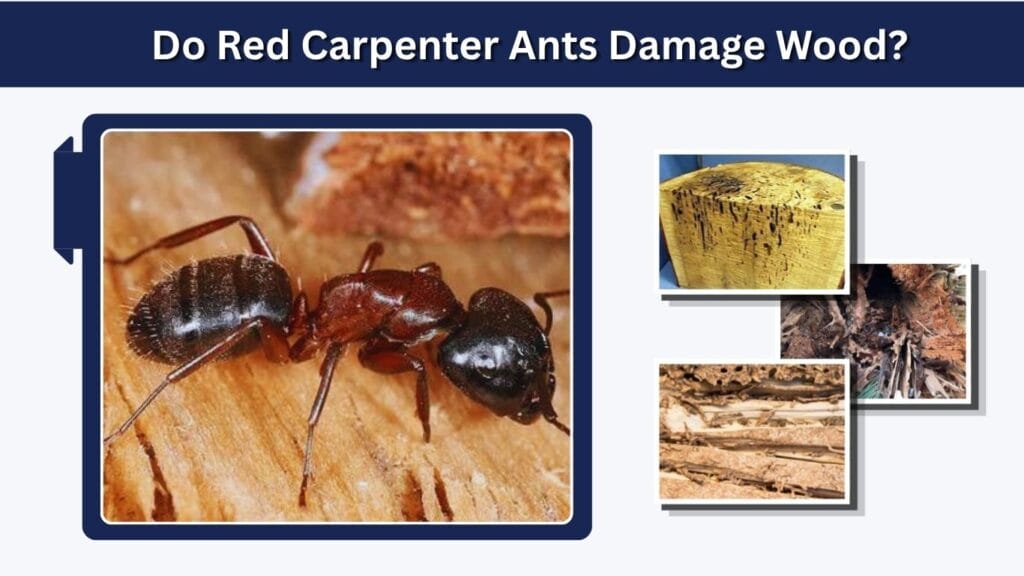
Carpenter ants do not consume wood for nutrition. Instead, workers use their mandibles to excavate it, creating smooth tunnels and chambers where the colony can live.
Over time, a large colony occupying structural wood can weaken it, particularly when moisture damage was already present.
Signs of Carpenter Ant Damage
Look for:
- Coarse sawdust-like material
- Ant body parts mixed with wood debris
- Smooth internal galleries
- Large ants active at night
- Rustling sounds inside walls
- Winged ants appearing indoors
- Ant trails entering cracks in wood
The longer a structural colony remains established, the greater the potential for damage.
Do Red Carpenter Ants Bite?
Red carpenter ants are not considered highly dangerous to people, but large workers have strong mandibles and can bite when trapped, handled, or defending themselves.
Carpenter ants do not have a functional stinger, so their defense is different from fire ants.
Is a Red Carpenter Ant Bite Dangerous?
A bite may cause temporary pain or irritation but usually does not require medical treatment.
Wash the area with soap and water and avoid scratching irritated skin.
Seek medical assistance for severe swelling, breathing difficulty, widespread hives, or another unexpected reaction after any insect encounter.
Red Carpenter Ant vs Fire Ant
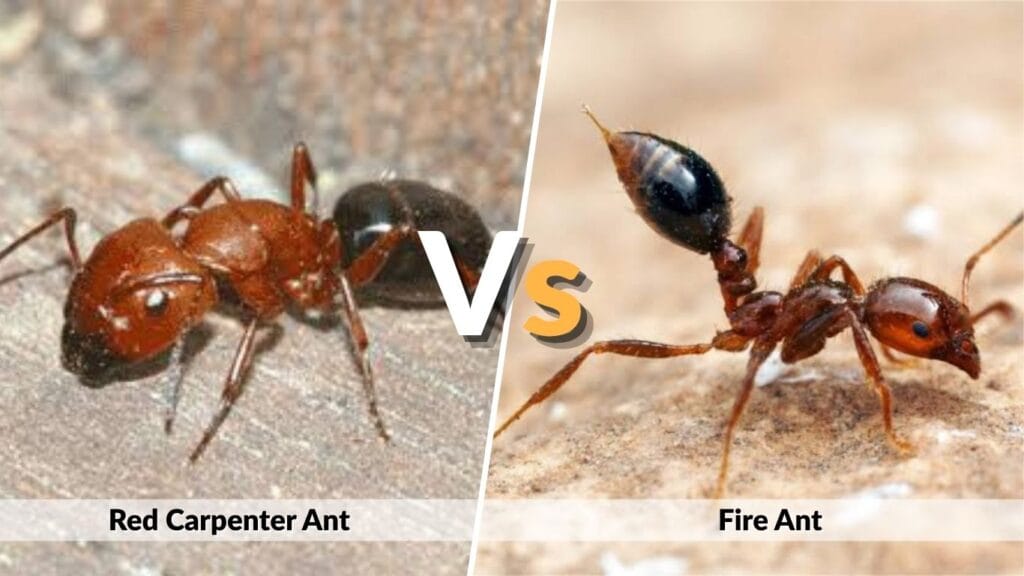
Red coloration is one reason carpenter ants are sometimes mistaken for fire ants. The two are substantially different in size, nesting behavior, appearance, and defensive ability.
Main Differences
| Feature | Red Carpenter Ant | Red Imported Fire Ant |
| Typical worker size | Large, often 6–14 mm | Smaller, about 3–5 mm |
| Nest | Wood, trees, structures | Soil mounds |
| Stinger | Absent | Present |
| Defense | Can bite | Bites and delivers painful stings |
| Body | Often red and black | Usually reddish-brown |
| Wood damage | Can excavate wood | Does not make wood galleries |
Red imported fire ants characteristically construct soil mounds and can deliver painful stings, whereas carpenter ants are primarily associated with wood cavities.
How to Get Rid of Red Carpenter Ants
Successful carpenter ant control depends on finding the nest rather than merely killing workers walking through the kitchen. The colony may be located outside in a tree or stump, while foragers enter through branches, utility lines, cracks, or gaps around the structure.
Carpenter Ant Control Steps
- Locate active ant trails.
- Check for leaking pipes and roof problems.
- Replace moisture-damaged wood.
- Trim branches touching the building.
- Move firewood away from the house.
- Seal cracks and utility openings.
- Use appropriately labeled carpenter-ant bait where ants are actively feeding.
- Locate and eliminate the nest whenever possible.
Ant baits may contain ingredients such as borax, fipronil, spinosad, or avermectin. Use commercial products according to their labels rather than improvising strong homemade mixtures. Spraying around bait can make ants avoid it.
Persistent indoor infestations are often best handled by a pest-management professional because hidden parent and satellite nests can be difficult to locate.
FAQs
1. Are there really red carpenter ants?
Yes. Camponotus chromaiodes is officially known as the red carpenter ant, and several other carpenter ant species can also have reddish coloration.
2. Are all red-and-black ants carpenter ants?
No. Several unrelated ant groups can be red and black. Body structure, size, nesting behavior, and geographic location should also be considered.
3. Do red carpenter ants bite?
Yes. Large workers can bite when handled or threatened, but carpenter ants lack the functional stinger found in fire ants.
4. Why are red carpenter ants inside my house?
They may be searching for food from an outdoor colony or nesting in moist, decayed wood somewhere inside the building.
5. What is the best way to get rid of red carpenter ants?
Find and eliminate the nest, repair moisture problems and damaged wood, block entry routes, and use correctly placed labeled baits when appropriate. Difficult structural infestations are best handled professionally.