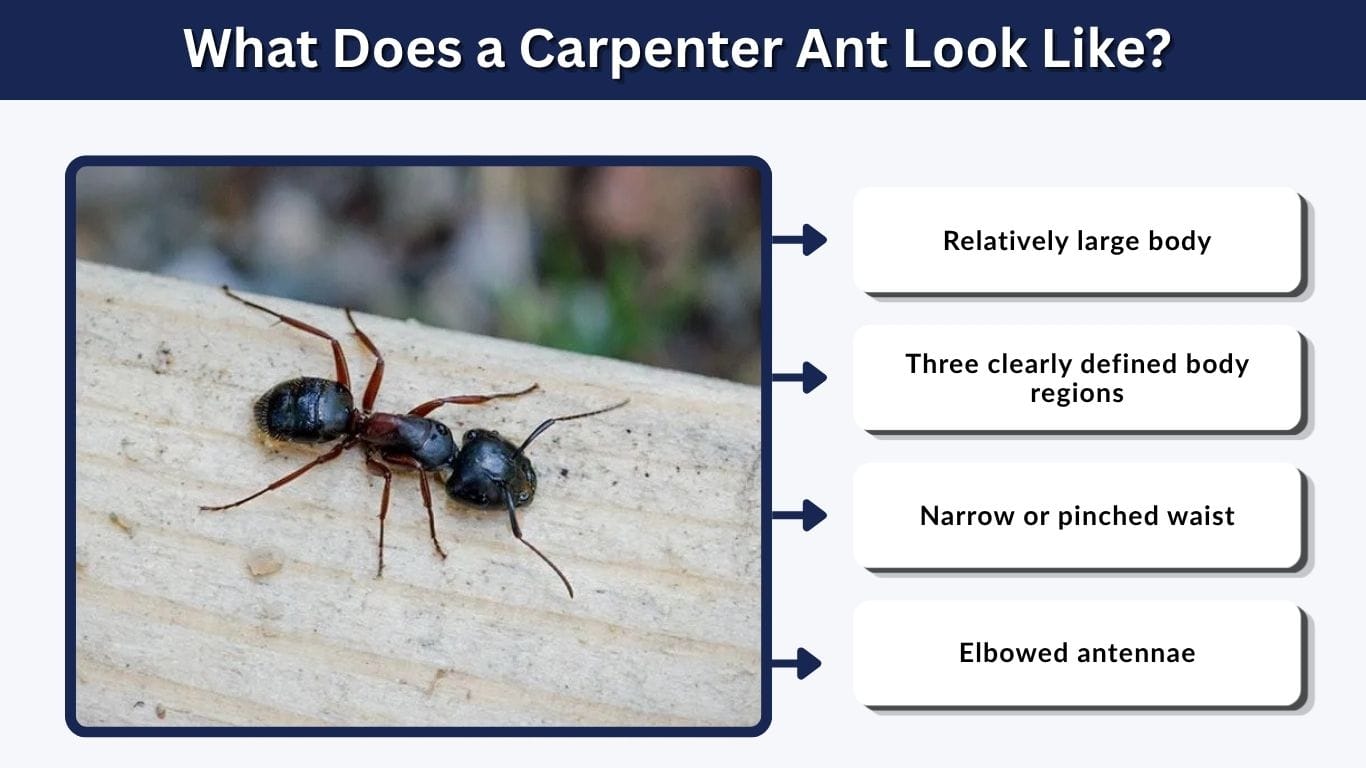
Carpenter ants are among the largest ants commonly found around homes. They can be black, reddish-brown, red and black, or occasionally lighter depending on the species. Their most recognizable features include a narrow waist, elbowed antennae, and a smoothly rounded upper thorax. Workers vary noticeably in size even within the same colony. Queens are much larger, while reproductive carpenter ants develop wings. Knowing what workers, queens, nests, and damage look like makes it easier to distinguish carpenter ants from termites and other household ants.
What Does a Carpenter Ant Look Like?
Carpenter ants belong to the genus Camponotus. Because many species exist, there is no single color or exact size that identifies every carpenter ant. Some are entirely black, while others combine black with red or reddish-brown. Body structure is usually more dependable than color when identifying them.
Carpenter Ant Identification
Look for these characteristics:
- Relatively large body
- Three clearly defined body regions
- Narrow or pinched waist
- One petiole node at the waist
- Elbowed antennae
- Smoothly rounded upper thorax
- Workers of several different sizes
- Black, brown, reddish, or red-and-black coloration
Workers commonly range from roughly 3/16 to 1/2 inch long, although exact size varies among species.
Why Are Some Carpenter Ants Bigger Than Others?
Finding both small and large carpenter ants does not necessarily mean you have different species.
A colony produces workers of different sizes. Large workers are often called majors, while smaller individuals may be called minors. Intermediate-sized workers can also occur.
Queens are larger still.
This size variation is actually a useful identification clue because many household ant species have workers that are much more uniform in size.
What Does a Black Carpenter Ant Look Like?
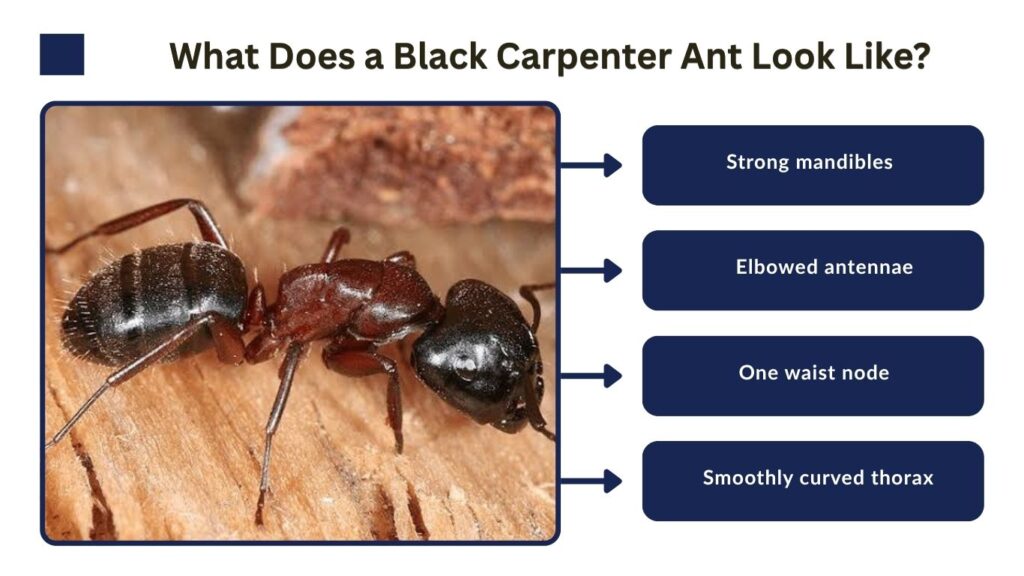
The black carpenter ant, Camponotus pennsylvanicus, is one of the familiar carpenter ants in eastern North America. Workers are predominantly black and have the characteristic carpenter-ant body shape. However, seeing a large black ant is not enough to confirm identification because several unrelated ants can also appear black.
Black Carpenter Ant Features
A typical black carpenter ant has:
- Glossy to dull-black coloration
- Large head
- Strong mandibles
- Elbowed antennae
- Narrow waist
- One waist node
- Smoothly curved thorax
- Long legs
- Different-sized workers
Color varies among Camponotus species; some carpenter ants have distinctly reddish or red-and-black bodies instead.
Carpenter Ant vs Regular Black Ant
Size provides one clue, but body structure is more useful.
Carpenter ants usually have an evenly rounded thorax when viewed from the side and only one waist node. Many other household ants have an uneven thorax or two waist nodes.
If ants are also emerging from wood or producing piles of coarse wood shavings, carpenter ants become much more likely.
What Does a Queen Carpenter Ant Look Like?
A carpenter ant queen is noticeably larger and heavier-bodied than workers. Before mating, a young queen has wings. After her mating flight, she sheds them and begins establishing a nest. Her enlarged thorax remains obvious because it once contained powerful flight muscles.
Queen Carpenter Ant Identification
Look for:
- Much larger body than workers
- Broad, robust thorax
- Large abdomen
- Elbowed antennae
- Narrow ant-like waist
- Wings on unmated reproductive females
- Small wing scars after the wings are shed
Winged queens of some species can approach 3/4 inch or more in length.
What Does a “Pregnant” Carpenter Ant Queen Look Like?
People sometimes describe a queen with an enlarged abdomen as pregnant, although ant reproduction does not work exactly like mammalian pregnancy.
A mature egg-laying queen may have a noticeably swollen abdomen compared with workers. However, body size alone cannot confirm whether she is actively producing eggs.
Queens usually remain deep within the main nest and are rarely seen during normal colony activity.
What Does a Carpenter Ant With Wings Look Like?
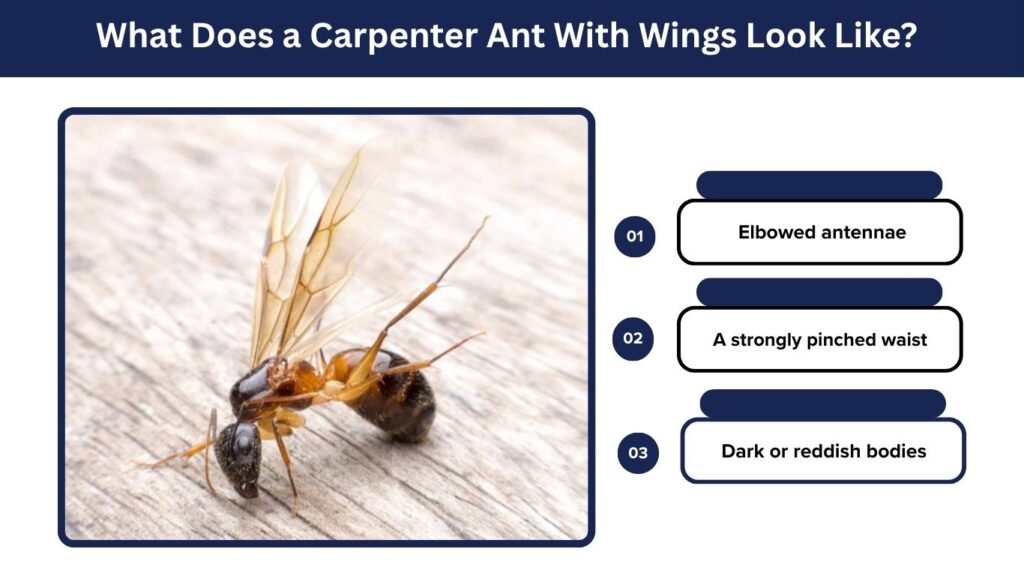
Only reproductive males and females develop wings. These winged carpenter ants, called alates or swarmers, may suddenly appear indoors when a mature colony produces reproductives. Large numbers emerging inside a home can indicate a nest within or very close to the structure.
Winged Carpenter Ant Identification
Winged carpenter ants have:
- Elbowed antennae
- A strongly pinched waist
- Two pairs of wings
- Front wings longer than rear wings
- Dark or reddish bodies
- Three clearly separated body sections
Queens are larger and more robust than males.
Winged Carpenter Ant vs Termite
This distinction is particularly important.
A carpenter ant has elbowed antennae, a narrow waist, and front wings longer than its hind wings.
A termite swarmer has straighter antennae, a broad waist, and front and rear wings that are approximately equal in length.
What Does a Carpenter Ant Nest Look Like?
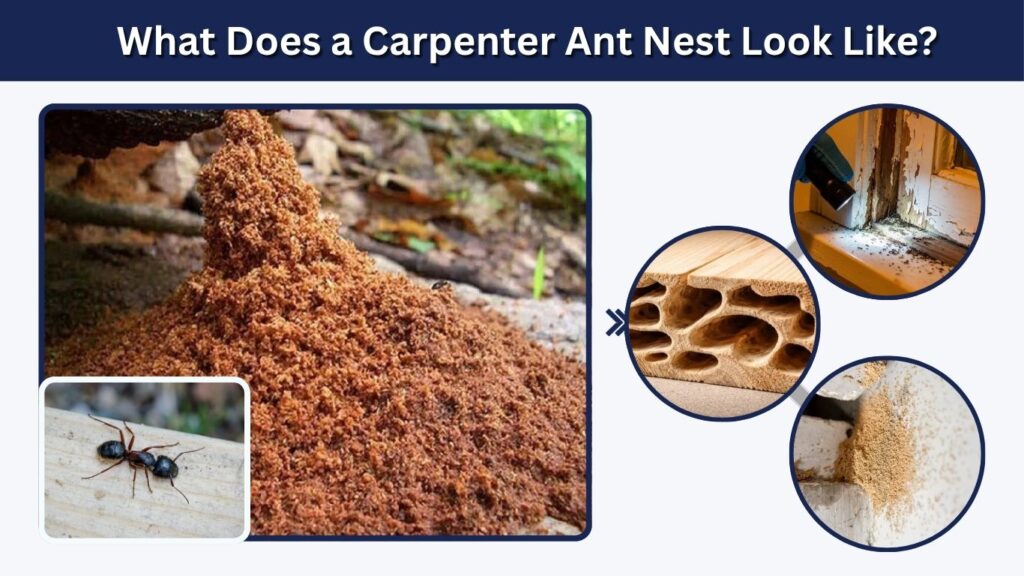
Carpenter ants do not build the obvious paper nests associated with wasps. Their nests are hidden inside wood, trees, wall voids, or similar cavities. They excavate wood to create smooth internal tunnels called galleries. They do not eat the wood; instead, they remove it while expanding their nest.
Signs of a Carpenter Ant Nest
Watch for:
- Smooth galleries inside wood
- Coarse sawdust-like debris called frass
- Ant body parts mixed with debris
- Large ants traveling in trails
- Activity around damp or damaged wood
- Winged ants appearing indoors
- Faint rustling inside walls
Carpenter ants commonly favor moisture-damaged wood, although they can also establish some galleries in drier material.
What Does a Carpenter Ant Hole Look Like?
Carpenter ants may use cracks, gaps, or small openings as entrances rather than producing one distinctive round hole.
Workers remove chewed wood and other nest debris through openings known as dump holes. Small piles of coarse wood shavings beneath an opening can therefore be a useful sign of an active nest.
Unlike termite galleries, carpenter-ant galleries usually appear relatively smooth and clean inside.
What Does a Carpenter Ant Nest Look Like Outside?
Outdoors, the main colony commonly occupies dead trees, stumps, logs, fence posts, firewood, or decaying sections of living trees. Indoor infestations may sometimes be satellite nests associated with a larger outdoor parent colony.
Carpenter Ant Hill or Mound
Carpenter ants generally are not known for building large, obvious soil mounds like fire ants.
If you see a pronounced mound in open soil, another ant species may be responsible.
Carpenter-ant activity outdoors is more often associated with wood. Workers may disappear beneath bark, into cracks in logs, or through openings near the base of damaged trees.
What Does a Carpenter Ant Infestation Look Like?
Seeing one carpenter ant indoors does not necessarily prove that your house contains a nest. Workers can travel from outdoor colonies while searching for food. Repeated indoor activity, especially around damp wood, makes an infestation more likely.
Common Infestation Signs
- Numerous large ants indoors
- Ant trails appearing after dark
- Wood shavings beneath walls or trim
- Winged carpenter ants emerging inside
- Activity around windows and bathrooms
- Ants around leaking roofs or plumbing
- Smooth galleries found in damaged wood
- Rustling noises inside wooden cavities
Winged carpenter ants emerging indoors are a particularly strong indication that a mature nest is nearby.
What Does a Carpenter Ant Bite Look Like?
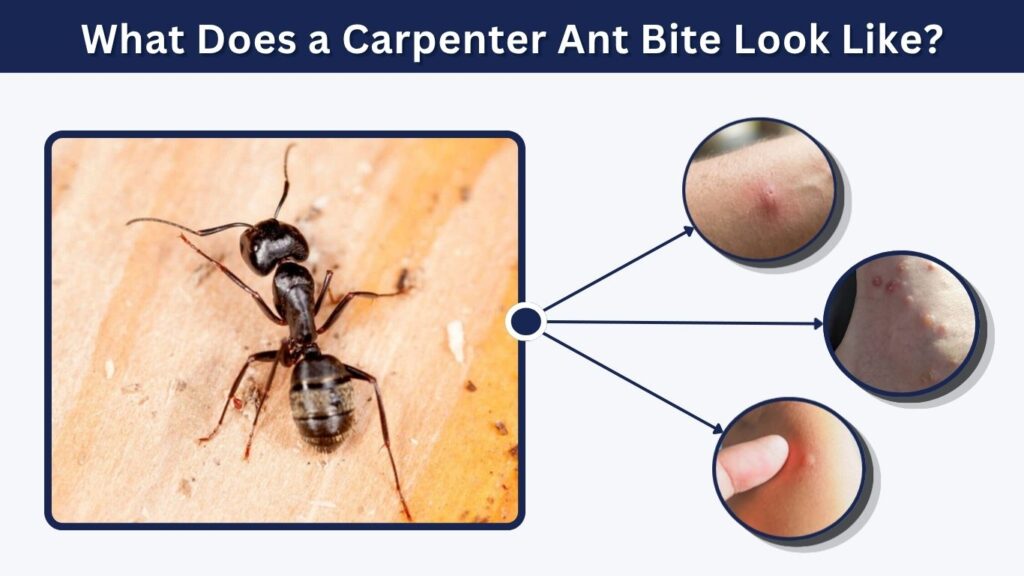
Carpenter ants have powerful mandibles and can bite if handled, trapped against the skin, or disturbed. A bite usually causes localized pain and irritation rather than the multiple pustules associated with fire-ant stings.
Carpenter Ant Bite Appearance
A bite may produce temporary:
- Redness
- Mild swelling
- Burning or stinging sensation
- Tenderness
- Small irritated spot
Appearance varies from person to person, so a skin mark alone cannot reliably identify the insect responsible.
Wash the area with soap and water and avoid scratching it. Seek medical attention for difficulty breathing, widespread hives, severe swelling, or another significant reaction.
Baby Carpenter Ant Appearance
Immature carpenter ants look nothing like miniature adult workers at first.
What Does a Baby Carpenter Ant Look Like?
Carpenter ants develop through:
Egg → Larva → Pupa → Adult
Larvae are pale, soft-bodied, legless, and grub-like. They remain inside the protected nest and depend on workers for food.
Only after pupation do they emerge in the familiar adult ant form.
Because larvae remain hidden inside nest galleries, homeowners usually encounter workers or winged reproductives rather than immature carpenter ants.
FAQs
1. What color is a carpenter ant?
Carpenter ants may be black, brown, reddish, yellowish, or combinations of red and black depending on species.
2. How can I identify a carpenter ant quickly?
Look for a relatively large ant with elbowed antennae, one waist node, a narrow waist, and a smoothly rounded thorax.
3. What does a carpenter ant queen look like?
The queen is much larger than workers, with a broad thorax and large abdomen. Young queens have wings, while mated queens normally shed them.
4. What does carpenter ant damage look like?
Damaged wood contains smooth excavated galleries, often accompanied by piles of coarse sawdust-like debris outside the nest.
5. How do I know if carpenter ants are nesting in my house?
Repeated sightings, frass, activity around damp wood, indoor rustling, and especially winged carpenter ants emerging indoors can indicate a structural nest.